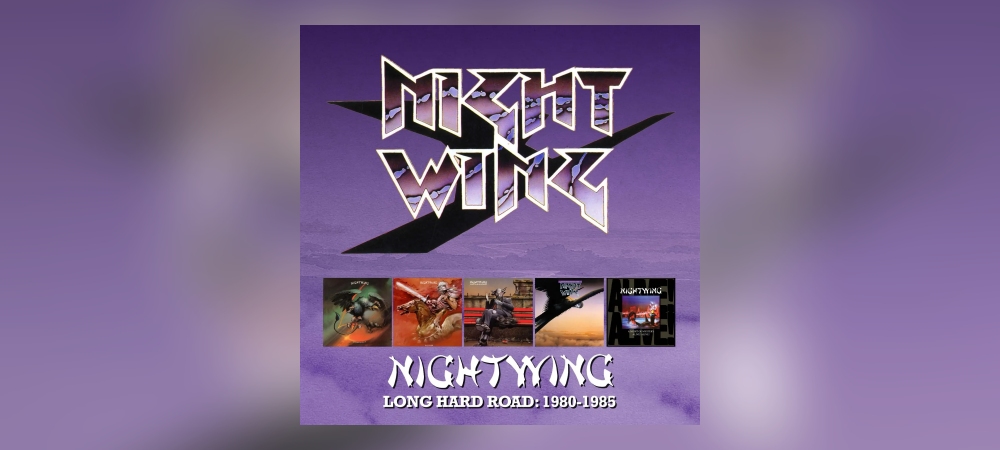
With an NWOBHM-shaped hole in my life after reviewing Holocaust’s second boxset and interviewing guitarist John Mortimer, I was only too pleased to find out that another British hard rock band from the early 80s was getting a box set, and dove in without any preconceptions.
Well… except for one. I had presumed all the NWOBHM groups would sound hard, raw and primal like early Holocaust did. That could not be further from the case with Nightwing; after spending years in a power trio called Strife – the name seems ironic given the difficulty they had securing a label to consistently release their material – bassist Gordon Rowley was interested in exploring more kinds of sounds, something that could only be achieved with a dedicated keyboardist and second guitarist.
The group’s debut Something in the Air is a powerhouse but also an enigma. It begins with a thoroughly symphonic instrumental overture, led by synths, suggesting a calm, deep concept album. Without a proper segue, however, or even a fade-out, the following hard rock track Nightwing (the band’s first B-side that gave them their name) kicks in, and you realise what kind of NWOBHM you’re in for. In the notes, Rowley admits that the first album lacked direction but says that it shouldn’t matter if you happen to be playing whatever you want. There are a few misses – Boogie Woman is exactly as unappetising as it sounds and, at five minutes, thoroughly outstays its welcome – but they are made up for by hits like Edge of a Knife, which is brought to life by Tullian flute provided by guest Pat McBride.
Two longer, slower and more angst-ridden tracks dominate the album, placed at the end of each side. The first is the title track, which, ironically, I happened to be listening to while battling my way through smog created by Canadian forest wildfires. The lines “I can feel something in the air” and “What are we dying from in the air?” became hilariously literal on my first listen. At 7 minutes, this pensive track has enough time for an extended guitar solo during the middle and the outro, where the band really rocks out. The other track is a reworking of Vanilla Fudge’s You Keep Me Hangin’ On, which itself was a hard rock reimagining of the Supremes’ 1966 original. Vanilla Fudge clearly did the heavy lifting with their arrangement of the piece, but Nightwing’s sounds cleaner and more polished, so it’ll be up to you to decide which is the best version.
Rich Davenport skilfully guided me through Holocaust’s journey in the notes for their second boxset, and I was delighted to see him back on board for this set too, giving rich context for what could be heard on the recordings. I was baffled by some of his takeaways, however, as he mentioned twice in his conclusion that the band’s second album Black Summer is regarded as the best of the set with an “adventurous blend of hard rock and progressive inflections.”
If anything, Black Summer is far less adventurous than the group’s debut; no flute here! Rowley says that, unlike on their original, guitarist Alec Johnson had an overabundance of ideas, resulting in every track on the album being written by him. (There is some discrepancy about the track Searching, however: on Discogs, it’s credited to Johnson, but the booklet credits a mysterious ‘P. Goaley’ whom I cannot seem to find any information on.) As a result, the album does sound more streamlined and hard-rocking, but also a lot less distinctive and characterful.
The first six tracks are pretty forgettable. Kenny Newton, the keyboardist, is clearly influenced by the prog greats such as Emerson and Wakeman, and his shimmering synth timbres sometimes feel at odds with the hard rock vibe that the rest of the band seem to be striving for. But the gritty organ comes in handy for the spooky title track of Black Summer, a slightly more prog fare about meeting a beautiful vampire at a… concert? There’s a slew of other keyboards in this track, and I love Newton for his inventiveness, but it really feels as if he doesn’t consult the rest of the group while creating his parts and that the others have to work around him.
The final track is even longer at seven minutes, but is somehow less progressive than the title track, mainly because of a tedious repetitive outro that sees the band riffing off a heavy-handed synth theme. (As a side note, too many of this band’s songs are about having limited success with women.) The title of this track, Don’t Want to Lose You, is ironic because they actually are losing me with this boring outro.
With Black Summer seeming like a disappointment in my book, I had low hopes for Stand Up and Be Counted, featuring a bizarre image of a horned, bespectacled creature wearing a suit and tie, sitting cross-legged on a bench. I certainly didn’t expect one of the album’s deep cuts to pull me in like no other. But then I heard the singer repeatedly yell, “What are you doing next Saturday?” over a hard riff and I couldn’t help laughing at what a bizarre way this would be to make a romantic gesture.
So I played it again, and more of the details came to light. The song is just two minutes and fifty-seven seconds long (perfect for Eurovision!) and yet seems to defy all attempts at genre categorisation. While the verses have a reggae feel to them, the choruses are back in the hard rock style while Kenny Newton regularly plays a sci-fi-esque motif on the keyboard. It’s the most unwieldy blend of genres I’ve ever heard, but somehow it’s thoroughly addictive.
Moreover, new singer Max Bacon has a captivating voice reminiscent of Freddie Mercury but with almost none of the discipline to go with it; according to Rowley, Bacon was originally Johnson’s milkman whom the guitarist pulled into the studio and needed to coach how to sing. He does a fine job, but the urgency with which he asks “What are you doing next Saturday?” suggests there’s a more pressing reason than the lyrics would otherwise suggest, perhaps “… because we have to fight off the cyborgs!”
Elsewhere on the album, Newton’s synths dominate on songs like Treading Water and Dressed to Kill, giving them what has by now become the ‘signature Nightwing sound’. Call Your Name gives the listener a taste of no-nonsense rock before the closing mini-epic The Last Song, which feels a lot like the Pavlov’s Dog track Of Once and Future Kings.
Roger Dean’s artwork graces the band’s fourth output, My Kingdom Come, replete with a new band logo, but with no floating islands in sight, you may not recognise his work. This album is notable for the involvement of none other than Steve Hackett, who produced and added some guitar work to the laid-back, lounge-y Night of Mystery. The synths and bass on this track make it sound more like a slow Camel song, and I appreciated hearing this different side to the group. However, at under four minutes, it’s entirely too commercial; for my tastes, I’d appreciate it if it swelled into a hard prog instrumental that maybe gave way to the final verse at around the eight-minute mark. It feels as if there’s some wasted opportunity there.
To thank Hackett, the group also recorded their own version of Hackett’s Cell 151 from Highly Strung, apparently the Genesis guitarist’s only solo hit. Rowley freely admits the cover was a disaster, with mistakes being made on the recording, but that Hackett liked it anyway.
The rest of the album feels like perfunctory Nightwing, with no Next Saturday to pique my interest. The final pair of tracks are more interesting: Men of War is a military paean that is filled with marching beats and Newton’s heavy synths. The title track, meanwhile, is the band’s obligatory closing epic with a man-vs-machine theme that feels oddly relevant now in the rise of AI. “Who’s programming who?” In a stylistically brilliant choice, the song’s riff descends into a whirlwind-like section before getting replaced in a computerised ‘robotic’ version of the same riff made with mid-80s technology, representing victory for the machines. It’s one of the most innovative ways I’ve heard technology used in storytelling for some time.
The final disc is the band’s live album, which has a title so unwieldy b that I daren’t spell it out again (you can scroll down the page and judge for yourself in the track listing). The album was recorded during the band’s 1984 tour in countries that don’t exist anymore: Yugoslavia and West Germany. As great at metal history as Davenport is, I do wish he’d brush up on his geopolitical history, as he consistently refers to Yugoslavia (a country where Nightwing became surprisingly popular) as ‘former Yugoslavia’ when speaking about events that happened in the 1980s: back then, it wouldn’t be ‘former’ at all. It’s fascinating that a lot of these British metal groups seem to find more success on the continent than they do at home.
I love when box sets include a live album as it really gives valuable context when listening to a band you haven’t heard before. You get to hear the songs they consider the best or most popular and how they handle things live. Nightwing’s performances here are energetic and infectious, breathing new life into songs I’d found ordinary, such as Treading Water and Dressed to Kill, renewing my interest in the band’s catalogue. On top of that, they play both of the songs related to Hackett and both of the first album’s epics. In just 38 minutes, the band pack a pretty big wallop.
From just listening to the music, one wouldn’t suspect that both Alec Johnson and Max Bacon had recently left the group, their places being filled by Glynn Porrino and Dave Evans respectively. Bacon had actually left with Hackett, who clearly admired his Mercury-esque vocals, and the lucky milkman would be heard two years later on GTR, the notorious Howe/Hackett collaboration. Rowley and Johnson, meanwhile, had fallen out, with Johnson preferring to focus on progressive material while Rowley wanted to keep things simpler. Although I want to like Rowley more as a person, I have to side with Johnson in terms of the musical vision. Johnson would not surface again for another 20 years until he turned up in the reformed prog group England.
Sadly, the set does not include the VI album that was recorded in 1986 but apparently suffered due to a fire in the studio, resulting in only the rough mixes being available. It feels like a crucial piece of the band’s history is missing from the set, but perhaps the rights were not available to Cherry Red at the time. The band would also go on to reform in the mid-00s and record one more album, 8472, in 2006, but this exclusion feels less egregious for reasons that need not be explained.
Rich Davenport’s essay on the band’s story is excellent, but I had to strain to read his transliterated interview with Gordon Rowley. While it’s fascinating to get a first-hand account of what happened during those years, Rowley’s responses could have been tidied up somewhat to be more legible to readers. I’ll share just one particularly egregious paragraph:
I had a break coming, so I went home. I phoned Kenny, “Get down here today, I’ve only got 10 days, and I’ve got a song I want to do”. I got Paul in, and we picked it up in no time, got it done in two days. I couldn’t wait to play it to Don. I said, “I did it for fun; I just like the song. At some point in time, I’m going to do it properly”. We were always playing tricks on each other.
So, what does he do? He tells Graham. Graham came in with a grin on his face. “Hi, Gordon. What did you get up to over there?”
It’s the kind of paragraph that tells the story over the phone but does not translate very well to the page. Whenever I transcribe interviews, I make sure to trim them to highlight the facts legibly while trying to retain as much of the artist’s personality as possible, but I don’t shy away from cutting a few minutes of the interview if it contains nothing relevant or interesting. I’m surprised that a Classic Rock journalist wouldn’t think to do the same.
Nevertheless, there is valuable information about Rowley and the band to be gleaned if you can wade through the trough of verbal diarrhoea. Rowley seems like a friendly bloke, but his story is like a book by Lemony Snicket: full of unfortunate events. With his hardships in Strife, difficulties in finding bookings in the UK, the falling out with Alec and the studio fire, I can see that music-making was not always a joyous experience. On top of that, Rowley’s health often comes into play as well: a heart attack had originally put a stop to his tenure in Strife, and he reveals that after Nightwing he had three more heart attacks, two strokes and lost his left leg to diabetes. Despite all these pitfalls, he remains alive and chipper, saying, “I do a hell of a good Long John Silver these days.”
Something else to be chipper about is the level of detail afforded to the CD slipcases in this box set. Nightwing had some fantastic album covers in their time, with luminaries such as Melvyn Grant and Roger Dean gracing the sleeves with their magic. While I’ve seen plenty of CD slipcases merely include the front cover with a blank side with the tracklisting on the reverse, I’m happy to report that the first three albums have their original LP sleeves recreated on the reverse, while the fourth has a subtly modified version with all the original information plus what appears to be updated Roger Dean artwork and a link to his website (which presumably didn’t exist in 1984). The live album didn’t receive the same treatment; there’s only a blown-up version of the central image with a simplified track list pasted over it.
Still, I’m quite grateful for the studio albums being rendered so authentically; although there’s a small error on Something in the Air: on the original LP sleeve, the Fantasia overture and its Reprise are tied to the first and last tracks respectively, and are timed as such between two brackets. Perhaps the person designing the package didn’t quite understand how these timings were supposed to work, as they’ve copied the track length onto Fantasia and the Reprise to make it appear as if they last the same length as the track that follows, which would significantly alter the running length of the album. It’s odd that mistakes like this even happen in the first place.
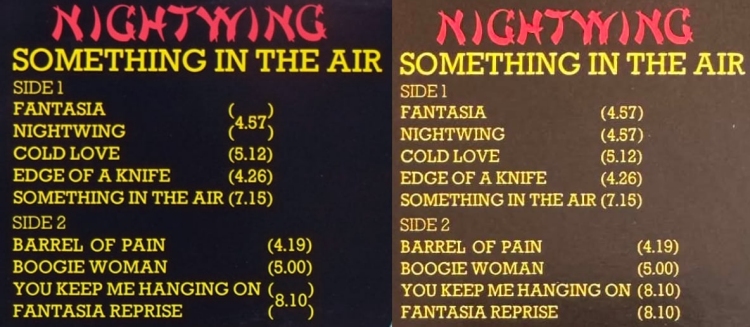 Original LP track listing (left) and CD reissue track listing (right)
When I took on this project, I feared that I might be wading through hours of 80s hair rock slop. Instead, I found the little band that could, passionate through and through and willing to make a few missteps if it meant getting it right in other places. To call it ‘prog’ would be misleading, but ‘progressive tendencies’ are what the band had in spades; these are amply provided by Kenny Newton and his synths, amongst other things. While rarely heady, the music is often good-hearted fun and the line-up changes and light directional shifts throughout the time period mean that you’re not paying for five discs of the same stuff. While it isn’t perfect – the omission of the band’s 1986 album feels particularly atrocious, but that may be beyond HNE’s control – one can tell that a lot of care has been put into the presentation of Nightwing’s catalogue; new and returning fans will be able to appreciate and enjoy this quirky group even more because of that care.
TRACK LISTING
DISC ONE: Something In The Air (1980)
01. Fantasia (1:38)
02. Nightwing (3:16)
03. Cold Love (5:10)
04. Edge of a Knife (4:27)
05. Something in the Air (7:12)
06. Barrel of Pain (4:16)
07. Boogie Woman (4:55)
08. You Keep Me Hanging On (7:06)
09. Fantasia Reprise (1:00)
Time – 38:55
DISC TWO: Black Summer (1982)
01. Overnight Sensation (5:54)
02. Bird Has Flown (3:45)
03. Carry On (3:03)
04. Long Hard Road (5:53)
05. Searching (3:30)
06. Evil Woman (5:20)
07. Black Summer (6:51)
08. Don’t Want to Lose You (7:04)
Time – 41:15
DISC THREE: Stand Up And Be Counted (1983)
01. Let Me Be Your Lover (4:38)
02. Treading Water (4:23)
03. The Machine (4:46)
04. Dressed to Kill (3:30)
05. Stand Up and Be Counted (3:16)
06. Next Saturday (2:57)
07. Still in Love with You (4:50)
08. Games to Play (3:02)
09. Call Your Name (3:24)
10. The Last Song (5:24)
Time – 40:03
DISC FOUR: My Kingdom Come (1984)
01. Back on the Streets (6:09)
02. Fingers in the Fire (2:59)
03. Night of Mystery (3:45)
04. Give Me the Love That I Want (3:46)
05. Cell 151 (3:15)
06. The Devil Walks Behind You (3:50)
07. Living Behind the 8 Ball (4:11)
08. Men of War (4:53)
09. My Kingdom Come (6:16)
Time – 39:01
DISC FIVE: A Night Of Mystery – Alive! Alive! (1985)
01. Fantasia (1:37)
02. Dressed to Kill (3:44)
03. Something in the Air (6:53)
04. Cell 151 (3:30)
05. Night of Mystery (4:42)
06. You Keep Me Hanging On (7:49)
07. The Devil Walks Behind You (4:10)
08. Treading Water (5:19)
Time – 37:39
Total Time – 3:16:53
MUSICIANS
Gordon Rowley – Bass, Vocals
Kenny Newton – Keyboards, Vocals
Alec Johnson – Lead & Rhythm Guitar (Discs 1-4)
Steve Bartley – Drums (Disc 1, tracks 3,4 & 7, Discs 2-5)
Max Bacon – Lead Vocals (Disc 3, Disc 4)
Eric Percival – Lead Guitar, Rhythm Guitar (Disc 1)
Glynn Porrino – Lead Guitar (Disc 5)
Dave Evans – Lead Vocals (Disc 5)
Paul H. Ellison – Drums (Disc 1, tracks 2,6 & 8)
John Mylett – Drums (Disc 1, track 5)
~ With:
Pat McBride – Flute (Disc 1, track 4)
Norton Buffalo – Harmonica (Disc 1, track 7)
Berington van Campen – Keyboards, Guitar (Disc 3)
Steve Hackett – Guitar (Disc 4, track 3)
Admondo Hurley – Additional Vocals (Disc 4)
ADDITIONAL INFO
Record Label: HNE Recordings Ltd. | Cherry Red Records
Catalogue#: HNE5BOX246
Country of Origin: UK
Date of Release: 28th August 2026
LINKS
Nightwing – Facebook | Boxset info at Cherry Red Records