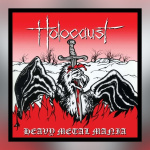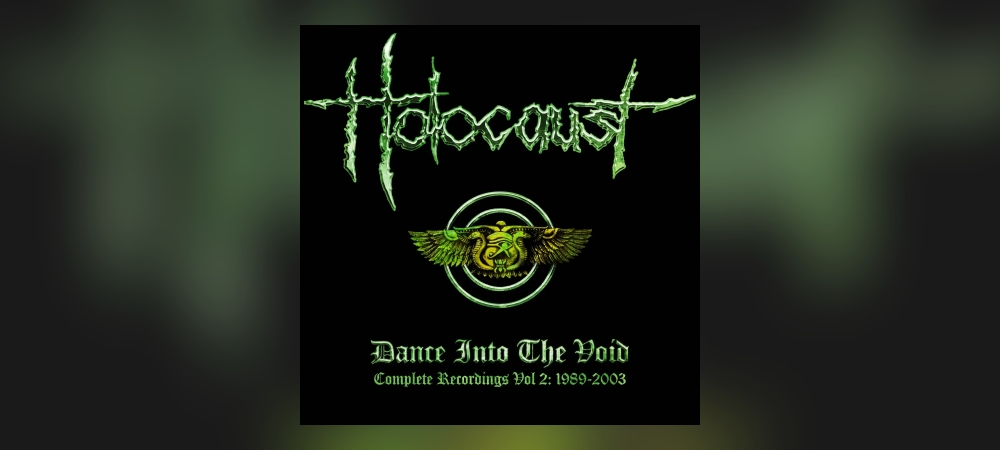
Three years ago, I was introduced to the Scottish heavy metal act Holocaust through their 6CD box set that compiled their complete early 80s recordings. With their debut EP and LP, they managed to make a splash in the new wave of British heavy metal (NWOBHM) scene and performed some raucous gigs as captured by their live VHS, which was converted into an album. I was disappointed that HNE Recordings had not reproduced the video in the set, but some good news is that I found the whole thing on YouTube to share with you.
Another person impressed by this recording was none other than Lars Ulrich (Metallica’s drummer, in case I have to spell it out), who was deep into the NWOBHM scene at the time and looking for anything to inspire his new group. Impressed by the band’s raw, unpretentious intensity, he selected a Holocaust deep cut, The Small Hours, to perform live with Metallica to beef up their set. This song was not on any of Holocaust’s studio recordings at this time, meaning that Ulrich must have had one of their live albums to know the song at all.
By 1984, the original Holocaust had completely crumbled due to creative differences, and guitarist John Mortimer had put out a second low-budget LP titled No Man’s Land as a last-ditch effort to cash in on the waning popularity of NWOBHM music. After the inevitable flop, Holocaust seemed to vanish without a trace.
But the kiss of life came in the form of Metallica’s 1987 release, The $5.98 E.P. – Garage Days Re-Revisited, featuring five cover songs by prominent NWOBHM artists. The second track was The Small Hours. Metallica had quickly become one of the best-known metal artists and were riding the wave created by their critical and commercial success, Master of Puppets. Suddenly, millions of heavy metal fans became familiar with Holocaust’s name, and I can only imagine this recognition inspired John Mortimer to revive the band from extinction.
But I can’t imagine any fan could have expected what was to come next. In his five-year absence, John Mortimer’s musical style seemed to have metamorphosed rather like a caterpillar in a cocoon before becoming a butterfly. The straightforward metal with earnest, simple lyrics had been replaced by something much heavier and darker. In his time away, Mortimer had drawn on contemporary metal and progressive influences to create more meaty and complex music. Holocaust had grown up.
This is abundantly evident on The Sound of Souls, published before the end of the decade in 1989. This is where the new HNE box set picks up the story. We’re reintroduced to the band through the crunching riffs of and intense lyrical imagery of This Annihilation before (admittedly dated) 80s technology serves up an unnerving percussive introduction to I Smash the Void. Metallica’s thrash can be heard on the headbang-ready Dance Into the Vortex.
The band show their instrumental flair on Curious before the completely unprecedented Three Ways to Die, a twelve-minute colossus of blistering heavy metal, with the second half filled with instrumental twists and turns. The music in this track satisfied both my prog and metal sides, and I have no qualms in deeming it a masterpiece. I was quite stunned at what Holocaust had become.
Three bonus tracks on the first disc helped to link me back to what the band had once been, with 1994 versions of three of their most popular tracks: Death or Glory, Heavy Metal Mania and The Small Hours. While the songs were recognisable, the way the band were playing these songs sounded tighter and heavier, further evidence of a change in approach to the music.
In 1992, the band re-emerged with Hypnosis of Birds, which would be re-worked with a new running order and extra tracks for the American market as Spirits Fly in 1996. Possibly to capitalise on Metallica’s name-check, the band finally recorded a studio version of The Small Hours here and also recorded a cover of Master of Puppets as a thank you. This version is enjoyable but is practically identical to Metallica’s, save for the timbre of the instruments.
Beneath a murky, thrashy exterior lies a rather diverse album; the energy that went into crafting the towering epic of Three Ways to Die is now diversified to experiment with different sounds: we hear a cello on The Tower and a flute on the following Book of Seasons. Later on, Mortimer slows things down for the distinctly Twin Peaks-esque Summer Tides, a relaxing instrumental. It’s just a brief interlude, however, as Mortal Mother and Cairnpapple Hill show how tight and complex the band can play. Despite all this variety, however, I found the album difficult to connect with due to the lack of any standout tracks besides the re-recorded The Small Hours.
The band would return in 1997, Mortimer having been inspired by The Chronicles of Thomas Covenant by American fantasy author Stephen R. Donaldson. I’m not familiar with the books at all, but Mortimer makes a strong case for the series, pushing his compositional capabilities further than ever before to make a truly satisfying album from start to finish. The opening Leper’s Progress is a ‘soft’ thrashy introduction to the album, seemingly Metallica-inspired with a beguiling high bass tone in the bridge. The lengthy Return to Dust crawls at a snail’s pace while recalling classic Iron Maiden.
However, what comes next is a complete surprise. Paradox is an experimental 37-second track with Mortimer chanting “White Gold Wielder, Unbeliever” (phrases from the book series, as I understand) over a distorted guitar riff. After the straightforward metal, it feels out of place. Subsequently, we’re launched into a sixteen-minute epic titled The Battle of Soaring Woodhelven. I honestly thought there must be a glitch on my computer because I would have never expected Holocaust, the NWOBHM band that came up with Heavy Metal Mania to ever pen a sixteen-minute track. It’s a satisfying, multi-faceted listening, but has some clunky pacing and doesn’t stand up to Three Ways to Die, which has become the standard by which I judge the rest of the band’s material.
Long songs reign on this album as the following track Valley of Megiddo is six minutes long and also progresses at a plodding pace, quite repetitively. Occasionally, Mortimer yells “In the valley of Megiddo!” dramatically, as if that’s supposed to mean something to an audience member not familiar with the books. (Quick edit: I just discovered Megiddo is a real place in Israel… shows what I know. The lyric still makes me laugh, nonetheless.) For my money, though, the best track on the album is the nine-minute Alexander, a varied and ambitious piece that actually feels like an adventure with tight instrumentation. Oddly, the album ends with not one but two soft guitar-led instrumental outros, each about two minutes long.
The band would return with the new millennium with The Courage to Be which unfortunately represents a step down from the variety and adventure we saw in Covenant. The album is positively drowning in distorted guitar, with the same timbre on every track making it difficult to tell one song from the next. When you start to parse through the fuzz, there are gems to be found such as A Gentleman’s Penny-Farthing, an instrumental using odd meters. Having recently been asked a pub trivia question about pre-decimalisation British currency, I noticed that a penny plus a farthing would equal 5/4 of a penny, and that this instrumental was primarily in 5/4 time; John Mortimer let me know I was the first listener to have told him I found this Easter egg.
Inexplicably, When Penelope Dreams is split into two listed tracks, despite being a full minute shorter than the preceding Neurosis. The first half is more acoustic with the band returning to heavy rock for the second half – I wish the two were sandwiched together so that I’d more readily view it as one full track. An unexpected delight comes in the form of From the Mine Shaft to the Bike Shed, whose title has more distinct words than the song itself does. “Miiiine Shaaaaft! Bike Shed, Bike Shed!” The comedic simplicity and indeed the lyric itself recalls Syd Barrett’s Bike from Pink Floyd’s debut album. Other prog influences can be found but they’re simply buried in a heap of distortion.
Lastly – for this boxset, at least – Primal, released in 2003, does exactly what it says on the tin. Suffering with the declining health and loss of both parents, John Mortimer eschews amy shred of pretension and ushers forth straightforward gloom and despair. The production on this album is an improvement over Courage’s fuzz, but the progressive influences I enjoyed before have all but disappeared.
With anger and bitterness present in Mortimer’s vocals, it’s an extremely raw and occasionally uncomfortable listen. The one unintentionally funny bit in the album is on Made Righteous when Mortimer’s affected growl makes it sound as if he has a lisp and is singing, “Made wighteous!” At 43 minutes, it’s by far the shortest album proper of the collection, a sign that Mortimer had no more to give; it’s nevertheless a testament to his passion for metal that he continued to put out music under these conditions and channeled the negative energy into something creative. The album can be seen as a song cycle and ends with the bleak Lost Horizons, bringing the box set to a close as well.
While the albums were interesting to hear as a collection, I was more fascinated by the liner notes, penned by Classic Rock journalist Rich Davenport which provide a rich contextual framing for these works. As a fan with only a passing knowledge of metal, I was extremely grateful for Davenport’s discussion of the wider genre at the beginning of the essay in order to understand the fork in the road that lay before Holocaust in the early 80s. Davenport represents Mortimer as a metal purist while his band members on The Nightcomers come off as posers who were happy to cash in on a burgeoning scene.
In the fifteen-year period of this box set, we hear more details about how Mortimer kept on making music while struggling to find anywhere to play live in the UK. However, the band went down a treat at Germany’s Wacken festival in ‘93. Davenport points out that the Internet was not fully established by then, so Mortimer did not have a way to know how popular his music was overseas. Despite this lack of perceived popularity, however, Mortimer consistently put out new music throughout this period purely because of his passion for the genre.
The passion in Davenport’s essay is audible in every note of this box set. There’s no hint of pretension or trying to follow a musical fad; this music is Mortimer’s soul laid bare. Many elements of Mortimer’s story reminded me deeply of the 2008 rock documentary Anvil! The Story of Anvil, which also saw a heavy metal act that had its heyday in the early 80s, inspired musicians like Lars Ulrich, and fell on hard times in the subsequent decades, unable to book gigs despite proficiently making albums. At one point, Mortimer reveals how he met his bass player (who was already a fan of Holocaust) in a chance encounter whilst working at a supermarket, another detail that would not be out of place in the Anvil story. The only difference is that there was no documentarian in the mid-00s available to make Holocaust a cult hit.
While this second era of Holocaust is variously described as ‘progressive metal’ by some journalists, the moniker doesn’t fit, as it would suggest that prog and metal would influence the band in a roughly 50/50 split, as it does with Dream Theater. One would expect to hear longer, more technical solos. I’d say Holocaust’s prog/metal split is closer to 10/90; there are undoubtedly some progressive influences, but they are few and far between. While Mortimer’s musical taste greatly differs from my own, I am still in awe of the passion that can be heard in every performance, and it moved me to invite him to be interviewed for our journal, which he graciously accepted.
This box set captures one of the most striking artistic transformations I’ve encountered; it’s hard to imagine that the mind behind Heavy Metal Mania and Smokin’ Valves would go on to create such ambitious music. The booklet may well be its greatest asset, painting a vivid and compelling picture of Mortimer’s life during this period. It’s a shame, however, that no live albums were recorded at the time, as alternative performances tend to deepen my appreciation of individual songs. Even so, the collection ultimately affirms the truth of Mortimer’s enduring lyric: “I’ve got heavy metal music in my blood, and I’d like to get it to you if I could.”
TRACK LISTING
DISC ONE: The Sound of Souls (1989)
01. This Annihilation (5:15)
02. I Smash the Void (3:37)
03. Dance Into the Vortex (3:56)
04. Curious (3:38)
05. Three Ways to Die (11:50)
06. Death or Glory (2:47)
07. Heavy Metal Mania (3:18)
08. The Small Hours (7:01)
Time – 41:17
DISC TWO: Spirits Fly (Hypnosis of Birds) (1992/1996)
01. Into Lebanon (5:13)
02. The Small Hours (7:08)
03. Hypnosis of Birds (7:50)
04. The Tower (7:39)
05. Book of Seasons (2:21)
06. Mercier & Camier (3:01)
07. Summer Tides (2:59)
08. Mortal Mother (4:22)
09. Cairnpapple Hill (2:03)
10. In the Dark Places of the Earth (6:42)
11. Caledonia (4:03)
12. Heavy Metal Mania (3:33)
13. Death or Glory (3:24)
14. Master of Puppets (8:13)
15. War in Heaven (3:04)
Time – 71:28
DISC THREE: Covenant (1997)
01. Leper’s Progress (4:08)
02. Salt Heart (6:40)
03. Return to Dust (7:29)
04. Paradox (0:37)
05. The Battle of Soaring Woodhelven (16:36)
06. Valley of Megiddo (6:03)
07. Mount Thunder (5:21)
08. We Shall See Him as He Is (6:12)
09. Alexander (9:24)
10. The Infinite (2:18)
11. Absent Friend (2:20)
Time – 67:01
DISC FOUR: The Courage To Be (2000)
01. The Collective (7:42)
02. A Gentleman’s Penny-Farthing (1:55)
03. Neurosis (8:31)
04. When Penelope Dreams (Part One) (4:10)
05. When Penelope Dreams (Part Two) (3:04)
06. From the Mine Shaft to the Bike Shed (3:42)
07. Fundamentalist (5:43)
08. Spanner Omlette (4:52)
09. Home from Home (6:37)
10. The Age of Reason (5:21)
Time – 51:34
DISC FIVE: Primal (2003)
01. Iron Will (4:44)
02. Black Box (4:31)
03. Hell on Earth (4:58)
04. Transcendence (2:50)
05. Fools (Bring on the Light) (4:04)
06. Made Righteous (2:58)
07. It’s Your Dream (3:30)
08. They Colonize (5:18)
09. Colossus (6:06)
10. Lost Horizons (4:25)
Time – 43:22
Total Time – 4:34:42
MUSICIANS
John Mortimer – Guitars, Vocals
Steve Cowen – Drums (Discs 1-4), Bodhrán, Bongos
Graham Hall – Bass (Disc 1)
David Rosie – Bass (Discs 2-3)
Graham Cowen – Bass (Disc 4)
Iain McKenzie – Guitar (Disc 4)
Bryan Bartley – Bass (Disc 5)
John McCullim – Guitar (Disc 5)
Ron Levine – Drums (Disc 5)
ADDITIONAL INFO
Record Label: HNE Recordings Ltd. | Cherry Red Records
Catalogue#: HNE5BOX186
Country of Origin: UK
Date of Release: 24th April 2026
LINKS
Holocaust – Website | Facebook | Bandcamp | YouTube | Info at Cherry Red Records | Instagram