
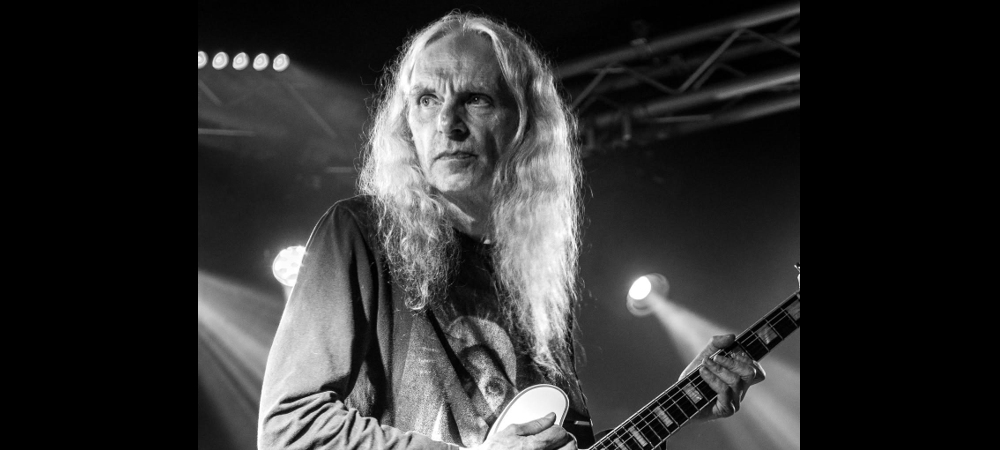
Basil Francis: Hello John! Thank you for speaking to the Progressive Aspect.
I first heard the term “New Wave of British Heavy Metal” (NWOBHM) whilst reviewing the Holocaust Vol 1 boxset, which was released back in 2023. Tell me about when you first heard the term NWOBHM and what it means to you. Do you like it as a term?
John Mortimer: Well, I had already got the ball rolling with the band at high school when the term started to be used in the UK music papers. I think it was Sounds that first used the term. Maybe summer of 1979?? I got a real thrill from that because I had just written Heavy Metal Mania and, to be honest, my bandmates initially thought it was a bit of a silly song…but they soon began to change their minds when everyone started talking about the NWOBHM. So I have a real affection for the term based on the feeling of validation back then.
Basil Francis: Whenever I tell people I’m listening to a band called Holocaust, I get self-conscious because it is quite a triggering word with negative connotations. Do you think the band’s title may put off some potential listeners?
John Mortimer: Probably. Back in the late 1970s, the word “holocaust” did not have an association with the Nazi atrocities, at least not so far as I was aware. The thing associated with the word in everyone’s mind at the time was nuclear war. Everyone was extremely anxious about the potential “nuclear holocaust” that actually looked likely as a result of the Cold War tensions between the USA and the Soviet Union. The mushroom cloud was a ubiquitous image in those days. My reason for calling the band Holocaust was that I felt like a Heavy Metal band should be as powerful as a nuclear detonation. It also tapped into a certain rebelliousness in the collective consciousness at the time. It was like a declaration that you were not afraid and, like, screw the politicians and the military, you know?
Then in the early 80s, a TV docu-drama appeared about the Nazi atrocities entitled “Holocaust” (edited to add: I believe the TV program is actually from 1978). When the Cold War ended, and the Berlin Wall came down, the word was no longer principally associated with nuclear war but unfortunately had become associated with the Nazi atrocities. What can you do??!! As for the word itself – it first appeared in the Septuagint, the Greek translation of the Hebrew scriptures that constitute the so-called “Old Testament” in Christianity. It referred to a sacrifice that was totally consumed by fire. Holo- as in “Holistic” or “Holograph”, thus “Comprehensive”, “Complete”; and “-Caust” as in “Caustic”, “Burning”. Given that, I still think it’s a good name for a Metal band.
Basil Francis: Your first EP was titled Heavy Metal Mania and feels like something of a manifesto. It’s credited to Ed Dudley and to you. Did you write the lyrics and how personal are those words to you?
John Mortimer: I did indeed write the lyrics and vocal melodies, the riffs and the chord progressions. They are indeed deeply personal words for me. It is because Ed and I got the twin lead guitar intro (as featured on The Nightcomers album) together that Ed is credited along with me. That whole song – music, words, everything apart from the twin lead guitars as the intro – came together in minutes. “Spontaneous” is definitely a word one could use here. It’s like me saying, “I have to play this music…it doesn’t matter what I might be feeling or what circumstances there might be…destiny has decreed that I must play this Metal music; I have no choice.”
I had no amp when I wrote that song – just my guitar. I was saving up for an amp, and I used to share Ed’s amp at practises as it had 2 inputs. So I had to imagine the heavy sound when writing Heavy Metal Mania.
Basil Francis: Why was a duelling guitar intro added to this song for the LP version? Which do you prefer?
John Mortimer: I just happened to come across the opening phrase when practising one day shortly after writing Heavy Metal Mania. I really liked it, so I just played it over and over so I wouldn’t forget it. I had no way of recording musical ideas back then, and I can’t write music down, so the only option was to play the idea over and over until it became burned into the mind. It struck me that this behaviour was manic in nature, and so I wondered if Ed and I could get an intro for Heavy Metal Mania together based on that opening phrase. These days the opening has been refined slightly (it’s beautiful now with the new band), and I hope that the definitive version will be on a new Holocaust Live album in the future.
So Phoenix Records decided to skip the twin lead intro for the single and feature it on the album.
As for the two different old recordings of the song, I think they both have their merits. The single version does have a certain charm. Lars Ulrich pointed out to me that it’s probably the only Metal song ever recorded where the drummer does absolutely no fills and not even a single cymbal crash! Nothing…just the solid groove and that’s it. Until he pointed that out I hadn’t even realised!
Basil Francis: In the liner notes, you say, “I had a vision of heavy metal being the next stage that heavy music was going to. We have Black Sabbath and all of those bands that we’re really paying homage to – now it’s going even further, into new territory, with fresh energy.” Did you feel as if you were pushing the boundaries of heavy metal back then? Where were you hoping to get it to?
John Mortimer: I personally was wanting to explore what that “heaviness” thing was and concentrate it, purify it. I wanted to experiment with extremes of tempo. This wasn’t where the rest of the band were at in the earliest days, unfortunately.
When Nicky Arkless became the drummer, there was a bit of a change. He was a really open-minded guy and a great drummer. It was when he joined that I wrote The Small Hours, which he loved. But the polarisation began around then as well. Nicky and I wanted to experiment, and the others wanted to be rock stars, basically.
Basil Francis: After The Nightcomers and some touring, the original incarnation of Holocaust came to an end. In the liner notes, you say “The other guys didn’t want to explore extremes of heaviness, extremes of tempo. They were more into Aerosmith, UFO and Thin Lizzy. I loved those bands as well, but the metal aspect was more interesting for me. In the NWOBHM, the only thing that really inspired them was Def Leppard, and they just didn’t relate to what I was doing.” Would you say that you were the only band member who believed in the lyrics of Heavy Metal Mania?
John Mortimer: Yes.
Basil Francis: When I listened to the Vol 1 boxset, I was utterly confused by the Hologram disc, where Ed Dudley formed a separate group and made American-sounding AOR music. I didn’t understand the New York jigsaw piece album cover. I didn’t understand any of it in the context of Holocaust. I didn’t understand why he tried to soften the band’s name from Holocaust to Hologram rather than just come up with a new band name. What were your thoughts about Hologram at the time and now?
John Mortimer: Just nonsense driven by a blind, self-defeating commercialism.
Basil Francis: How do you feel about the Hologram album being included as part of the Holocaust recordings box set?
John Mortimer: It’s completely inappropriate.
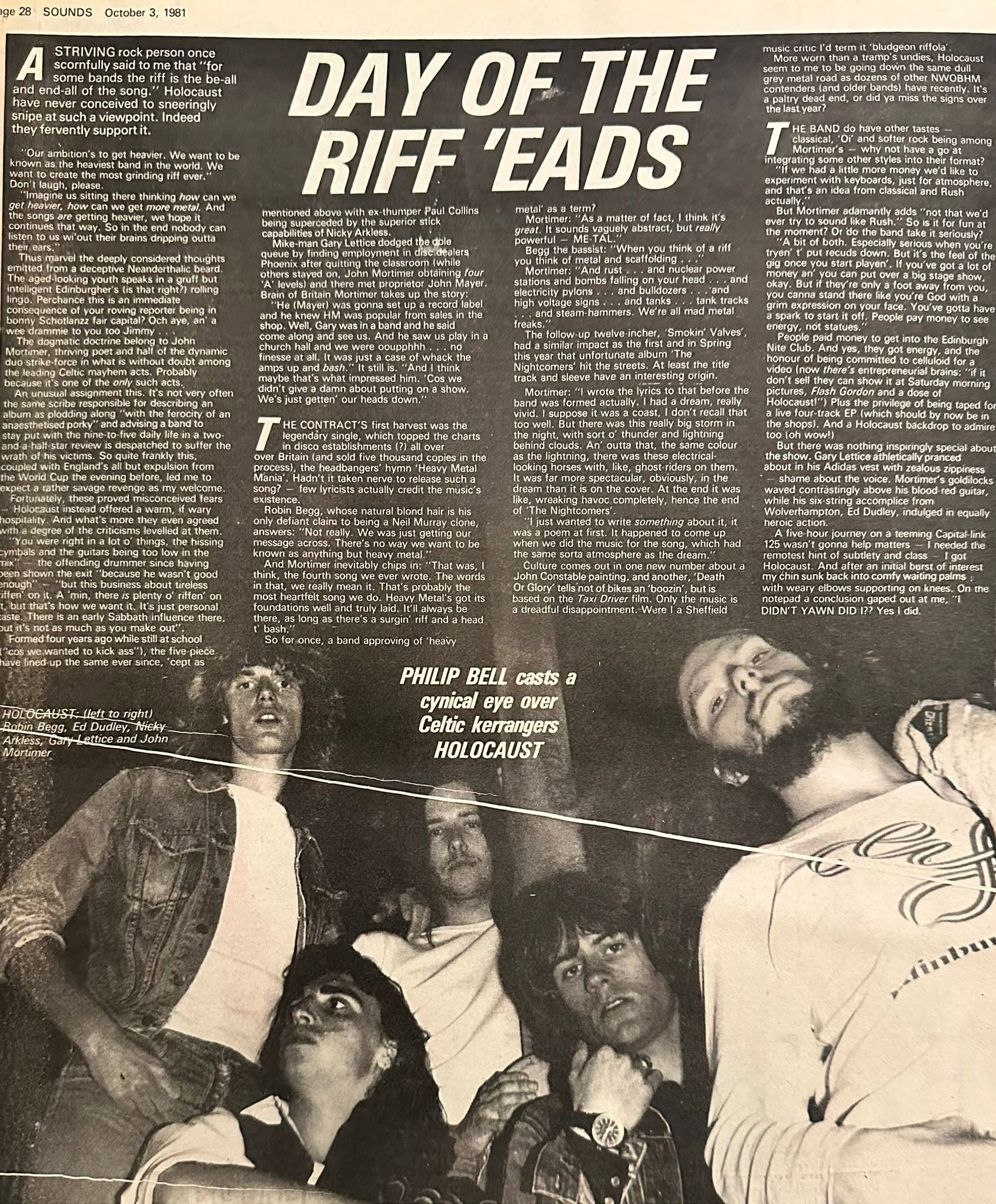
Basil Francis: I really enjoyed reading some of the scathing reviews of the band from press clippings included in the Vol 1 booklet. In particular, Philip Bell of Sounds gave The Nightcomers a 2½ star review before being posted to Scotland to interview the band in a separate article. Do you remember that interview at all, and were you aware that he’d written a rather harsh and reductive review of your album previously? Was that stance typical of the music press at that time?
John Mortimer: It was typical, yes. The only thing I remember about Philip Bell was him complimenting Edinburgh as “a lovely little city”. He was just another disinterested observer making a living from what young people were spending money on but not genuinely interested in discovering why they found what they consumed relevant.
Basil Francis: Between 1984 and 1989, you released no new material, but with The Sound of Souls (1989), you returned to the scene with a completely updated, more technical sound, far different from the sound before. What happened to you in those five years and how were you influenced to get heavier and more technical?
John Mortimer: As for heavier – that was just a given; I always wanted to get heavier. Now that the other guys in the original band were no longer there it was completely natural that the material got heavier.
As for technical – well, it was just a matter of getting more experience playing. When the first 12” single was released I had only been playing guitar for a year, or just over a year.
There are only 5 songs on The Sound of Souls album but years of work went into them at (drummer) Steve Cowen’s soundproofed basement. I was every bit as inspired by the Thrash Metal movement in the mid-to-late 1980s as I had been by the classic bands in the NWOBHM days. Metallica covering The Small Hours was a beautiful inspiration, and I loved their early albums and so many other bands that were emerging at the time…above all Voivod. I cannot tell you how much I listened over and over to Killing Technology and Dimension Hatröss back then. I still regard them as a truly great band. We had a wonderful experience playing in Montreal in 2014, I think it was, and both Denis aka Snake and Michel aka Away were in the audience. We didn’t know they were there at the time, and yet because we were in Voivod’s hometown, I paid homage to Voivod before playing Dance Into the Vortex from The Sound of Souls, acknowledging the inspiration they had been for me. The Voivod influence is all over The Sound of Souls.
Well, it was mind-blowing enough when they introduced themselves after the show… but then they told me that the very first song they ever jammed as Voivod was Death or Glory from The Nightcomers. It turns out they were all very much inspired by that album in the early days of the band. So it had come full circle – because now they had influenced me! And up to that point neither of us were aware of the mutual influence! Amazing!
Still further on The Sound of Souls… the two most recent members of Holocaust are Craig Shortel (bass) and Jonny Hall (guitar). Together they learned and home-recorded all of The Sound of Souls just for the sheer love of it! They had to do that by ear, as there were no tutorials or guitar tabs or anything like that available. Now I am certain that would be tremendously difficult; it must have taken a huge commitment. Those two have enriched the band beyond description.
So, yes… The Sound of Souls is a significant album for Holocaust. We just recently played at the Steel Over the Solent festival and there was a fan right at the front waving The Sound of Souls vinyl about. More and more people are talking about it; I’m delighted about that.
Basil Francis: I imagine the release of The $5.98 E.P. – Garage Days Re-Revisited by Metallica must have had something to do with your return to the scene. Can you walk me through how you discovered that Metallica had made a cover of your song The Small Hours? I’d also love to hear about what happened when you heard their cover for the first time; where were you, how did you feel, etc.
John Mortimer: I got a phone call from a guitar-playing friend of mine at the time as he’d seen it in the music press. I could hardly believe him, but I thought, “Well, why would he make that up if he hadn’t seen it”? On the day of the release I went out and bought it, came straight back home to my bedroom, put it on the turntable and took a deep breath. It speaks volumes that I was really afraid they might just be having a laugh and actually taking the piss out of the song! It was when James’ vocal came in that it was clear they were not taking the piss – they just dug the song. And that blew me away! I loved the version they did. It just felt surreal. But wonderful.
I had already been working on the songs for The Sound of Souls for a year or so at that point. The Metallica cover was a great encouragement. I eventually found a small indie label in Scotland (Chrome Records) that was willing to put up a modest budget for the recording of the album. That was based on the fact that now they could promote the album based on, “This band has influenced Metallica…” and all that. Didn’t make any difference though; nobody in the music business was interested. However, that Metallica cover meant so much to me and it always will. I greatly admire Metallica, and it’s awesome to be honoured in that way by fellow creators and musicians.
Basil Francis: What’s surprising is that The Small Hours had not been previously recorded in a studio, so Lars Ulrich must have tracked down one of the live recordings of the band. How does it feel to know you’ve directly influenced one of the biggest music acts of all time?
John Mortimer: Really strange, to be honest. It’s not just Metallica either. Bands as diverse as Gamma Ray and Six Feet Under. It feels humbling in one way – but it provided me with a certain confidence also. Back in the day, nobody complimented those songs that have been covered, i.e. The Small Hours, Heavy Metal Mania, Death or Glory. Up to that point when Metallica did their cover in 1987 I had just felt like some pathetic little freak who should give up music but couldn’t. Obviously after 1987 I could think, “well, fuck you all!”…if Metallica see the value in it then who was going to say that what I wrote and performed was hopeless?
What definitely is strange though is that very few copies of those early albums were actually manufactured and sold. I believe it was 2,000 for The Nightcomers, for example. Yet seriously influential and significant people got hold of them. Weird!
Basil Francis: I noticed that you subsequently made at least two studio recordings of The Small Hours for your next EP and studio album. Was this to capitalise off the recognition from Metallica?
John Mortimer: It was the record company idea – surprise, surprise! Just like the cover of Master of Puppets. Don’t get me wrong, I enjoyed both of those endeavours, but if it had been up to me neither of them would have happened.
Basil Francis: I picked up Vol 2 of the complete recordings not expecting that there would be progressive influences in your music this time around, but they are plain to see on some tracks. A Gentleman’s Penny-Farthing is solidly in 5/4 while Three Ways to Die stretches to over 11 minutes long. What progressive influences did you bring when composing these songs?
John Mortimer: Well, there was never any conscious application of influence. But from when I was about 13 years old I had loved early and mid-period Genesis and the subsequent Steve Hackett solo material, Yes, Focus, Pink Floyd, Alan Parsons Project, Rush and other bands. I was also a huge fan of the composers Philip Glass, Steve Reich and John Adams. All of that is inevitably going to come through as one develops as a musician.
Basil Francis: The Battle of Soaring Woodhelven stands out particularly in your catalogue at over 16 minutes long. Was the plan to make it an epic or did it just end up that way? How popular is that song amongst fans? Would you ever go back to writing long form songs again?
John Mortimer: The most recent song that I’ve written (entitled Remote Station), turned out to be 11 minutes 55 seconds. That will be on the next studio album for sure. As with Soaring Woodhelven, there was no intent to set out and write on an epic scale – it just turned out that way. When I write, it’s like discovering something that already exists; it’s my job to feel my way into it and bring it into conscious manifestation.
Soaring Woodhelven is mentioned quite a lot by fans of the 2nd era. It’s a meaningless song if you’re not familiar with the books by Stephen R. Donaldson. However, a lot of people seem to be able to relate to it in their own way, which is great. When I wrote and recorded that song I didn’t think anyone would be hearing it outside of the band, really.
Basil Francis: The liner notes of Vol 2 show how the lack of Internet in the 90s made it impossible for you to detect how popular Holocaust really was. How has that changed now?
John Mortimer: Through social media and email we get gig invitations, (mostly in Europe), and when we play those gigs it just seems like the band is getting more and more popular. Never ceases to amaze me!
With the new line-up we are going to be taking a much more pro-active approach to building the band.
Basil Francis: I understand that Primal was recorded around the time that you lost your parents. The album has a very raw, pared-back and doom-laden sound with shorter, more straightforward songs. By comparison, whenever a member of Dream Theater has lost their parents, the songs have been sentimental but still complex and progressive. Primal, to me, represents complete despair. Is this a fair assessment?
John Mortimer: Yes, that’s fair. Up until two or three years ago, I could not bring myself to actually listen to that album because the associations were just too painful. The first song on the album, Iron Will has always been part of the live repertoire and somehow it’s different; probably because it represents the only hint of hope on that album. About two or three years ago one of our “superfans” in Liverpool was asking me about the song Black Box from that album…and do you know…I could not, for the life of me, remember anything about it. So in order to answer her question about it I listened to it and it was like listening to a band that had nothing to do with me! When I hit “play” I had no idea what I was going to hear. Thing is, I really thought it was great and I went on and listened to the rest of the album in the same way. What an experience! Yes, it brought back all the horror of those days but I have to give credit to myself for still managing to be so wonderfully creative…albeit in a very dark manner. I love that album now.
Basil Francis: After Primal, it would be another twelve years before you returned to making music. What happened in that time that prevented you from recording more? Was Holocaust still gigging during that period?
John Mortimer: Actually there was a whole lot of material developed and recorded with Scott Wallace and Mark McGrath but it wasn’t conceived of as Holocaust, at least not by me. From about 2004 to 2011 we worked on material that we refer to as the “Predestination” project. There is easily enough material to fill an double vinyl album there.
When the 2nd era ended with “Primal” in complete disaster and darkness I could not even imagine continuing with the idea of Holocaust as a band. Yet I could not stop creating music; in fact, if anything I found my creative urge was stronger than ever. Scott had a studio set up at his home and that meant being able to create music without the thought of Live performance limitations. I could record as many guitar tracks as I wanted. It was a healing and nourishing experience. The intention is to finish that off one day and release it as a “From the archive of the proto-3rd era” type of thing – it needs most of the vocals recorded, and I would like to re-record a lot of the guitar parts with the better sounds I now have. We’ll see.
Much of the “Predestination” project is Metal and Scott and Mark used to regularly ask me if I’d be interested in going forward as Holocaust again. They would do this about once a year on average, I’d say. My response was always, “No way!” Then in 2011 I engaged with Lady Gaga’s material and, without any exaggeration, she caused a total revolution in me. Scott, Mark and I used to get together for Predestination recording sessions once every two weeks and in the space of one of those fortnights everything changed.
The Lady Gaga material inspired me to view myself first and foremost as a performing artist. I used to shy away from the Live situation because of nerves, stage fright, lack of confidence…that sort of thing. Now I just wanted to be on a stage (or even in the corner of a pub for all I cared!), kickin’ ass with Holocaust!
I will always feel a real sense of gratitude to that woman for what her creativity did to me back then. The songs Shine Out, Expander and the instrumental Observer One all came coursing through me as new Holocaust songs, riding on that wave of inspiration from Lady Gaga. In Shine Out there is the line, “For me, the Christ is a woman – but I cannot keep calling her, she’s kinda busy”; that is an obvious nod and wink to her and to the song Telephone. The Observer One instrumental was completely inspired by her dance moves. These three songs were self-released by the band as an EP, and then remixed versions appeared on the Predator album. The song, also on that album, Can’t Go Wrong with You, is a song from me to her.
Basil Francis: I hope you don’t mind me saying, but reading the story in the liner notes, I was strongly reminded of the 2008 film Anvil! The Story of Anvil. Both stories feature heavy metal artists that had a modicum of popularity in the early 80s followed by decades of being relegated to obscurity. Meanwhile, the band leaders are fiercely passionate about their music and refuse to stop making it despite the adversity of not being able to find gigs to play. You worked at a supermarket while Lips, Steve Kudlow was a truck driver. You can even compare both bands’ most popular songs (Heavy Metal Mania and Metal on Metal) as songs about how passionate each artist is about heavy metal.
If you’ve seen the film, how did it make you feel, and were there any other comparisons between Anvil and Holocaust you could make? In what ways are your stories different?
John Mortimer: There are indeed many similarities, although Anvil were waaaay bigger in their early days than Holocaust has ever been to this point. Watching that film gave me a real feeling of kinship with them. They seem to be incredibly likeable guys as well. Maybe in the future we will tour together… who knows?
Basil Francis: How have you enjoyed the HNE box sets of your work so far? Will we expect to see a Vol 3 soon?
John Mortimer: I don’t actually have either of the box sets, as I don’t formally have any publishing rights for the 1st and 2nd Eras and (just like the Anvil documentary says again and again), everybody gets paid except the artist. Yep, that’s the music industry for you!
I very much hope there will be a third box set because we have an album entitled Luna by the same 3-piece line-up that recorded (and OWNS!) the Predator and Elder Gods albums. We love Luna, but now that the new 5-piece band is up and firing on all cylinders, we don’t want to release it now. What we are looking to do with the 5-piece is to kick off the 4th Era with a double live album and a new studio album. Luna could then be later released as part of a 3-album box set of the 3rd era.
Basil Francis: It’s been seven years since Elder Gods and nearly fifty years since the band’s inception. Is there more Holocaust music coming?
John Mortimer: Oh, yes indeedeeeeee!!!!!
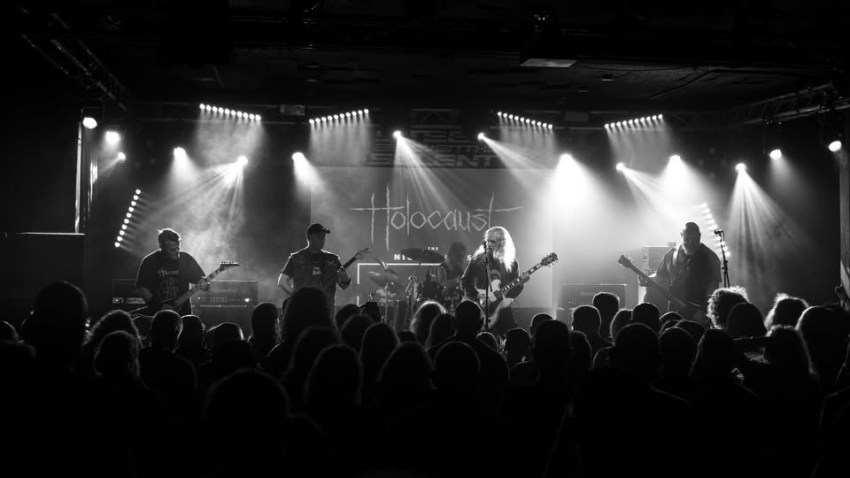
Basil Francis: Thank you so much for talking to The Progressive Aspect. I’m looking forward to seeing what you do next.
[Photos courtesy of Gordon Stewart]
LINKS
Holocaust – Website | Facebook | Bandcamp | YouTube | Instagram


