
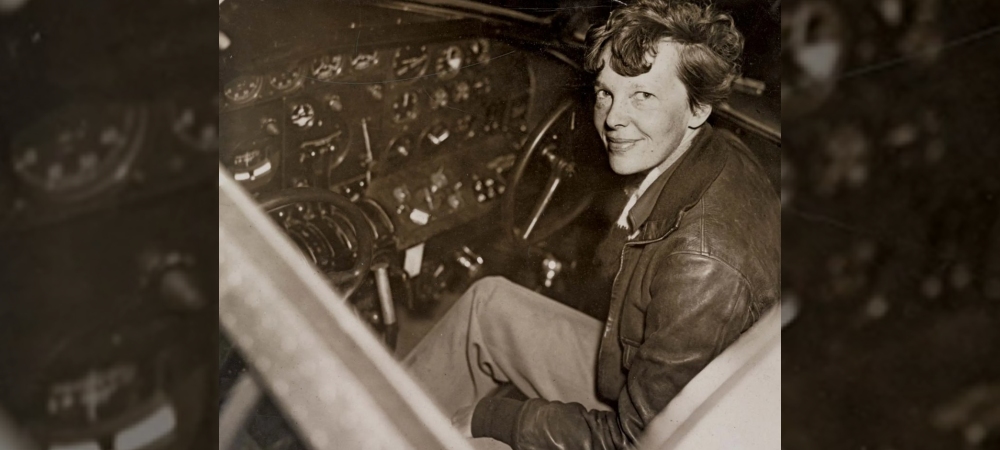
Amelia Earhart has an enduring appeal as an adventurer since the 1930’s. As a pioneering aviator she flew long distances over remote areas of the globe, in a male dominated era when women were not expected to go on such adventures. Over the years she has also attracted various musical interpretations of her life and adventures. Additionally, she has been poetically used as a metaphor by artists. This musical interest reached its zenith in 2024 when two notable musical artists strangely almost simultaneously released albums based on her life.
American experimental electronic and classical composer Laurie Anderson (most well known in the U.K. for her unlikely hit single O Superman in 1981), released her album Amelia on 30th August 2024, closely followed by Public Service Broadcasting just over a month later on 4th October with The Last Flight. Public Service Broadcasting have previously focused on aeronautics with their iconic Spitfire song and their classic ‘Race for Space’ album.
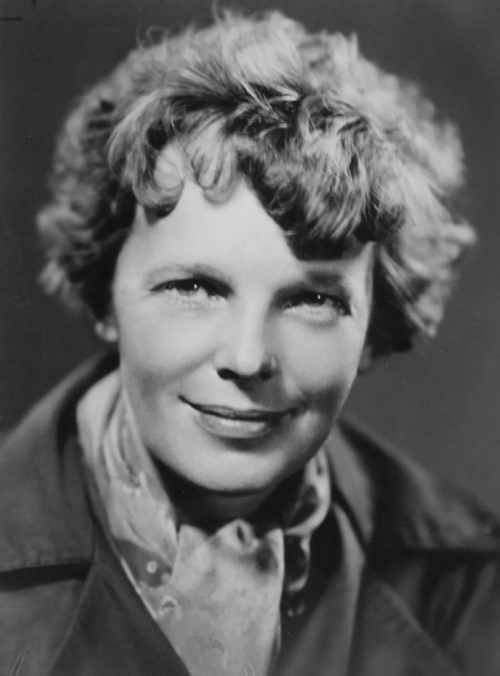
Before we take off on this exploration of music associated with this remarkable woman it may be helpful to outline her life and her achievements for those who may be unfamiliar with her. This may also provide some insights why she has inspired a range of musical perspectives on her story. Born in 1897, Earhart always had an eye for pushing herself in an era when women were perceived as delicate creatures, incapable of testing themselves in the same way as men. This was not the life or role that Amelia wanted.
In 1928 she became the first woman to fly the Atlantic (as a passenger), landing in West Wales. Let’s remember that powered flight only started in 1903, and Louis Bleriot was the first person to fly the English Channel in 1909, less than 20 years before her transatlantic exploits. Alcock and Brown were the first men to fly the Atlantic in 1919, followed by Charles Lindberg’s solo flight across the Atlantic in 1927. Amelia became known as ‘Lady Lindy’ as a result of her presence on the 1928 flight, becoming quite a celebrity. She used this status to fund her flying exploits with various endorsements, including ‘Active Living’ fashions for women, and became an associated editor of ‘Cosmopolitan’ magazine. She was determined to push forward the cause of women in a patriarchal society and became a standard bearer for an enhanced role for women in society. She promoted air travel, which was in its infancy, particularly for women. This inspired her to form the ‘99’s organization for female pilots.
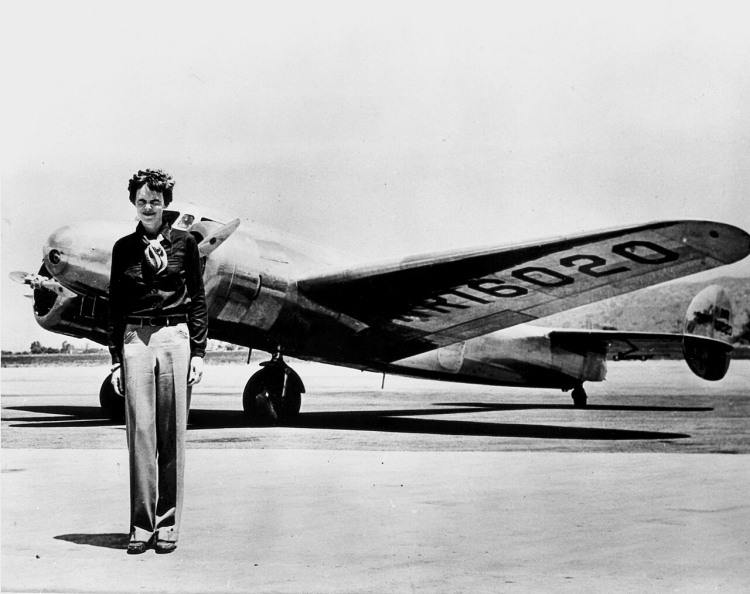
Underlining her fierce sense of independence, when she married her publicist George Putnam in 1931, she presented him with a letter stipulating that their marriage was a ‘partnership with dual control’. She also insisted on not taking his name and retained ‘Earhart’ as her surname. In the air she competed in various air races and challenges in the late 1920’s and early 30’s, culminating in her completing the first female Atlantic solo flight in 1932 to much international acclaim, including the Legion of Honour from France. She continued to embark on long-distance flights and air races in the 1930’s. In 1936 she started planning the first flight around the world by a woman and chose to try to take a roughly equatorial route. After an aborted first attempt Amelia Earhart commenced her epic flight from Miami on 1st June 1937 with her navigator Fred Noonan. They crossed the Atlantic, and then across Saharan Africa to Saudi Arabia and India, flying west to east. They traversed southern Asia and reached New Guinea on 29th June 1937, having flown 22,000 miles. The last leg of this circumnavigation would be over the vast Pacific Ocean with a flight of 7,000 miles, relying on navigating their way to tiny islands in the vastness of the ocean. On 2nd July they took off from Papua New Guinea to find the miniscule island of Howland Island, over 2,500 miles away. The US Coastguard cutter ‘Itasca’ was stationed at the island to aid in radio communications, guiding them on to the island. However, despite radio calls indicating they were approaching the vicinity of Howland Island, Amelia Earhart, Fred Noonan and their Electra aircraft were never seen again. The US Navy and Coastguard conducted a prolonged search for Earhart, the most extensive and expensive maritime search yet conducted at that time, indicating her high public profile in America.
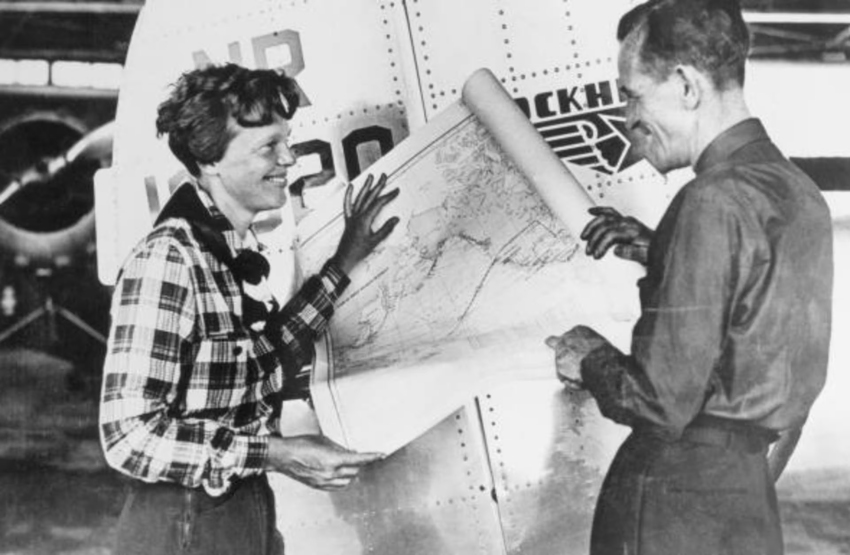
Such is the appeal of the mysterious disappearance of this pioneering aviator, over the years right up to the present day, subsequent searches for their remains have been conducted but with no firm evidence of her fate. This has led to various theories about her disappearance, including the idea that being unable to find Howland they continued south to crash land on Nikumaroro (also known as Gardner Island) but no crash site has ever been found. More outlandishly, another theory speculated that they were captured and executed as spies by the Japanese army on another island. Another idea is that they tried to turn back to Papua New Guinea and crashed in New Britain… but these theories are all speculation with no firm evidence.
Over the years the legend of Amelia Earhart and her disappearance have grown and continues to fascinate. This interest is echoed in the various musical explorations about Amelia Earhart, often reflecting the perspectives of the artists or how they have poetically used her reputation. The first recorded song inspired by this story was Amelia Earhart’s Last Flight by Red River Dave McEnery in 1939. This traditional country style ballad focused on the tragedy of the last flight by this American National Hero. It was later covered by Ronnie Lane of The Faces on his first solo album ‘Anymore for Anymore’ in 1974. Two years earlier in 1972, the British folk rock band Plainsong released their album ‘In Search of Amelia Earhart’, including ‘The True Story of Amelia Earhart’, although other songs had nothing to do with her story.
The most iconic artist to write a song inspired by Amelia Earhart is the legendary singer-songwriter Joni Mitchell who recorded Amelia on her 1976 album Hejira. (David Crosby later covered Amelia in 2017.) Joni poetically used the image of Amelia Earhart as a metaphor for her own experience as a woman, going solo after the break-up of a relationship. She told the L.A Times in 1996: “In this song, I was thinking of Amelia Earhart and addressing it from one solo pilot to another, sort of reflecting on the cost of being a woman and having something you must do.”
Bachman Turner Overdrive, of You Ain’t Seen Nothing Yet fame, released Amelia Earhart on their rather unsuccessful 1979 album Rock ’n’ Roll Nights. B.T.O, without founder member Randy Bachman, had to use a few other songwriters, including Bryan Adams, to write some of the songs on the album. Their rather soft rock song Amelia Earhart takes a straightforward narrative approach, initially focusing on her dreams as a child through to her rise to aviation glory, and culminates with her tragic disappearance. Vaguely entertaining as a song, featuring Jim Clench of April Wine on vocals, B.T.O’s rather anodyne take on Amelia Earhart provides little insight into her story. Relying upon guest songwriters may explain the band’s evident lack of emotional engagement with the subject matter.
The fascination of musical artists from a variety of genres with Amelia Earhart continued into the 21st century, including singer-songwriters Heather Nova and Tom McRae. Bermudian Heather Nova created the rather moving song I Miss My Sky (Amelia Earhart’s Last Days), imbued with her plaintive voice and a mournful violin. She imagined Amelia Earhart had crash landed on an island and remained forever bound to the ground as a castaway unable to fly and yearning for flight… ‘I Miss my Sky…’ .
English singer-songwriter Tom McRea skilfully used Amelia Earhart’s story as a metaphor for longing and a desire for reconnection in his 2007 song The Ballad of Amelia Earhart. The song contains some intriguing details from Amelia’s life, but the main focus is about a relationship in which one partner has drifted away, leaving the other one waiting in hope they will return. As we know, in the end Earhart never returned, which also seems the likely conclusion to this relationship, and McRae evokes those forlorn emotions with restraint and sensitivity.
Progressive rock has more recently cast its gaze upon the legendary aviator, including an expansive piece in 2020 by Marillion’s keyboardist Mark Kelly’s own solo project band, Marathon. Kelly’s take on Amelia was preceded in 2008 by Australian band Unitopia, who recorded a beautiful, largely instrumental track Amelia’s Dream for their classic The Garden album. The only words on this beguiling piece, featuring lovely flute from Amanda Timms, are from a 1935 radio address by Amelia Earhart discussing the romance and utility of flight, taken from her speech “A Woman’s Place in Science”. Unitopia smoothly segue into ‘I Wish I could Fly’ with clear inferences to Earhart’s final journey and comparisons to the ancient myth of Icarus:
Will send you higher on Icarus’ wings, Defying gravity’s realm’
… and maybe they have a point – perhaps Earhart did take one risk too many on that flight, akin to flying too close to the Sun?
One of the best evocations of the Amelia story is found on the 2020 Marillion keyboardist solo album Mark Kelly’s Marathon with the excellent extended piece Amelia. Kelly’s lyricist Guy Vickers shares in the extensive sleeve notes that the song was inspired by his interest in this pioneering aviator. Vickers read an article in 2018 in which a forensic anthropologist attempted to categorically conclude that the evidence of various items of 13 bones (including a skull), parts of a woman’s shoe, a sextant box of a type known to be used by her navigator Fred Noonan and bottle of the Benedictine liqueur which Earhart was said to have carried at times, all found in 1940 on Gardner Island, confirmed that Amelia Earhart had crash landed on that island. This was quite a leap of faith, particularly in the context that an anthropologist in Fiji in 1941 examined the bones and concluded they belonged to a Caucasian male and not a female. Somewhat inconveniently these bones and items have long since disappeared so these claims cannot be verified. This 2018 claim was subsequently dismissed by other academics who had drawn very different conclusions, but it shows how the disappearance of Earhart still draws so much attention and interpretation, passing almost into myth.
What interested Kelly’s lyricist Guy Vickers, who admitted he feels those items said to have been discovered on Gardner Island were indeed probably evidence of Earhart’s final fate, is just how Earhart and Noonan died in those circumstances. 1930’s navigation was clearly far less sophisticated than modern day GPS systems, but it appears that a lack of planning by Earhart (eg not previously confirming the frequency for radio broadcasts with the Coastguard ship waiting for them at Howland Island) and a failure in communication, contributed to their sad ending somewhere out in the vastness of the Pacific Ocean. Some speculate that with better preparation they could probably avoided disaster. Vickers sees Earhart as a metaphor for communication failure and lack of preparation.
Additionally, he also sees Earhart as a figure upon which others impose their own perspectives on the mystery of her disappearance, perceiving the ‘evidence’ in their own way to confirm their own wishes and theories. Whatever angle you take on the story, Mark Kelly’s Amelia song is an outstanding melodic rock song with great guitar work, fabulous keyboards and wonderful harmony vocals from Oliver M. Smith.
That brings us to the curiously, almost simultaneously, released but very different Amelia Earhart themed albums released in 2024 by Laurie Anderson and then Public Service Broadcasting. Laurie Anderson was first out of the blocks with a sombre evocation of Amelia’s last flight, conveyed in atmospheric orchestration, rich in violins and cellos with additional electronics. Anderson speaks the part of Earhart with characteristic monotonal restraint evoking a curious sense of detachment. Amelia’s real voice is used in This Modern World (with the same speech used previously by Unitopia) – actual recordings of her voice are relatively rare. Anderson is portraying Amelia Earhart as some sort of early feminist icon, echoed in the later The Word for Woman Here. The ethereal atmospherics that characterise this album are occasionally punctuated with lighter diversions, such as the harp-like plucked tones and subtly echoing guitar of Road to Mandalay, but the mournful strings are never far from the musical palette.
Flying into the Sun is a little more dramatic punctuated with barely discernible radio communications, as they fly towards their fate. There is a curious disconnect between the sad inevitability of this loss with the rather emotionless vocalisation of Amelia Earhart by Laurie Anderson. However, this may also exacerbate a sense of foreboding tragedy for our heroine. Howland Island is virtually a speech from Anderson with subtle sound effects, detailing the circumstances of Amelia’s final flight towards the tiny island with very matter of fact details about the errors and difficulties Earhart encountered. Radio, with the eerie vocalisations of ANOHNI, draws this tale appropriately to a close with a synth / string drone under a mixture of vaguely heard radio calls and whistles, (Earhart whistled into her radio in a desperate attempt for her signal to be heard on that flight – tragically she could be heard to some extent by others but her radio was not tuned correctly for her to hear any responses). Lucky Dime is an elegiac coda of mainly sea noises with Amelia talking about her aircraft shining like a ‘Lucky Dime’… never to be seen again.
Laurie Anderson’s perspective on Amelia Earhart is reverential, with the emphasis on portraying her as a tragic feminist hero going inexorably to her sad fate. This is an album which exudes great respect for its central figure, and is conveyed with characteristic individuality by Anderson, but its tone and lack of dynamics may struggle to engage the listener. The musical panorama is strangely muted, and it never really takes off in terms of portraying the story … but Anderson fans familiar with her idiosyncratic style, and those with a more minimalistic taste in music, may engage much more readily with Anderson’s singular approach. It is certainly an album exuding respect for Amelia Earhart, conveying her as a driven and determined, but fatally flawed woman, well ahead of her times.
Public Service Broadcasting have a successful history of thematic releases punctuated with archival speech clips to illustrate their narrative, whether about World War Two, the Mining industry, the Titanic or the Space Race. On The Last Flight they turned to the story of Amelia Earhart, which was a story that fascinated their main man J Wilgoose Esq. He was keen to focus on a woman as he was frustrated that so much archival material was so male oriented. In that context it probably says a lot that even though Amelia Earhart was a very famous public figure in her age that little actual material of her recorded voice exists, apart from the opening piece I Was Always Dreaming, taken from a 1935 radio speech about “A Woman’s Place In Science”…. Public Service Broadcasting instead chose to use character actor voices to convey the story, most notably Kate Graham. She voiced Amelia Earhart, largely based on some of her writings, and it is done very convincingly and respectfully. Conversely, whilst Amelia’s voice has been largely fabricated for this release, this device actually seems to give more authenticity to her story. Public speaking on the radio or on news reels back in the 1930’s were usually quite stiff and formal, as was the fashion in those early days of broadcasting and filming, which can give a rather stilted quality to such sound clips. In contrast the speech clips on this album, largely based on her diary and writings, give a much more human feel to how her story is presented.
Public Service Broadcasting atmospherically introduce her narrative with the sometimes eerie and foreboding I Was Always Dreaming but they take off energetically with Toward the Sun which injects a sense of excitement and desire to fulfil dreams as she prepares for her epic flight. ‘The Fun Of It’ was a 1932 book written by Amelia, and Public Service Broadcasting reflect her more pleasure-seeking, hedonistic side with a jangling The Fun of it, sung with 1920’s style ‘Flapper Girl’ brio by Andreya Casablanca, and punctuated with some meaty riff on guitar by J Willgoose Esquire. Wrigglesworth’s drum switch with ease from swing to crunching power.
In contrast the feel of transatlantic flight is more subtly presented with vocals from Kate Stables and lush strings in the sweeping The South Atlantic. Public Service Broadcasting seem at ease with various musical styles to convey the different aspects of the story. The thumping beat and electronica of Electra is more typically in their mainstream wheelhouse, reminiscent of Gagarin and their classic Spitfire (there is even a sneaky little film quote previously used in Spitfire buried in the mix of Electra at one point – seems apt as both songs glorify an airplane). Other songs more prosaically describe parts of her flight eastwards across Africa, the Middle East and southern Asia.
A Different Kind of Love touches more personally on Amelia’s relationship with her husband, which touchingly imagines a long-distance phone call between them. However, EERA’s soft vocals clearly outline Amelia’s assertive position regarding her marriage, demanding a ‘different kind of love’, in which she has freedom to do what she wants to do independent of her husband – not typical of marriages in the 1930’s. It’s a love song but typical of Public Service Broadcasting, taking a different perspective honouring the individuality and strength of Amelia Earhart. The ethereal Howland is threaded with spectral strings under indistinct and increasingly desperate radio communications as Earhart tries to locate the tiny island. The strings rise elegiacally and then recede into the distance. Amelia’s imagined final words are voiced by Kate Graham, quoting from the famous Henry Wadsworth Longfellow poem ‘The Tide Rises, the Tide Falls’:
The day returns but nevermore
Returns the traveller to the shore
As the album fades away there are actual windswept field recordings from Howland Island, filled with bird calls.
Public Service Broadcasting tell a compelling story with an array of musical themes and textures which gives a more rounded perspective on Amelia Earhart as a human being, capable of great things but also fallible. They also successfully convey some sense of her spirit of independence, set against a backdrop of the sadness of her eventual fate.
Amelia Earhart was an outstanding woman far ahead of her time, pushing the boundaries as an early champion of women’s rights. It is probable she will continue to attract the interest of artists and musicians in years to come as her story is truly remarkable for her endeavour and daring, all framed within the irresistible web of mystery around her disappearance. Artists will continue to look at her life through their own personal prisms, giving multiple and kaleidoscopic views of this outstanding human being… and her reputation will continue to shine like a ‘Lucky Dime’.
TPA would like to thank Guy Vickers for his help with this article.
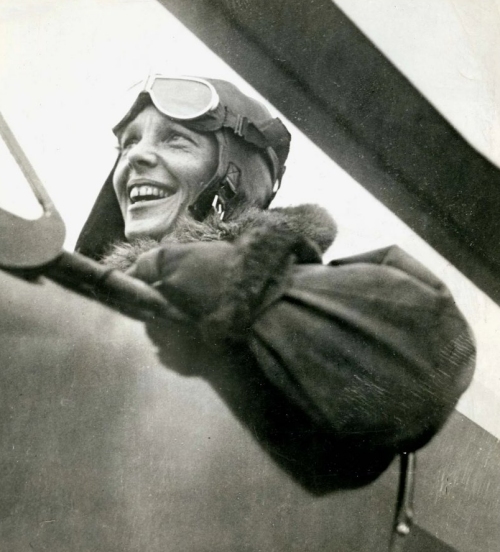
[Photographs of Amelia Earhart courtesy of Encyclopaedia Britannica]


