As I discovered last year when reviewing the ‘reimagined’ Playing the Fool live album, Gentle Giant were a group that put a serious amount of effort into their live performances, delivering the frantic energy, good humour and split-second technical precision that their music demanded and delighting fans globally. Rather than play straightforward renditions from their catalogue, the songs would live new lives on stage, rearranged sometimes to the point of being completely unrecognisable or as part of a medley. The unpredictable nature of the band’s setlist gave their concerts the edge over other artists.
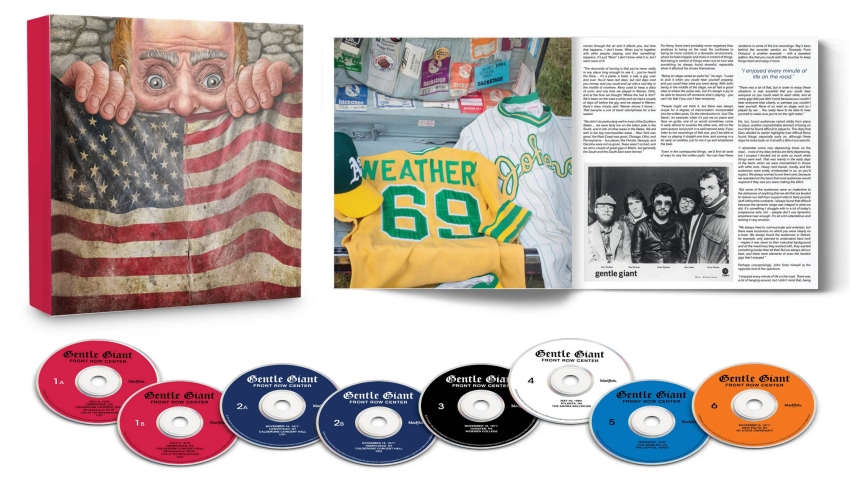
Now, you can get up close and personal with the group and join them on a few of their adventures around the States in the latter half of the 70s. The Front Row Center (the spelling is deliberately American) box set was originally released in 2022 as a 10-LP vinyl box set, spanning four performances. In the intervening time, two more performances have been added: a ‘Live in Studio’ performance from 1975 at Capitol Records, as well as a more standard 1977 live performance from New Paltz, New York. But is more necessarily better?
The set begins with a 1976 set recorded in Hempstead on New York’s Long Island on the eve of the Bicentennial Independence Day. Funny to think that America’s 250th just took place this year. The spirits are high in the crowd as the band play through tunes from Octopus through to Interview. On reflection, it’s not such a surprise that the set list greatly mirrors the running order of Playing the Fool, with only the reggae-inflected Give It Back standing out as something new to hear on this set.
Shockingly, this is the only place in the whole set where you’ll hear anything from Interview; the booklet essay points out that the band agreed with the largely-held view that the album hadn’t represented any artistic growth and that it had been ‘just the same’ as Free Hand. It was a surprise to me that the band had felt so negatively about their own work that they’d choose to omit it in future tours; if you read my review, you’ll know I’m not such a fan of it either, but I didn’t think it was that bad.
The second performance (which also spans 2CDs like the first) coincidentally takes place at the very same venue, nearly a year and a half later in November 1977. Just like much of the audience at the Calderone Concert Hall, your next brush with the band is theirs too, so you’re coming in with a similar hope to hear something fresh and different from the previous set.
And this is where the box set tells on the band somewhat: four of the tracks here were played at the previous performance, including the 16-minute Excerpts from Octopus suite, which is played pretty much the same as before. On top of that, the lengthy violin solo that takes up at least ten minutes of the listener’s time is once again featured here; even the booklet admits that the surround sound effect of this solo is lost when played on CD. Overall, about 45 minutes of the concert is the same stuff the punters heard before, about half of the concert. While the live rearrangements feel fresh the first time you hear them, they lose their lustre quickly. I almost laughed when booklet essayist Alan Kinsman spoke about the great lengths the band went to, changing their set for each tour.
From this set, one of the songs not featured on the previous performance (but apparently a staple ever since the group’s debut) is Funny Ways. Here, the first verse is missing, presumably due to tape damage; throughout the set, a few little deletions and tape errors can be heard, all of them fastidiously documented by Kinsman in the booklet, including some I didn’t even notice. Fortunately, they aren’t frequent enough to be bothersome.
The song is prefaced by a Welshman, identified as drummer John Weathers, addressing the audience directly for several minutes as the rest of the band changes their instruments. Kinsman demonstrates in the booklet how extroverted and fired up he was by live performances, so he seemed the right man to be the face of the band during these points. Things start well as he reads positive signs from audience members and compliments the Budweiser. He also references the previous Calderone Bicentennial performance, which makes me think, “Hey, I was at that one too, in a way.” He teases the audience for not bringing their friends this time; presumably the crowd was no larger.
Then, John reacts to some audience member yelling “Bullshit” at another band member, defending him, before pointing out, “There’s been enough aggressiveness tonight.” Eh? Then he says, “It took 10 fucking minutes to sweep the stage up, you naughty people, you… you narrow-minded bunch.” I was completely bewildered by what was happening at this point, but fortunately the booklet came to the rescue. Kinsman adds vital context to the scene: Gentle Giant were touring with pub rock legends Dr. Feelgood at the time (yes, even I had heard Milk and Alcohol years before I ever listened to Gentle Giant). It was an unusual pairing, as the groups played vastly different genres. While Dr. Feelgood were set to achieve great success in the UK (John Weathers even points out that Gentle Giant would support Dr. Feelgood back in the motherland), their style didn’t suit American tastes, and certainly not the prog rock crowd. But I’ll admit, I’m shocked to hear that the audiences were so negative as to throw stuff at the group and chastise them: the prog audiences I’ve been around are usually the nicest and kindest people you’ll meet, and not the type to boo another artist off the stage. Consequently, Dr. Feelgood cancelled the rest of their tour with Gentle Giant, and the band were able to find other artists to support their shows.
Finishing his talk with the audience, John says that if they were treated by an audience as they had treated Dr. Feelgood, he’d ‘pack it in’. The audience become incensed by what they probably perceive as an attack on their character, and a hubbub breaks out, prompting John to shout over the audience to calm them down. Impressively, he manages to dispel the tension with a chuckle by telling them to “Quiet down, there’s a good boy… Or I’ll have to set my roadie on you.” At last, he introduces the soft Funny Ways. The spoken introduction lasts under four minutes, but I’ve pored over it so many times that I couldn’t help but write three paragraphs dedicated to it. This little episode offers a fascinating glimpse into how Gentle Giant handled the less glamorous side of life on the road: perhaps not always with the greatest diplomacy, but certainly with plenty of personality, humour and a willingness to speak their minds. Lesser bands might have deleted the moment from the finished product, but I applaud Gentle Giant for keeping this awkward moment in and letting us draw our own conclusions about it.
The third performance in the box set took place just 48 hours after the second, this time in Chester, Pennsylvania. The setlist is exactly the same, but Funny Ways was not caught on tape, so it’s missing. John’s talk with the audience is a lot less inflammatory this time around, mainly focusing on different American beer preferences; this seems to have been the main focus of his diatribes. The pieces from Interview were replaced with songs from The Missing Piece, which happen to be a lot more enjoyable live; Derek struggles to hit the high notes consistently on Memories of Old Days, but For Nobody is particularly fierce. The band’s turn towards shorter, easier-to-play songs meant that fewer rearrangements were needed.
For the fourth performance (which was the last of the vinyl set), I had to do some of my own research. I’d never listened to the band’s final two albums, Giant for a Day! and Civilian, released in 1978 and 1980 respectively, due to their poor reputation. But since the final disc in this set was recorded in 1980 on the band’s farewell tour, I had to take the plunge.
Giant for a Day! was every bit as poor as other reviewers have claimed: it seemed like the band had made every effort to take out what made their music so unique and created empty, soulless, plodding 4/4 vessels in a blunderous attempt to become mainstream. I wonder if the point they were trying to make was: “Listen to how bad it would sound if we stopped being complex.” It actually hurts to listen to.
Civilian, on the other hand, was a lot more convincing. While the prog is still sorely lacking (the band still committed to the plan of breaking into the mainstream), the boys seem to have figured out how to add the soul and personality back into their music. As a result, I’ve found a fair chunk of the album to be extremely catchy, and the stomping openers Convenience (Clean and Easy) and All Through the Night have become guilty pleasures.
The band were raring to show off their new wares in Atlanta, Georgia, on a Thursday evening in 1980 in The Agora Ballroom. Still, I was quite surprised that they brought six of the album’s eight tracks to the stage, leaving a lot less time for prog than before. Frustratingly, however, the prog they did bring was all repeats from the previous sets: Free Hand, Playing the Game and Memories of Old Days all loom large in this set. Knots and The Advent of Panurge are finally played separately, the former with a much more percussive edge.
So, if anything, I was happier to hear new music being played rather than reheated leftovers. The live renditions cemented my enjoyment of Civilian by showing the band fully endorsed it too. I was particularly drawn into the hypnotic repetitiveness of Inside Out; I started to question if I needed lifting too. By comparison, only the title track of Giant for a Day! was selected for the setlist, showing that they also viewed that album as something of a creative misstep. Given that it was the band’s farewell tour, I’d have welcomed a set that was more all-encompassing of the band’s career, but the Civilian-heavy setlist made for a more unique Gentle Giant recording.
Before I was aware that this 8 CD set was an expansion of an existing vinyl set, I was confused as to why the performance date skipped backwards to 1975 at this point. I felt grateful that the earlier year would predate and therefore preclude songs such as Free Hand and Memories of Old Days that had been dominating the proceedings.
But I wasn’t expecting the recording to be so crystal clear. After hours of listening to scratchy tapes, this studio performance had unprecedentedly pristine audio quality. Doubtlessly, the folks at Capitol Studios in Los Angeles had their hands on some of the top equipment in the world, and boy does it show.
The band begin with one of my favourite deep cuts, the relentlessly intricate Cogs in Cogs. While one of prog’s notorious features is long-form songs, Gentle Giant prove here that prog songs can be concise without losing any of that ‘prog’ quality. The song is only three minutes long; I sometimes wonder how it would have fared if it had been submitted to Eurovision. Here, the song glimmers and sparkles thanks to the technology used to record it; I dare say it sounds better than the album version, as I can hear all the instruments clearly. No Steven Wilson needed!
The rest of the tunes also dazzle with their new live arrangements, and the high audio quality only emphasises how sharp the band are at hitting their marks. Proclamation sounds excellent, although it seems rather oddly paired with Funny Ways as part of a medley. In a Glass House remains my favourite album by the group, so I’m pleased to see it getting some representation with a sprightly performance of Experience that runs a few minutes shorter than the album version.
So Sincere is extended to include the group’s ‘Drum Bash’, and you almost certainly won’t hear it in higher quality anywhere else. The Advent of Panurge similarly includes the band’s group recorder spot, which incorporates Yankee Doodle Dandy; as we’ve heard from all the other performances so far, the song was kept this way in live performances all the way to the end. In all honesty, I’m not a fan of the recorders; the problem is that it completely replaces the gloomy, bass-heavy instrumental from the studio version and utterly changes the song’s menacing vibe. If they kept that instrumental and added the woodwind, I’d be fine, but as soon as Ray Shulman starts playing the bass again after the break, it’s as if they can’t get to that final verse soon enough.
The biggest gem for me, however, is the final track: unexpectedly, the band show Three Friends some love by playing Mister Class and Quality?, an underrated track that I never see mentioned. I was curious to hear how John Weathers would tackle Malcolm Mortimore’s parts; he handles them with aplomb, staying true to how they were originally played while subtly adding the power he was known for. The exquisite audio quality captures all these nuances brilliantly.
But rather than finish the piece, the band take a sharp turn into another of my favourite tracks from that album, Peel the Paint. It becomes evident that they’re about to do the guitar solo, and we get several minutes of Gary Green and John Weathers simply rocking out together. Gary does not attempt to stick to the original notes he played (which I have all but memorised from countless air guitar sessions I would have performed in my dorm as a student), but instead embarks on a new shredding journey to match the energy of the new drummer. It’s fascinating to compare the two jams, but simply for nostalgia’s sake, the Mortimore version still wins for me. This is capped off by a more straightforward rendition of Valedictory, making for an unusual cross-album medley.
After 46 minutes of incredible music with audiophile-level sound quality, it feels like a big downer to have to go back to the concert tapes again, but the last offering is another recently unearthed tape, also from November 1977, this one recorded 10 days before CDs 3 and 4 (and 12 days before CD 5). As a result, the setlist is completely identical, except for Plain Truth (Part), which doesn’t include the song itself but the end of the violin solo and the band’s drum bash. Excerpts from Octopus is cut off near the end, just as the band are about to begin the final verse of The Advent of Panurge. Whatever, I felt pretty done with this exercise in monotony too.
As I’ve mentioned throughout my review, Alan Kinsman’s essay in the coffee-table-sized booklet has been a source of much vital context for understanding the contained performances. But having recently read through Sid Smith’s masterful notes for Slightly All the Time, which felt effortless to read, Kinsman’s prose is decidedly uneven. While Smith was able to write a flowing piece that drifted between topics seamlessly, I would have been grateful if Kinsman included chapter titles so that I knew where he was headed.
His essay starts with the formation of the group and the Shulmans’ previous activity in Simon Dupree and the Big Sound; given that the box set itself starts midway through the band’s career, my natural worry was that this would be a completely unfocused and general essay about the history of the band rather than a focus on the recordings.
Soon after, however, he switches the topic squarely to live performances, with interview snippets that highlight each band member’s perspective of performing live. Quotes by keys player Kerry Minnear and drummer John Weathers are featured most prominently; they are portrayed as opposite ends of the personality spectrum, with Kerry as a quiet, timid, academic introvert who doesn’t appreciate the unpredictability of concert performances and audiences. John, meanwhile, seems like a rowdy, boisterous extrovert whose raison d’être is to get out and perform.
A section which I would have titled ‘Anecdotes’ backs up these portrayals, with the standout story coming from John – he mentions getting too drunk at a party in Quebec City in January 1975 and being ejected from his taxi into the cold winter snow. Almost freezing to death as the band and the roadies whizzed by him, a miracle happened when a taxi finally stopped for the shivering Welshman and helped him get back to his hotel, despite the language barrier. Weathers tells the story much better than I do, of course, and Kinsman keeps the quote in full as an anecdote worth reading about.
Only on the 39th page (with only 9 pages to go) does Kinsman finally get to the details of the recordings in the boxset. I had been quite worried that there would be no information whatsoever, so it came as a relief when I reached this portion, which, once again, could have easily had a chapter title to signal interested readers to make their way here to start with. The wait turns out to be worth it, however, as Kinsman’s accounts for each performance are full of context, including clarifying quotes from the band. For example, this is how I learned that Funny Ways must be missing from the Chester performance, as John Weathers highly doubts he would have been chatting to the audience right before The Face. Kinsman must have been thorough in his research of the group’s setlists from across the years, as he is able to explain knowledgeably when certain songs were dropped across the years.
A couple of other points from the booklet made me scratch my head (figuratively): Kinsman doesn’t usually describe each concert venue, but goes into unnecessary detail about the Elting Gymnasium on the SUNY, New Paltz campus, explaining when it was built and who it was named after, and why the Elting family was important. It gave the vibe of someone who had done a late-night rabbit-hole Google search to find out as much information as possible and presented it without considering what was relevant to the assignment. While Kinsman is always thorough, his prose would always seem relevant, except for this one tangent that goes nowhere. I’ll save the other point for my conclusion.
Overall, I’d classify this release as ‘for serious collectors only’. The newly added Capitol Tapes is a shining beacon of quality, and a serious addition of value to this set; every Gentle Giant fan should hear it. That disc alone could have sold well by itself; it’s surprising that they added it to this box set where it’s dragged down by murky, bootleg-quality live recordings.
Besides that beautiful recording, the rest of the box set feels like an exercise in pretending to be Gentle Giant for a day, playing the same songs again and again, seeing how the sausage gets made. By hearing so many live recordings of the same rearrangements over and over again, it strips them of their novelty. The fact that half the setlist was repeated across two consecutive concerts at the same venue is a pretty damning indictment of the band’s approach to live performance. And now the same band hopes that you will purchase a box that has three nearly identical live performances from November 1977.
I approached this set with some of the same scepticism I had towards Yes’s Progeny: Seven Shows from Seventy-Two. While there’s undoubtedly value in preserving these performances for posterity, I question the entertainment value of presenting so many complete concerts when the setlists are largely interchangeable. At some point, the diminishing returns become difficult to ignore: the purchaser is being asked to pay for a considerable amount of additional material while receiving a copious amount of repeated songs.
I crunched the numbers: eight songs are played four times or more, with The Advent of Panurge played on all six performances. As such, these worst offenders account for an additional 28 performances across the performances, or roughly two and a half hours of music. And that’s not even counting the first time they are played.
The other point that had me scratching my head in Kinsman’s prose was on the final page: his use of a triple negative in the following sentence: “Listening to these recordings, it’s difficult not to question the widely-held view that Gentle Giant peaked in 1975, and it was all downhill from there.” I genuinely thought he was agreeing with the assumption at first until I read closer. His point is not illustrated well, as the 1975 performance in this set is easily the best in terms of both content and sound quality, while the following sets suffer as a result of the Giant’s ill-fated march towards mainstream acceptance.
But I think I see the point he’s trying to make. While many fans choose to discount or conveniently forget about the last two or three Gentle Giant albums and the period that surrounded them (up until recently, I was also firmly in this group), the Front Row Center box set forces the listener to brazenly accept that this period of prog decline did in fact happen. Listening to all the sets, and especially the Atlanta 1980 concert, made me confront the reality of the band’s decline in their last years together, and, combined with the booklet, gave me the context for the band’s ultimate split that the final two albums couldn’t have.
TRACK LISTING
DISC 1 (1A) – Hempstead, NY – Calderone Concert Hall ‘Live at the Bicentennial’ 3/7/1976
01. Intro/Just the Same (7:40)
02. Proclamation/Valedictory (5:16)
03. On Reflection (6:53)
04. Interview (6:51)
05. The Runaway/Experience (10:37)
06. So Sincere (10:49)
Time – 49:35
DISC 2 (1B) – Hempstead, NY – Calderone Concert Hall ‘Live at the Bicentennial’ 3/7/1976
01. Excerpts from Octopus (17:11)
02. Give It Back (5:26)
03. Timing (13:14)
04. Free Hand (7:55)
Time – 44:17
DISC 3 (2A) – Hempstead, NY – Calderone Concert Hall 16/11/1977
01. Two Weeks In Spain (2:58)
02. Free Hand (6:46)
03. On Reflection (7:12)
04. I’m Turning Around (4:10)
05. Just the Same/Playing the Game (10:11)
06. Memories of Old Days (7:27)
Time – 38:58
DISC 4 (2B) – Hempstead, NY – Calderone Concert Hall 16/11/1977
01. Betcha Thought We Couldn’t Do It (6:27)
02. Funny Ways (7:59)
03. The Face (16:13)
04. For Nobody (4:31)
05. Excerpts from Octopus (16:02)
Time – 51:22
DISC 5 (3) – Chester, PA – Widener College 18/11/1977
01. Two Weeks In Spain (3:00)
02. Free Hand (7:49)
03. On Reflection (6:09)
04. I’m Turning Around (4:08)
05. Just the Same/Playing the Game (9:51)
06. Memories of Old Days (7:29)
07. Betcha Thought We Couldn’t Do It (4:20)
08. The Face (13:31)
09. For Nobody (5:25)
10. Excerpts from Octopus – Part 1 (6:05)
11. Excerpts from Octopus – Part 2 (9:45)
Time – 78:07
DISC 6 (4) – Atlanta, GA – The Agora Ballroom 29/5/1980
01. Convenience (Clean & Easy) (4:13)
02. All Through the Night (4:13)
03. Free Hand (8:22)
04. Knots (3:54)
05. Playing the Game (4:57)
06. Memories of Old Days (8:12)
07. Giant for a Day (5:11)
08. Inside Out (6:35)
09. It’s Not Imagination (5:05)
10. Underground (11:22)
11. For Nobody (4:58)
12. The Advent of Panurge (6:34)
13. Number One (7:35)
Time – 79:34
DISC 7 (5) – Los Angeles, CA – The Capitol Tapes February 1975
01. Cogs in Cogs (2:59)
02. Proclamation/Funny Ways (12:54)
03. Experience (5:27)
04. So Sincere (9:52)
05. The Advent of Panurge (5:46)
06. Mister Class and Quality?/Peel the Paint/Valedictory (8:45)
Time – 46:00
DISC 8 (6) – New Paltz, NY – NY State University 6/11/1977
01. Two Weeks in Spain (3:15)
02. Free Hand (7:39)
03. On Reflection (6:15)
04. I’m Turning Around (4:11)
05. Just the Same (5:07)
06. Playing the Game (4:51)
07. Memories of Old Days (5:19)
08. Betcha Thought We Couldn’t Do It (2:38)
09. Plain Truth (Part) (6:32)
10. For Nobody (4:27)
11 Excerpts from Octopus (14:52)
Time – 65:10
Total Time – 7:33:03
MUSICIANS
Ray Shulman: Bass, Guitar, Vocals, Violin, Trumpet, Recorder, Xylophone, Percussion
Kerry Minnear: Keyboards, Vocals, Cello, Vibraphone, Recorder, Xylophone, Percussion, Guitar
Derek Shulman: Vocals, Bass, Shulberry, Recorder, Percussion
Gary Green: Guitars, Vocals, recorder, Xylophone, Percussion
John Weathers: Drums, Percussion, Glockenspiel, Vibraphone, Vocals, Guitar
ADDITIONAL INFO
Record Label: Madfish
Catalogue#: SMABX1335
Country of Origin: UK
Date of Release: 27th November 2026
LINKS
Gentle Giant – Website | Facebook | Boxset info on Gentle Giant site | Boxset info on Burning Shed/Madfish | YouTube | X | Instagram