In the third instalment of the brand new season of the ever-popular Celebrity Traitors, comedian James Acaster looked around the turret with his brand new teammates and commented, “It’s changing a lot, this Traitors. It’s like the Sugababes,” referencing the pop trio that famously replaced each founding member one by one until none of them remained. If we lived in a timeline where pioneering Canterbury scene and freewheeling jazz rock artists were also household names as well, Acaster may have mentioned Soft Machine instead; personnel change was the only constant with the Softs, making them the Sugababes of prog rock. What a thought.
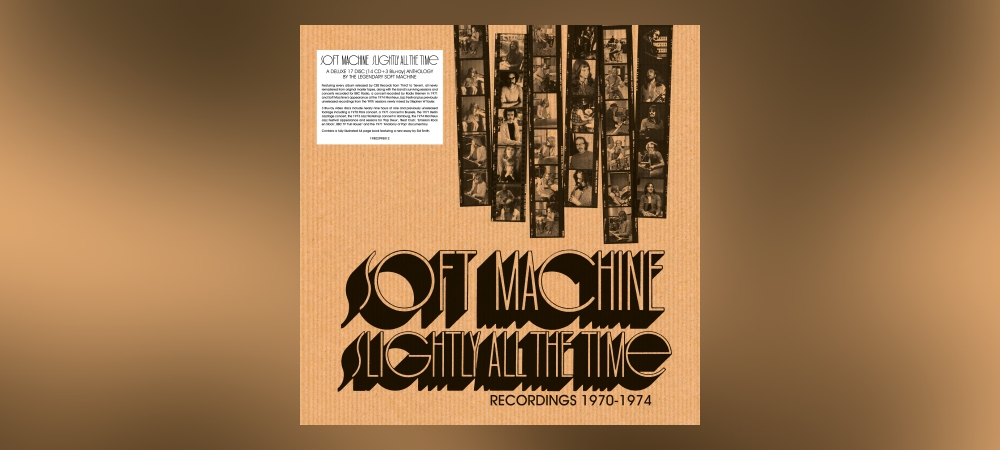
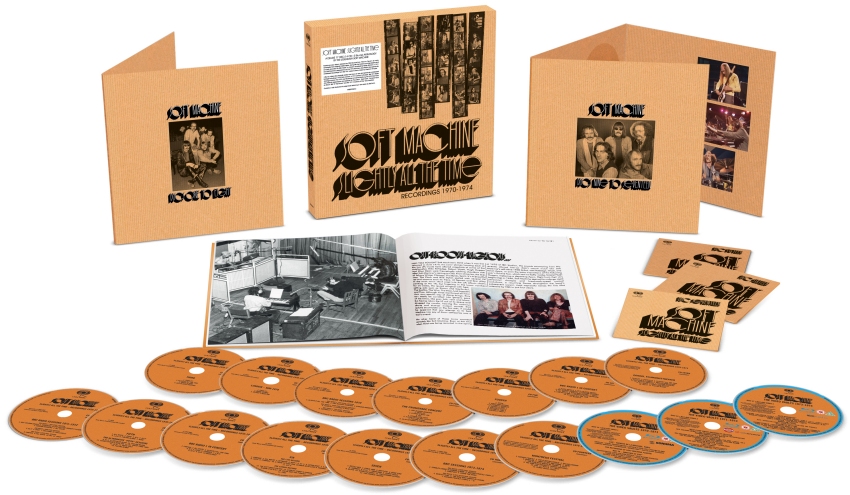
Sony Music now endeavours to bring hungry fans a 17-disc behemoth set of their work; amazingly, these discs don’t even cover the band’s full tenure, only the four-and-a-half-year period between 1970 and 1974 when Soft Machine were signed to CBS Records. While the numerical titles of Soft Machine’s albums would never give anything away as to their content, this period between Third and Seven was easily the most transformational, with no fewer than five line-up changes causing the band’s sound to metamorphose rapidly, much to the dismay of contemporary critics. This box set doesn’t just cover those albums, however, but examines the spaces in between with the help of concert and radio tapes – some of which are previously unreleased – archival performance footage (and other TV spots) and also a weighty booklet containing Sid Smith’s detailed history of this era of the band. More on that later.
The starting place is Third. Three years before Yes were ready to deliver their monumental, controversial opus Tales from Topographic Oceans, Soft Machine had already given the blueprint of what a progressive rock double LP with just four side-long suites could look like. Many years ago, when I was a brand new fan of the genre, I dove into the deep end with Soft Machine by buying Third first. At first, I was thoroughly put off by the experimental tape loops that take up the first five minutes of Facelift, and I wasn’t impressed by what I thought of as ‘straight jazz’ when listening to Slightly All the Time and Out-Bloody-Rageous.
Thankfully, Robert Wyatt’s side – Moon in June – hooked me. The whimsical, comedic lyrics about sex and New York State were something I could latch onto, while the furious 6/8 instrumental maelstrom that followed was completely spellbinding. “Now, why couldn’t the band sound more like that?” I wondered. I’d soon come to learn that Wyatt, one of prog rock’s most inventive and idiosyncratic artists, was wondering the same thing too. While the band’s first two albums had showcased a lot of this psychedelic whimsy (and Moon in June had also dated back to 1968 as well), bassist Hugh Hopper and keyboardist Mike Ratledge were more interested in the instrumental jazz realm and were pushing forward with or without Wyatt.
Fortunately, Wyatt persevered and made a solo recording of the lyrical first half of the song; if you’re listening carefully, it’s quite easy to notice when the other bandmates join, as the musicianship suddenly becomes a lot more skilful. Having enjoyed Moon in June so much, it was only a matter of time before I warmed up to the other three sides. I was further pulled in by the presence of Backwards towards the end of Slightly All the Time; already a fan of Caravan, I recognised the tune immediately from he A Hunting We Shall Go medley. Realising just how tightly interwoven all of the Canterbury Scene stories were at the time was thrilling.
Following Third are three CDs of live recordings from 1970 as the band take the material from their new album for a spin. Two-and-a-half hours of live recordings can feel pretty overwhelming on a binge listen, and because the recordings weren’t clearly demarcated on the Sony Music Promo Portal, I really wasn’t sure what I was listening to at the time.
Soft Machine fans will be aware that the album version of Facelift was actually a Frankensteined edit of two live recordings from January 1970; just like the literary monster, the results are startling, as the cuts between these takes are glaringly obvious, one sounding much louder and more raucous than the other. With this set, I’m grateful to have several intact recordings of Facelift to hear how it actually sounded live. I also appreciate that the band continued to perform Esther’s Nose Job long after they decided to drop lyrics from the legendary suite from Volume Two. Parts of it are still reprised as late as Fifth.
At long last, we make it to Fourth, only the second studio album of the set. With the tension between Wyatt and the other members as high as it was on Third, I remember being shocked to see his face on the cover of Fourth, behind the permanent oblong sunglasses of Mike Ratledge. I tried to wrestle with why he might have stayed despite his singular, extraordinary talents and creativity being overlooked, and the only theory I can come up with was a sincere sense of loyalty to the group he had founded. Like his song, he was dedicated to them, but they weren’t listening.
Although Wyatt had no creative control over Fourth, his skill and precision on the drums make much of the album a delight. The album begins with the rip-roaring Teeth, a busy, densely structured rollercoaster that takes the listener through a plethora of moods in just over nine minutes. It’s easily one of the most ‘prog’ recordings they ever made. Colour footage from the making of the album (produced for French TV) shows just how difficult this mini-suite was to pull together, while also capturing band tensions as Wyatt showboats a loud drum solo as the other three members try to work on the composition. A lot of Soft Machine song names are utterly preposterous, but Teeth perfectly captures this song’s aggression.
Kings and Queens is a soft, melancholic reprieve after the excitement of Teeth, but Fletcher’s Blemish is… a sign of things to come, unfortunately. It’s chaotic, discordant, free improvisation, and it’s annoying to listen to. Fortunately, on the album, it’s only given four minutes to bother you; on one of the BBC Radio sessions from CD3, there’s an ungodly twelve-minute version to truly test your patience. Thank goodness the ‘Skip Track’ button exists, eh?
That just leaves Virtually, the side-long suite that takes up the second half of this album. The first half feels strong, dark and vital, while the final two parts meander once again into free-jazz territory and fail to provide a memorable conclusion to the record. I can only imagine that Wyatt was bored silly having to sit through take after take of this.
Although Fourth was recorded in the Autumn of 1970, Wyatt persevered with the group for almost another year; it’s wild to me that he stayed so much longer given his published statements of how little he enjoyed working with Hopper and Ratledge by this point. This ‘pre-divorce’ period is documented in both audio and video during this time. A German broadcast from March 1971 shows a dejected Wyatt staring at the ground or just about anywhere else besides his bandmates as they crash through cacophonic Neo Caliban Grides. This grating experiment of a track must have been popular with Hopper and Ratledge at the time, as it is featured on each of the three live CDs between Fourth and Fifth, even though it is Fletcher’s Blemish level of time wasting.
Knowing what an incredible talent Wyatt was behind the kit, it’s sad to see him waste so much time being unhappy and squandering his creativity and talent here, especially knowing that it wouldn’t be long before a topple from a Maida Vale window would leave him unable to drum for the rest of his life. Gratifyingly, the band still let him perform some of his vocal improvisations during this set, and it’s fascinating to see the animal side of him come out and perform these based on instinct. In one of the BBC Radio sessions from June 1971, I was frankly astonished to hear him perform Dedicated to You But You Weren’t Listening, apparently solo. The old ‘song’ style is completely at odds with what Soft Machine had been doing by then, and it’s bizarre to hear Wyatt’s lyrics so late in the box set.
By the end of the 8th disc, Wyatt had finally been replaced with Phil Howard, whose brief stint with the group was nonetheless documented on camera at the Berliner Jazztage, where the Softs performed an hour-long set, beginning once again with Neo Caliban Grides; even the name annoys me. While Howard funnels a lot more energy into the group than Wyatt did, he seems to stick out like a sore thumb, rarely looking at the others or changing his rhythm to match the time signature of the song he’s playing. Classics like Out-Bloody-Rageous start to become unrecognisable and unsatisfying by this point. It’s no wonder John Marshall was drafted to replace him in the middle of the sessions for the group’s following album.
Fifth is the nadir of the Softs’ output, in my humble opinion. The black album cover featuring a simple number “5” on the front is rather symbolic of the lack of proper ideas that went into it. I hadn’t listened to this album in years, so I was appreciative of the box set giving me some incentive to reappraise it. Of all the directions Hopper and Ratledge could have taken the group, they chose the worst one by leaning into the ‘free jazz’ angle, with many of the tracks featuring extended periods of dull free improvisation.
The opening All White is so nondescript in its melody that I still cannot recall it after listening to it eight different times. At least Drop is in 7/8 (my favourite time signature) once it gets going. But tracks with more unusual names like M C, L B O and Bone just leave me scratching my head as to what the group are trying to achieve; it feels as if the group just threw ideas together and recorded them without much planning. A late game surprise does come in the form of Pigling Bland, however, which is structured more like a real song and features a neat 7/8 coda that neatly references Esther’s Nose Job.
I was initially disappointed to learn that alternative takes for the Fifth album had been unearthed during the research for this set, as I was not keen on hearing them. But, surprisingly enough, there’s a more vital energy to the performances, and the mixing on them somehow feels less muddy. Howard’s non-stop drumming occasionally feels too busy, but the tracks still feel like an improvement to the album versions. With two more energised As Ifs, two Pigling Bland and a more intact Esther’s Nose Job coda to listen through, I really wish these recordings had constituted the real Fifth, somehow.
With only a limited number of CDs to go, there isn’t as much live material to get through before the following album, only an hour-long BBC Radio 1 in Concert set from July 1972, right alongside Fifth’s release. Karl Jenkins had finally been recruited, following Elton Dean’s departure, and thus would begin a new era for the group. This early set showcases a few numbers that would be featured on Six’s live album, and was recorded just a few months beforehand. While it’s interesting to hear the band still working on the sound of those tunes, the standout track is the leisurely Slightly All the Time, sounding different from how it ever did before. Hugh Hopper introduces the familiar bouncing bass riff so you know what the song is, but rather than head straight into the melody, the band vamp on this for an inordinate amount of time, Ratledge giving one of his signature fuzz organ solos. Just when I think the band are about to move on and play something else, Jenkins finally plays the saxophone melody, relieving the tension that was built up for nearly seven minutes; I was impressed by the execution.
Onto Six, where the band switched from ordinal titles to cardinal; I’ve only just realised that the unsightly front cover with steel pipes penetrating a distended fleshy belly is supposed to represent a literal soft machine. This was also a double vinyl release and featured both a live LP and a studio LP. I was always put off by all the various names of the individual tracks, which I could never remember. Having now listened to more hours of live Soft Machine than I thought I ever would, I understand that the band always played their songs in a medley, and that the two sides of vinyl could essentially be treated as two long suites.
Six was the proving ground for Karl Jenkins, who Sid Smith notes was a prolific writer; songs like the notoriously uneven yet repetitive Riff were the prototype of what Jenkins would bring to the group: memorable repetitive themes, often in odd time signatures that would provide a satisfying base for the other band members to improvise on top of. It was a relatively simple idea, but Jenkins’s ability to come up with so many great little riffs like this would ultimately change the band’s sound forever, taking over what Hopper and Ratledge had started. While some fans argue against what they perceive as a hostile takeover of the group, in my humble opinion, Jenkins saved the group from producing more navel-gazing tedium.
On the studio disc (here presented on the same CD), the group were behaving much more experimentally. The Soft Weed Factor (whose title is a pastiche of John Barth’s 1960 epic historical novel The Sot-Weed Factor) is perhaps the most straightforward, despite stretching to over eleven minutes in length. A work of pure minimalism, the same riff is played the entire way through, with each instrument joining in one-by-one until Marshall’s drum fill signals that the whole band is present. During this section, Marshall is the only band member to play around, making the hypnotic track something of a showcase for the drummer. Although I’m usually drawn to densely structured, complex songs, I’ve found the timbre and predictable nature of this song very soothing since the first time I heard it, and I have found it practical when needing something to listen to while concentrating on work. Ironically, my least favourite part is when Jenkins and Ratledge try to add more to the song; the piercing, sustained notes on the organ and saxophone do not fit the timbre of the piece well and tend to wake me up if I’m using the song to fall asleep. These parts take up such a small part of the track’s runtime, however, that I can usually forgive them.
The minimalism proved to be a one-off experiment. The following Stanley Stamps Gibbon Album (until now, I always thought there was a ‘the’ between ‘Stamps’ and ‘Gibbon’) sees the band in more familiar 7/8 territory, although I’m not so fond of the overexcited gibbon-like main riff that feels overstimulating to listen to. Next, on the album’s fourth side is the exquisite Chloe and the Pirates, which sounds nothing like its name at all. Beginning with spacey sounds, we’re led into a smooth jam that has some pre-composed surprises later down the line. Finally, we have Hugh Hopper’s swansong, the bizarre, macabre, discordant 1983, presumably recorded mostly by himself. The track would act as the precursor to his Orwellian debut album 1984. I personally couldn’t wait for it to be over with.
I was pretty surprised that the following CD was simply Seven; there would be no live music to chart the gap between the two albums this time, or introduce new bassist Roy Babbington slowly. Seven was the group’s final album with CBS and the last in this set, but after having lost their way after Third, Seven finally saw the group back on form again (with a substantially different line-up, of course). Only Ratledge was present from the original group, but he would find less and less space for himself as Jenkins’s role in the group only grew, practically only guesting on 1976’s Softs. I can’t help but feel as if some karma came for Hopper and Ratledge after ignoring Wyatt and dismissing him in 1971; the shoe was firmly on the other foot.
Jenkins’s compositions had evolved somewhat by Seven, and playful, interlocking compositions like Nettle Bed, Day’s Eye and Tarabos showed just how well the riff-based formula could be applied. Some of the experiments with dissonant freeness still appear, but are in more bite-sized two-minute form like on D.I.S., and are vastly scaled down. The sedate Penny Hitch is a clear throwback to The Soft Weed Factor but, with changing chords, keys and more soloing, no longer seems true to the spirit of minimalism.
The fun doesn’t stop here, though, as two more live CDs round out the set. A BBC session from November 1973 reveals that Jenkins had debuted Hazard Profile (using a riff he had written during his Nucleus days as Song for the Bearded Lady) before the arrival of their illustrious new guitarist Allan Holdsworth, who would join their ranks a month later. This early version has a similar introduction with ringing bells, but not as much immediacy, with an unfamiliar floating keyboard pattern to accompany the buzz roll performed by Marshall. With no guitarist present, the synthesiser solo has very little of Holdsworth’s power or soul to it, but makes for a fascinating placeholder.
The listener is rewarded for their efforts: after making your way through thirteen and a half CDs, Allan Holdsworth comes to the rescue in the latter half of the thirteenth disc. I wasn’t sure we’d hear him at all, but this set contains two different versions of the full Hazard Profile suite with Holdsworth fully engaged. The Jenkins-led Soft Machine seemed fully aware that Hazard Profile was their magnum opus and didn’t skimp on playing it anywhere they were invited. The final CD includes their legendary performance at the Montreux Jazz Festival in July 1974, which is also included in video form on the final Blu-ray. If you can look past the very 70s TV camera quality and the dated outfits and signs, it’s a visual smorgasbord of excellent musicianship. Watching Holdsworth at work is such a treat, but Marshall hammering at his hanging wall of metal knick-knacks is also a surprise. What a way to close this box set.
Sid Smith is a veteran of the prog journalism scene; it’s doubtless you’ve already read many pages of his work. But I suspect that he also considered penning the liner notes to this comprehensive box set to be a task as challenging as climbing Mount Everest. With so many line-up changes in such a short period of time, and so many albums and live performances to cover, Sid Smith essentially had to write about a soap opera and a series of broad musical style changes simultaneously, charting both the movements and emotions of the group at the time.
I have to say, Smith has done a better job than I could have even imagined. While some of the story beats of Soft Machine’s twisting tale were familiar to me before, I appreciate Smith pulling relevant quotes from a variety of sources (including interviews with the band himself) to show the veracity of his work. Some of these sources, including a letter from Robert Wyatt to Ian MacDonald (a music critic, not to be confused with the King Crimson musician Ian McDonald), were brought to light as recently as this decade, making this essay much more than a reheated rehash of previously available scribblings. The statements made by band members – which occasionally contradict each other – are woven into a flowing narrative that is fascinating to work through and understand. Smith’s essay is also considerate enough to follow departing band members into their following projects such as Wyatt’s short-lived Matching Mole and Hopper’s debut solo album, giving the band’s story more vital context while keeping the tangents concise enough not to be overwhelming.
Unfortunately, the quality of the essay takes a nosedive whenever Smith gets to one of the five albums along the way and attempts to describe the music. The sharp, observant commentary about the state of the band turns into a whimsical, hyperbolic pastiche of vague, evocative adjectives that gives a façade of deep musical understanding without communicating that much to the reader about what is actually meant. I wonder how many readers will fully comprehend the following sentence: “Manifesting in the timbral gloom, harried ghost-notes arc into the cloistered space.” I don’t doubt that Smith knows his stuff; I just think he gets a bit carried away with his descriptions. I also get the impression that he feels duty-bound to say something nice about every album, even though no fan could possibly like them all to the same degree, as he seems to suggest he does. With no suggestion that he prefers any of the albums over the other in his words, the complimentary tone at times seems ingenuine.
The rest of the booklet is exquisitely laid out with plenty of band photos, press clippings and scans of the original master packaging. I chuckled at the pictures of the Six-era incarnation of Soft Machine, as it seemed as if Hopper and Ratledge had recruited doppelgängers; in shades with his handlebar moustache, Jenkins is a close look-alike for Ratledge while the fuzzy-haired, bespectacled Hopper and Marshall look like brothers. At the front of the booklet is an extremely handy Soft Machine personnel guide for the years 1969-1975, with arrows pointing to which album they worked on, and what months they were together; it’s a reference so useful that I’ve glanced at it countless times while writing this review. And last, but not least, I’m very happy to report that all five album covers (outer gatefolds, inner gatefolds and all) are fully rendered in large size in the booklet – each one afforded a double spread – so that you can admire the artwork and peruse the track listing and personnel list the old-fashioned way. As a stickler for full album art recreation, I’m very satisfied.
Having avidly collected Soft Machine’s albums long ago, I had considered myself fairly knowledgeable about the group. Since the band never recorded any live albums during this period, however, I was completely unaware of how the group performed and behaved live. With so many hours of audio and visual material available, I was much more connected to the band’s real story than before; the albums themselves only signal the band’s swiftly changing musical directions, while the live performances evidence how well the various line-ups clicked as a unit. This comprehensive set seems to leave no stone unturned in bringing as much documented material as it can to the buyer; if it’s sometimes overwhelming, I’m still glad the compilers put it in anyway.
As a musical journey, it’s also fascinating to follow. I remarked when covering Renaissance’s Opening Out (1977-1979) box set that it was interesting to have a box set dedicated to the steady decline of musical quality. Soft Machine’s case is even rarer; over the five included albums, the quality of the music appears more like a valley, starting out brilliantly with Third, and reaching a huge low with Fifth before miraculously almost getting back to where they were with Seven. It’s a shame that the set doesn’t include Bundles, which could easily be argued as Soft Machine’s finest album, but the abundance of performances from the Allan Holdsworth era are the next best thing. With so many personnel changes in such a short period of time, the CBS era of Soft Machine was easily their most complicated period to follow; this exhaustive box set is the best roadmap to that time that a fan could dream of.
TRACK LISTING
CD1
Third – Released in June 1970
01. Facelift (18:45)
02. Slightly All the Time (18:11)
03. Moon in June (19:05)
04. Out-Bloody-Rageous (19:11)
Time – 75:12
CD2
London – May 1970
01. Facelift (19:08)
02. Moon in June (7:38)
03. Esther’s Nose Job (13:03)
Time – 39:49
CD3
– BBC Radio Sessions 1970 (19:18)
01. Slightly All the Time
02. Out-Bloody-Rageous
03. Eamonn Andrews
– BBC Radio 1 “In Concert” – 31st May 1970 (31:59)
04. Facelift
05. Esther’s Nose Job
– BBC Radio 1 Session – 15th December 1970
06. Virtually (9:57)
07. Fletcher’s Blemish (12:13)
Time – 73:27
CD4
The Promenade Concert
Royal Albert Hall 13th August 1970
Recorded and broadcast by BBC Radio Three
01. Out-Bloody-Rageous (11:54)
02. Facelift (11:24)
03. Esther’s Nose Job (15:27)
Time – 38:45
CD5
Fourth – Released in February 1971
01. Teeth (9:13)
02. Kings and Queens (5:01)
03. Fletcher’s Blemish (4:37)
04. Virtually Part 1 (5:15)
05. Virtually Part 2 (7:04)
06. Virtually Part 3 (4:32)
07. Virtually Part 4 (3:22)
Time – 39:04
CD6
BBC Radio 1 In Concert 11th March 1971
01. Blind Badger (11:13)
02. Neo Caliban Grides (5:42)
03. Out-Bloody-Rageous/Eamonn Andrews/All White/Kings and Queens/Teeth/Esther’s Nose Job (32:01)
04. Slightly All the Time/Noisette (6:01)
Time – 54:57
CD7
Gondel Filmkunsttheater, Bremen, Germany
23rd March 1971
Radio Bremen concert
License from Radio Bremen / Studio Hamburg – OneGate Media
01. Facelift (10:33)
02. Virtually (8:38)
03. Slightly All the Time (8:45)
04. Fletcher’s Blemish (6:07)
05. Neo-Caliban Grides (9:49)
06. Out-Bloody-Rageous (9:36)
07. Eamonn Andrews (5:27)
08. All White (3:26)
09. Kings and Queens (4:05)
10. Teeth (9:24)
11. Pigling Bland (4:48)
Time – 80:38
CD8
BBC Radio sessions 1971
BBC Radio 1 Session – 1st June 1971
01. Neo-Caliban Grides (7:34)
02. Dedicated to You But You Weren’t Listening (2:46)
03. Eamonn Andrews / All White (7:11)
– BBC Radio 1 Session – 15th November 1971
04. As If (7:47)
05. Drop (6:58)
06. Welcome to Frillsville (10:36)
– BBC Radio 1 Session – 11th July 1972
07. Fanfare/All White/M C/Drop (11:14)
Time – 54:06
CD9
Fifth – Released in July 1972
01. All White (6:02)
02. Drop (7:46)
03. M C (4:56)
04. As If (8:01)
05. L B O (1:53)
06. Pigling Bland (4:21)
07. Bone (3:30)
~ Bonus tracks:
– The Alternative Fifth Sessions
08. As If (7:23)
09. Untitled Blow (4:08)
10. Pigling Bland (3:48)
11. (coda) Esther’s Nose Job (1:18)
12. All White (Take Two) (7:13)
13. As If (7:46)
14. Drum Solo (1:59)
15. Pigling Bland (4:54)
Time – 74:58
CD10
BBC Radio 1 In Concert – 20 July 1972
01. Fanfare (2:47)
02. All White (6:05)
03. Slightly All the Time (12:23)
04. M C (4:04)
05. Drop (5:35)
06. Stumble (8:04)
07. L B O (3:16)
08. As If (4:43)
09. Riff (7:56)
10. Gesolreut (6:54)
Time – 71:47
CD11
Six – Released in February 1973
– The live record:
01. Fanfare (0:43)
02. All White (4:49)
03. Between (2:24)
04. Riff I (4:33)
05. 37 ½ (6:53)
06. Gesolreut (6:16)
07. E.P.V. (2:47)
08. Lefty (5:02)
09. Stumble (1:36)
10. 5 from 13 (for Phil Seamen with Love & Thanks) (5:14)
11. Riff II (1:28)
– The studio record:
12. The Soft Weed Factor (11:20)
13. Stanley Stamps Gibbon Album (for B.O.) (6:00)
14. Chloe and the Pirates (9:32)
15. 1983 (7:56)
Time – 76:33
CD12
Seven – Released in October 1973
01. Nettle Bed (4:51)
02. Carol Ann (3:44)
03. Day’s Eye (5:03)
04. Bone Fire (0:36)
05. Tarabos (4:27)
06. D.I.S. (3:04)
07. Snodland (1:51)
08. Penny Hitch (6:38)
09. Block (4:18)
10. Down the Road (5:44)
11. The German Lesson (1:51)
12. The French Lesson (1:04)
Time – 43:11
CD13
BBC Sessions 1973 – 1974
BBC Radio 1 John Peel session – 20th November 1973
01. Stanley Stamps Gibbon Album (3:41)
02. Hazard Profile (Part 1) (4:58)
03. Sinepost (1:46)
04. Down the Road (7:39)
– BBC Radio 3 Jazz in Britain Session – 26th August 1974
05. North Point (3:00)
06. The Man Who Waved at Trains (5:41)
07. Hazard Profile (Parts 1 – 4) (16:56)
Time – 43:41
CD14
Montreux Festival – 4th July 1974
01. Hazard Profile (16:46)
02. The Floating World (5:15)
03. Ealing Comedy (4:14)
04. Bundles (3:09)
05. Land of the Bag Snake (4:27)
06. Joint (2:20)
07. The Man Who Waved at Trains (3:01)
08. Peff (4:28)
09. The Man Who Waved at Trains (reprise) (0:21)
10. LBO (4:45)
11. Riff II (3:08)
12. Lefty (2:07)
13. Penny Hitch (coda) (5:38)
Time – 59:39
Total Time – 13:35:47
DISC 15 Blu-ray video
The Video Vaults 1970 – 1971
– Théâtre de la Musique, Paris – 2nd March 1970
Recorded for French television – LICENSED FROM INA FRANCE
01. Eamonn Andrews
02. Backwards
03. Mousetrap
04. Out-Bloody-Rageous
05. Facelift
06. Vocal improvisation
07. Esther’s Nose Job / Pigling Bland
– Pop Deux 12th December 1970
The Recording of Soft Machine Fourth – LICENSED FROM INA
BBC TV – Anatomy of Pop – 10th January 1971
01. Neo-Caliban Grides
– Theatre 140, Brussels 14th January 1971
Filmed for “Pop Shop” – Belgian TV – LICENSED FROM SONUMA BELGIUM
01. Improvisation
02. Neo-Caliban Grides
03. Out-Bloody-Rageous
04. Kings and Queens
05. Teeth
06. Pigling Bland
07. Esther’s Nose Job (excerpt)
08. ….It’s Nothing
09. Mousetrap
10. Noisette
DISC 16 – Blu-ray video
The Video Vaults 1971 – 1973
– ‘Beat Club’ Radio Bremen TV Session – 23rd March 1971
Licensed from Radio Bremen / Studio Hamburg – OneGate Media
01. Neo-Caliban Grides
02. Out-Bloody-Rageous
03. Vocal improvisation
04. Eamonn Andrews / All White
– Berliner Jazztage Philharmonichalle, West Berlin – 7th November 1971
Licensed from ARDPLus GmbH
01. Neo Caliban Grides
02. Slightly All The Time
03. Drop
04. M C
05. Out-Bloody-Rageous
06. As If
07. Dark Swing
08. Pigling Bland
09. Esther’s Nose Job (Outro)
Filmed 5th November 1972 at CBS Studios, London
for “Emission Rockenstock”
Broadcast 30th January 1973 on ORTF French Television
Licensed from INA
01. The Soft Weed Factor
02. LBO
03. Gesolreut
BBC TV – FULL HOUSE– 17th February 1973
– Soft Machine interviews and the band perform
01. Gesolreut
02. Fanfare / All White
DISC 17 – Blu-ray video
– The Video Vaults 1973 – 1974
Soft Machine & Friends ‘Jazz Workshop’
Congresszentrum, Hamburg, Germany on May 17, 1973
Licensed from Radio Bremen / Studio Hamburg – OneGate Media
01. Fanfare
02. All White
03. Link 1
04. The Soft Weed Factor
05. Link 2
06. 37 ½
07. Link 3
08. Riff
09. Stanley Stamps Gibbon Album
10. Chloe and the Pirates
11. Gesolreut
12. E.P.V.
13. Link 4
14. Stumble
15. One Across
16. Riff II
– Bataclan, Paris
29th May 1973
Broadcast on “Pop Deux” – French TV 30th June 1973
Licensed from INA
01. Riff / Down The Road
02. Gesolreut / Chloe And The Pirates
– Montreux Jazz Festival – 4th July 1974
Licensed from Universal Music Operations
01. Hazard Profile
02. The Floating World
03. Ealing Comedy
04. Bundles
05. Land of the Bag Snake
06. Joint
07. The Man Who Waved at Trains
08. Peff
09. The Man Who Waved at Trains (reprise)
10. LBO
11. Riff II
12. Lefty
13. Penny Hitch (coda)
MUSICIANS
Mike Ratledge – Organ, Piano, Electric Piano, Synthesiser, Grand Piano, Celeste, Fender Rhodes Piano
Hugh Hopper – Bass, Bass Guitar, Sound Effects [CDs 1-11]
Robert Wyatt – Drums, Vocals [CDs 1-8]
Elton Dean – Alto Sax, Saxello, Electric Piano, Alto Saxophone [CDs 1-9]
Karl Jenkins – Electric Piano, Saxophone, Oboe, Baritone & Soprano Saxophones, Grand Piano, Celeste, Synthesiser, Recorder, Fender Rhodes Piano, Piano, Hohner Planet [CDs 8-14]
Roy Babbington – Double Bass, Bass Guitar, Acoustic Bass, 6-String Bass [CDs 5, 6, 9, 12-14]
Phil Howard – Drums [CDs 6, 8, 9]
John Marshall – Drums, Percussion [CDs 8-14]
Allan Holdsworth – Guitar, Voice [CDs 13, 14]
~ With:
Rab Spall – Violin [CD 1]
Lyn Dobson – Flute, Soprano Sax [CD 1]
Nick Evans – Trombone [CDs 1, 5]
Jimmy Hastings – Flute, Bass Clarinet, Alto Flute [CDs 1, 5]
Mark Charig – Cornet [CDs 5, 6]
Alan Skidmore – Tenor Sax [CD 5]
Neville Whitehead – Bass [CD 6]
Paul Nieman – Trombone [CD 6]
Ronnie Scott – Tenor Saxophone [CD 6]
ADDITIONAL INFO
Record Label: Sony Music
Catalogue#: 19802998812
Country of Origin: UK
Date of Release: 30th October 2026
LINKS
Soft Machine – Website | Facebook | Boxset Info at Burning Shed | YouTube