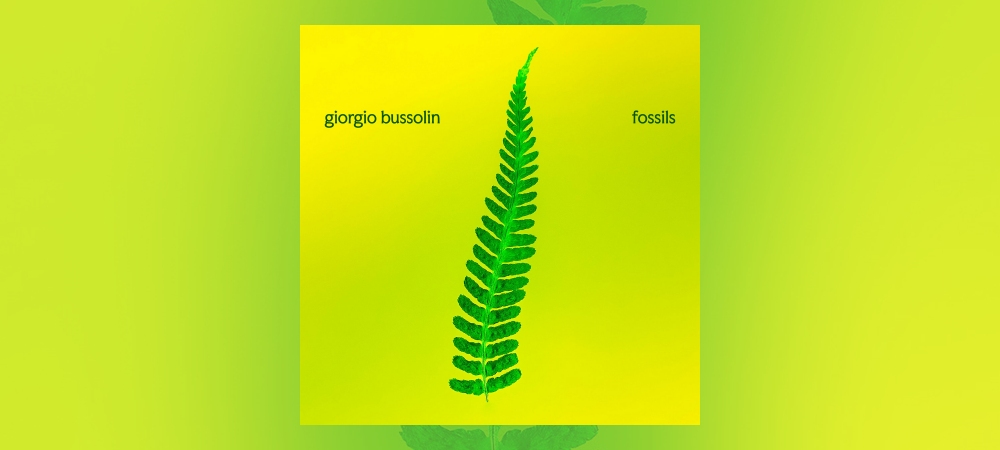
Listen. Listen carefully. Somewhere beneath your feet, a voice waits patiently to be heard.
Three hundred million years it has waited, give or take, pressed between layers of shale: the imprint of a frond, every vein intact, a leaf which fell into a swamp long before the first flower opened. Every minute detail is perfectly preserved. Nobody watched it fall. No one was alive to watch it fall. Now, in the 21st century, an Italian pianist remembers the illustrated books of prehistory he pored over as a boy, and gives the leaf a song.
Fossils is Giorgio Bussolin’s musical archaeology. Ten tracks, ten fossil plants, each named with a botanist’s precision: Alethopteris Pteroides, Glossopteris Indica, Sigillaria Alternans to name just three, every one a plant whose descendants, changed almost beyond recognition, still share the earth with us. By the close of the opening track, the leaf speaks in its own words: “I am the ghost in every seam, / the fossil voice beneath your feet.”
I believe it. After listening to this album, you will, too.
Bussolin is a pianist and organist by training. He spent a year in his studio writing, arranging, programming, and mixing; playing pianos, organs, keyboards, acoustic guitars, and small percussion himself; and shaping everything else from virtual instruments and samples with a craftsman’s patience. Fossils is his first venture into writing for voice, in English, his second language, and his lyrics draw on a deep classical schooling in metre and rhyme. His wife, opera singer Cristiana Bertoldo, lends a second voice, at first a ghost at the edge of the mix, later becoming something far more.
The palette is vast. A single echoed acoustic arpeggio. Rippling piano. Sweeping strings, flute, a saxophone which dances wherever the wind takes it. Crunching guitars and pounding drums. Massed choirs, and at one astonishing moment, monks. Over it all sits Bussolin’s own voice: gravelly, weathered, carrying the seriousness and wistfulness of long experience. It conveys whispers which speak of the age of the world.
Beneath the palaeobotanical structure lies a thoroughly progressive record: layered, theatrical, formally adventurous, and unafraid to move from intimate acoustic writing to full-scale rock explosiveness.
He tells the story through three voices. The plant speaks first, of growth, catastrophe and the long night of the stone. Then comes the scholar, who digs up the remains and names them. Behind both stands the composer, searching their tenacity for a hope of rebirth. Across the ten tracks, the plant’s “I” slowly gives way, until the final song belongs to a “we”. It hits you quite suddenly: the “we” is us.
I found I couldn’t listen to Fossils in a single sitting. Each track needed to be taken alone, held up to the light like a specimen from a collection, turned and studied. Hurry, and the album closes like a drawer before you have seen what lies inside.
The music closely reflects its own words. In Alethopteris Pteroides, the leaf recalls air “thick with dragonflies”, and voice and saxophone rise to meet the line, crossing and weaving like wings over a Carboniferous swamp. When the leaf calls itself “a breath of stone, a silent chord”, a choir answers with a wordless hum, ancient and communal, rising from somewhere beneath the forest floor. Again and again on Fossils, sound becomes the thing it describes. It’s quite brilliant.
Glossopteris Indica, the album’s heart, also carries its darkest lyric. Glossopteris fossils, scattered across every southern continent, helped prove the continents had moved, and the song opens with the earth itself in motion: crunching guitar, a thunderous, insistent drum, plate grinding against plate. Then serenity, and the voice. The plant tells of its own erasure, a name dissolving “in fault and flame”, and the lines begin to break apart as it sings. “No leaf returned.” “I passed unseen.” “I fell through time.”
Midway, the guitar falls silent and the forest breathes. Animal calls drift on the wind. Out of the stillness rises the female voice, singing of the wind forgetting the plant’s name while her own voice rides upon the wind. The wind forgets. She remembers. Later the two voices sing as one, the same words from two throats, until she breaks free in a melodic scream of devastating force. The guitar takes up her cry, intricate, jittery, insistent, and carries it into the fade.
The refrain grieves: “No forest sings my elegy.” The song answers its own lament simply by existing. Bussolin sings the elegy himself.
Listening, I feel like a time traveller, setting foot in a world at once familiar and unspoiled, yet agonisingly gone. I want to cry. The fossils beneath our feet hold memories of the place itself. A stranger can walk on it, and in the process, into it, and feel it as their own. Fossils hold such memories in a loving caress. Bussolin’s music opens the door and lets us in.
Annularia Stellata struts on grumbling, exaggerated strings, proud and loud, a plant boasting of its perfect symmetry with all the swagger of Ozymandias. We hear it knowing what came next. And yet the giant horsetail’s humble descendants still crowd our ditches. Modesty, it turns out, survives. Sphenopteris Elegans lets in air and light, a folk-tinged breathing space. In Sagenopteris Phillipsii, frantic, discordant piano finds its footing in a soaring guitar, as a Jurassic plant reaches, “before a single flower met the sky”, towards a future it would never see. Callipteridium Pteridium hovers, flute over rippling piano, a waltz moving upon the face of the deep, singing of the fossil as a negative: a shape held by absence, a frame around a silent dream. The dance wears itself out. Everything fades.
Then comes Macroneuropteris Scheuchzeri, and with it the album’s turn.
A river ripples beneath the piano. The melody is sublime, mournful and unhurried. The plant stands “tall and bright”, the saxophone floats, a languid drum arrives, and for a while everything feels like a dream of perfection. Clouds gather. The plant has become coal, drained and devoured, and I braced for anger. What came was larger and gentler: a calm beyond resentment. “We will rise,” the chorus promises, “reclaiming all our lands.” The saxophone returns, soaring, revelling in existence. Everything which once was. Glorious. Astounding.
Nature finds its own way; it always does. The Preacher of Ecclesiastes knew long ago we are here only briefly: our time will come, but the earth will outlive us. With a faltering serenity, Macroneuropteris sings the same message. Hope shifts: it belongs to the earth now. Thank goodness.
Sigillaria Alternans gathers everything up. It opens with inquisitive, staccato synth echoing in the dark, then explodes into a wall of guitar, drums and keyboards, the guitar dominant, as if it has kept quiet too long and will be heard. The storm recedes into a murmuring pulse, and monks begin to chant. Solemn, prayerful, unbearably moving. The female voice joins them, then leads them, her line calling through the darkness like whales across an ocean. I had no idea what they were singing, and I desperately wanted to know. The lyric sheet answers in Latin: Folia per lucem aevi transibit et in saxo fatum mortalium notabit. The leaves will pass through the light of the ages, and mark in stone the fate of mortals. A fitting epitaph for the memory of humanity.
The chant turns the album on its head. For an hour we have been reading the stone. Now the stone reads us.
Sigillaria was a giant of the coal forests, and coal is ancient sunlight. After the chant, silence falls, then a rippling piano rising like the sun, then guitar and drums bursting into a symphony of growth and the will to live. Everything here. Now. Thriving. So alive. Three hundred million years of stored light, released at last: the same fire now warming our world beyond bearing. A broken world. A living world. Both can be true. We have to learn to hold them together. At least, while we are here.
Syringodendron Complanatum shows the cost. The name belongs to the same tree, stripped of its bark, and here the human voice arrives, spoken almost as rap over a tribal rhythm and a breathy, eastern flute: the palaeobotanist scrapes at the stony crust, then all of us greedily pile in, breaking “the stone’s own heart” and tearing out the treasure. The plants sang. We talk and we grasp. It is an odd, unsettling track, something of life and death unfolding just out of sight, and the discomfort feels right. Every other catastrophe on Fossils keeps its geological distance. This one turns to face us, listening.
Which is why Pecopteris Polymorpha lands as poignantly as it does. A gorgeously sweeping orchestral opening promises a cinematic finale, but stops short. The acoustic guitar returns, gentle, inviting us to set down our weary load. “Every heavy weight we carried / becomes a new map for our steps.” The chorus is an embrace, a fond hug of hope, moving towards “ageless daylight”. My listening notes at this point read like a plea. Please, please, tell me everything will be ok.
We have the power to destroy everything. Even so, in the end we will be the next fossils in the ground, waiting for whoever or whatever comes next to dig us up. It’s a strange comfort, and one I find quite beautiful. Our insignificance, celebrated for what it truly is. We are one part of a larger whole. Fossils asks us to learn it, to appreciate it, to savour it.
A confession on which to end. When the press release arrived, an album about ten fossil plants struck me as a bit wacky. I was dismissive, even a little caustic. Out of curiosity, I played one track and the sound took up residence in my imagination, refusing to leave. Now Fossils is quite possibly my album of the year.
Old, so old, yet never far away. Hidden in plain sight, beneath our feet. It is our world. It was our world. There is only one.
TRACK LISTING
01. Alethopteris Pteroides (4:19)
02. Glossopteris Indica (7:08)
03. Annularia Stellata (4:31)
04. Sphenopteris Elegans (4:56)
05. Sagenopteris Phillipsii (5:32)
06. Callipteridium Pteridium (5:49)
07. Macroneuropteris Scheuchzeri (4:32)
08. Sigillaria Alternans (7:55)
09. Syringodendron Complanatum (4:20)
10. Pecopteris Polymorpha (5:46)
Total Time – 54:50
MUSICIANS
Giorgio Bussolin – Vocals, Pianos, Organs, Keyboards, Acoustic Guitars, Small Percussions, Programming and Sound Design
Cristiana Bertoldo – Vocals
ADDITIONAL INFO
Record Label: Independent
Country of Origin: Italy
Date of Release: 25th August 2026
LINKS
Giorgio Bussolin – Website | Facebook | Bandcamp | YouTube