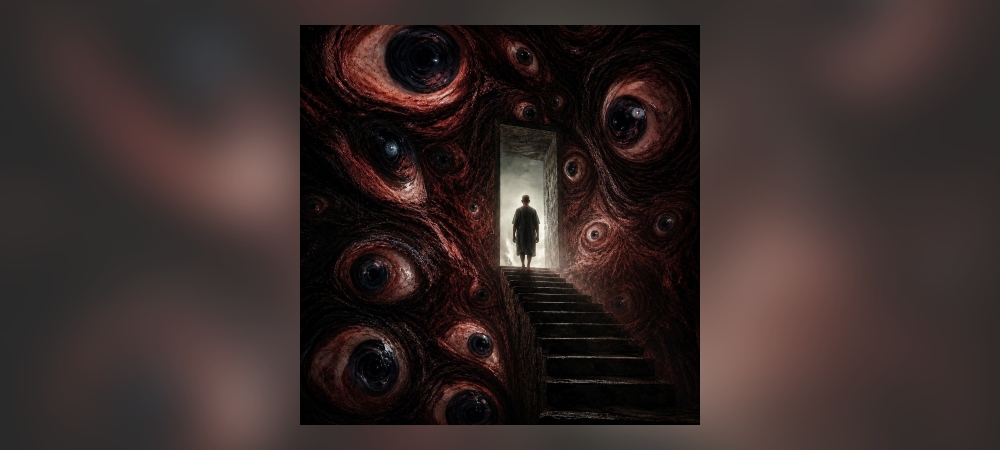
I must confess I was not familiar with Sonus Umbra prior to this release. Nevertheless, when their latest album, Liminality appeared in the TPA review pipeline, I decided to take a chance on it. For those, like myself, who are new to the band, here is a brief introduction.
Originally from Mexico and now based in Chicago, the band have been making music for more than three decades. In that time, and perhaps not surprisingly they have undergone various line-up changes, and Liminality is their ninth album.
The circumstances behind this album’s creation is uniquely tied to founding member and bassist Luis Nasser’s recent life-threatening health struggles. Nasser developed a brain tumour which required surgery to remove. Thankfully, he made a full recovery. It was his experiences during this period that became the foundation of the album:
“‘My brain became an antenna’, Nasser writes, and he scribbled what it received onto hospital napkins as fast as he could, before it faded like the memory of a dream. He walked out of the hospital with a stack of napkins, no story, and a covenant he had no idea how to honor.
The clarity came later, on a night walk through Parque España in Mexico City, in conversation with Rosa María Sánchez García, to whom the album is dedicated. She listened to the ICU story and gave it back to him in the form of a mirror. What had been an alien language became an image he could see and use: two chapters, seven pieces, one passage through the threshold.”
As indicated, the album is divided into two chapters. The first Truce With My Shadow consists of four tracks bookended by Electronic Death Music parts one and two, the second chapter Liminality consists of three tracks. The songs range in length from just over five minutes to a little more than nine.
It is clear that Nasser was eventually able to bring order to the thoughts he recorded during his recovery, as these compositions are excellent examples of pacing, structure and storytelling. What continues to amaze me, even after a forty-year career in mental health, is the brain’s remarkable capacity to overcome trauma while still finding ways to create. This album reinforces that belief, demonstrating how creativity can become both a coping mechanism and a powerful motivation to survive and move forward.
The opening track begins with familiar ICU soundscapes: beeping monitors and breathing machines that immediately establish the album’s setting. These sounds strengthen the notion that, even during critical illness, a person’s sense of hearing remains active. Supporting the medical ambience is Luis’ compelling, throbbing bass line reminiscent of a heartbeat. Gradually, guitars and vocals enter the mix, delivering thoughtful and reflective lyrics. A wonderful saxophone solo, courtesy of Steve Katsikas, emerges midway through the track before giving way to an equally impressive flute passage from Steve Royce, and resulting in a well paced and engaging introduction.
The next two songs are similarly well-constructed, with heartfelt lyrics that appear to reflect Luis’ struggle for life and recovery. The first chapter concludes with Electronic Death Music Part II (Phantasmagoria), an instrumental piece in which the tempo increases noticeably. Once again, a throbbing bass line provides the foundation while the flute weaves gracefully across the top.
Chapter Two closes the album with three excellent progressive rock compositions. The lyrics remain deeply personal and emotionally resonant, continuing to chart Luis’s journey through illness, recovery and reflection.
All three tracks are of a high standard, but for me, Pain Is Beauty stands out as the chapter’s defining moment.
This is unquestionably an album documenting a profoundly personal journey, yet there is much here with which listeners can connect. Thoughtful lyrics are supported by excellent musicianship throughout. The album highlights Sonus Umbra’s compositional skills and suggests that music itself may have been a significant driving force behind Luis’ recovery.
Liminality is a quality release that rewards repeated listening. With each play, new details emerge and its emotional depth becomes more apparent. I believe this album will appeal to a wide progressive rock audience, and it certainly deserves to be heard.
TRACK LISTING
– Chapter 1: Truce With My Shadow
01. Electronic Death Music – Part 1 [The Night I Died] (7:55)
02. Patient Spider (8:15)
03. Rubicon or Lethe (6:05)
04. Electronic Death Music – Part 2 [Phantasmagoria] (9:00)
– Chapter 2 Liminality
05. Uniquely Human – Part 1 (9:10)
06. Pain is Beauty – Part 2 (5:37)
07. A Hole in a Hole – Part 3 (6:57)
Total Time – 53:05
MUSICIANS
Steve Katsikas – Lead Vocals, Keyboards, Saxophone
Luis Nasser – Bass, Sound Design
Tim McCaskey – Acoustic & Electric Guitars
Rich Poston – Electric & Acoustic Guitars
Thor Bremer – Drums, Percussion
Steve Royce – Flute, Vocals
David Keller – Cello
ADDITIONAL INFO
Record Label: ProgRock.com Essentials
Country of Origin: US
Date of Release: 9th October 2026
LINKS
Sonus Umbra – Website | Facebook | Bandcamp | YouTube | X | Instagram https://www.youtube.com/playlist?list=PLMJUOFfWayxXkklWgnXfgtm9QIKdsVFvd