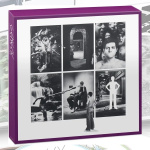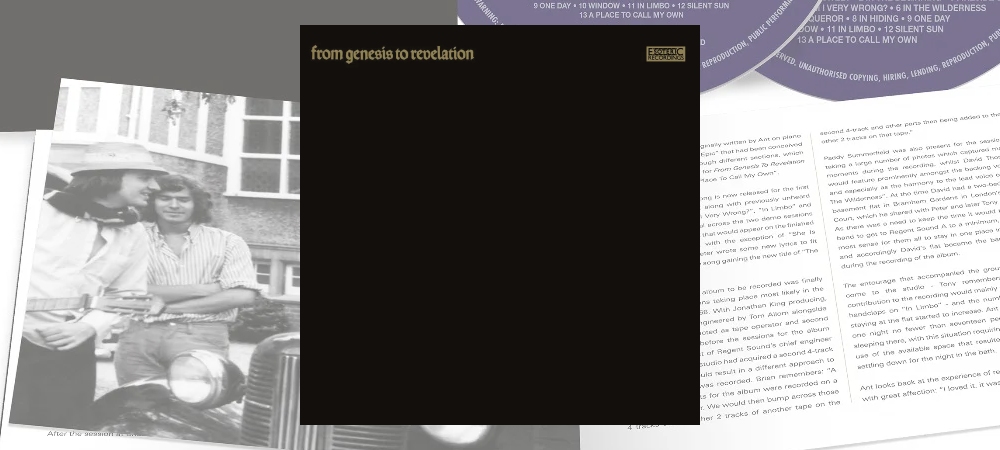
Genesis need no introduction as one of the most famous and successful rock bands ever. However, their introduction to the music world was always rather an obscure curiosity. Many consider 1970’s Trespass to be their ‘real’ first album, with little thought given to their often-forgotten or ignored 1969 debut album. Released under the auspices of pop guru (and later disgraced) Jonathan King on Decca records, this album had the title From Genesis to Revelation but not even a clearly defined band name on the cover. It virtually sank without trace, only selling about 600 copies. Of course, later superstardom for Genesis generated more retrospective interest in this inauspicious debut, and Jonathan King periodically re-released versions to exploit their later fame as much as possible. Cherry Red Records, that well-known and trustworthy curator label of heritage albums, now has the rights to distribute this album and, alongside the more recent discovery of some of the lost master tapes, this has enabled From Genesis to Revelation’ to be curated, remixed and re-released with the usual attention to detail and respectful care for which Cherry Red have become renowned.
To put this album into context, Genesis consisted of teenaged schoolboys from Charterhouse, an exclusive English public school in Surrey. This was well before the days of the arrival of guitarist Steve Hackett and drummer (and future unlikely superstar) Phil Collins for Nursery Cryme in 1971. This was a group of young men still studying at school with dreams of being songwriters and musicians. Formed in 1967 from two short-lived school bands ‘Anon’ and ‘The Garden Wall’, this embryonic form of Genesis recorded some primitive demos and when Jonathan King returned to his old school on ‘Old Carthusian Day’ one of their friends thrust a cassette with the demos into his hands. King heard enough in the songs, particularly Peter Gabriel’s singing, to offer them a demo recording for four songs. This impressed him enough to release two singles with The Silent Sun and A Winter’s Tale, coming out in early 1968. King added strings to these early singles, but despite showing some of the band’s early promise, neither were successful. Undaunted King suggested that they record an album and change their drummer – John Silver was recruited. Early suggestions for a band name included ‘Gabriel’s Angels’, ‘The Champagne Meadow’ and ‘The Coloured Mind’ but they could not agree on a name, so it was King who decided to call them ‘Genesis’.
King produced the album recordings in August 1968 during their holidays, whereupon in September they had to return to their studies at school and University. In their absence King added further strings and horns to their recordings. Such adornments to rock albums were somewhat in vogue, following in the footsteps of The Moody Blues unexpectedly successful 1967 album Days of Future Passed, since regarded by some as the first ‘Prog’ album. From Genesis to Revelation was released in March 1969 but made very little impact. Packaging the album in a totally black cover (a misguided attempt to mirror The White Album by The Beatles) with only the title and no band name did not exactly help raise its profile, with some shops assuming it was a religious album! The lack of success led to John Silver leaving the band and the band informing Jonathan King that they had split up, thereby ending their relationship with him. In hindsight it was perhaps fortunate that this under-developed debut album by young and very inexperienced artists did not remotely succeed. If there had been very early success it may have led them to remaining in the orbit of Jonathan King with his eye very much on commercial influences, which may have stunted their subsequent experimentation and imaginative approach to creating music.
Like many fans of Genesis from the mid to late 70’s onwards I remember working my way through all the back catalogue of the earlier Genesis albums issued before I discovered them. It was a wonderful voyage of musical discovery uncovering the delights of earlier albums such as Foxtrot, The Lamb Lies Down on Broadway and Trick of the Tail amongst other great albums. Their second album Trespass intrigued me in particular with its other worldly, pastoral fantasy feeling… and then the adrenalin-rush of The Knife. However, I do recall fellow fans of the band stating significant reservations about From Genesis to Revelation with some not even really including it as a proper Genesis album, which was puzzling. I eventually heard it, and I am sure I was not the only young fan of Genesis in the mid to late 70’s or early 80’s, imbued with the delights of Nursery Cryme, Selling England by the Pound and Wind and Wuthering amongst others, who listened to that very early embryonic album in disbelief and thought ‘WTF is that!!?’ 🙂 This was an album on a totally different and far inferior sonic plain to their later output, hobbled with muddy production and syrupy strings. It perplexed me and, like many fans who heard it I am sure, I subconsciously filed it under ‘disappointing youthful demos’ as it seemed to lack the musical ambition, excellent musicianship and imagination of their later albums. Indeed, it did not really feel like the same band, although Gabriel’s timbre of voice was pretty unmistakable. Whatever – this was one album I definitely did not feel compelled to listen to much again (and like many others subconsciously decided Trespass was their first ‘proper’ album,) and concentrated much more upon their later stellar albums.
So, in that context, what do we get with this remixed re-release?
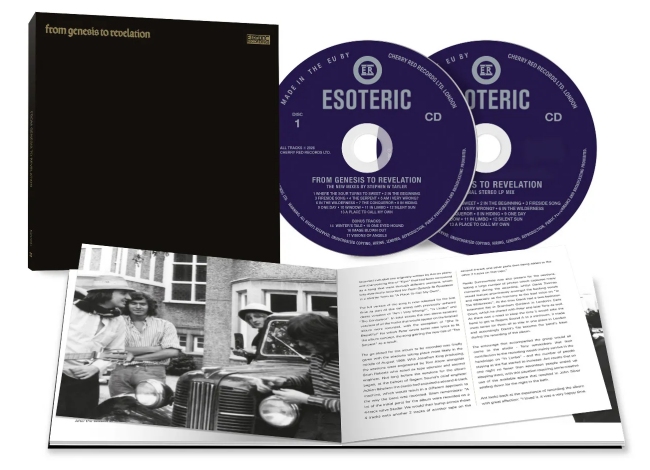
Firstly, a major feature of this re-release is the very informative and lengthy booklet by Jonathan Dann, who describes the early background of the band and this debut album in great detail. Such insight is actually crucial in setting the scene fully for the origins and nature of the album. Apart from the historical detail, this booklet also goes to unusual lengths to explain the work and insight Stephen W Tayler had to put into remixing this album, to the point of having to piece together fragments of one of the bonus tracks to achieve a decent mix. This was clearly not a straightforward ‘polish up’ of some master tapes, as the original material needed so much attention to enhance the better musical elements above the significant limits of its bargain basement production budget, and the clumsy addition of strings and horns by Jonathan King. This booklet and photos are almost worth the re-release alone, and is typical of Cherry Red’s respect and attention to detail.
Secondly, we get the 2026 remix version by Stephen W Tayler with added bonus tracks on one disc and the original 1969 stereo mix on the other disc. This allows the listener to compare and contrast the mixes. Other editions of this re-release include a comprehensive 4 CD/Blu-ray edition with two more CD’s – the 1969 mono mix and a disc of demos, some of which have never been released before. The additional Blu-ray includes the album in 5.1 and Atmos editions, and an interview with Peter Gabriel, Tony Banks and Mike Rutherford. Although Anthony Phillips was heavily involved in From Genesis to Revelation, curiously he was not part of that conversation. It is not clear whether he was not invited or declined to take part, which is a possibility considering his previous reticence in public, but if he was not invited it is a real pity.
This review does not cover the 4CD/Blu-ray Edition material, and will focus on the 2 CD edition. It is difficult to imagine what an Atmos/5.1 mix of this early material will reveal, such are the limitations of the source material in terms of production and recording, (although being Genesis it is certain that some feverish fans will definitely declare such mixes as a wonderous (‘Revelatio’!!!)
This was an interesting experience in revisiting an album my younger self had virtually dismissed, and had probably hardly ever listened to again after the first few attempts. The contrast between the original version of this album with the glorious later output of one of my favourite bands in their heyday was almost too much to compute back then! Coupled with the poor audio quality of the versions available back then it is hardly surprising this listener struggled to find a way into liking those primitively recorded early efforts. However, the years (and the informative booklet in this edition) have hopefully imbued some more insights about the context of the album into the mind of this listener, and the remix has lifted the quality of songs to a more satisfying and enjoyable level.
Very loosely based on the Bible, as suggested by Jonathan King as an over-arching concept, (a nice, simple concept for a group of teenagers to tackle… obviously!) this is an interesting set of songs which does show some of the seeds which would later blossom for Genesis. However, there are also some seeds which were not developed further, which is understandable for a very young band exploring their musical way forward. Where The Sour Turns To Sweet demonstrates both the strengths and weaknesses of this album. Starting with Tony Banks’ piano notes and distinctive finger clicks under Gabriel’s confident voice they instantly evoke a portentous atmosphere. Guitars join the piano as Gabriel’s voice rises more triumphally… but in the background one can hear some rather insipid strings and horns in a strangely jazzy chorus. Dann’s excellent booklet notes that the band were very disappointed with the way the orchestration had been added to the album. They were aware strings and horns were going to be added, but did not expect to hear the band squeezed in mono on one side of the recording with the strings and horns on the other side playing rather insipid simple lines. Mike Rutherord recalls ‘I think we were all disappointed. We’d imagined big, lush string sounds but I guess their budget was not a big string budget’. Jonathan Silver was more forthright in his view: ‘I was shocked and a little upset when I heard it… I was somewhat amazed at the overpowering element of Arthur Greenslade and the gang’. (Arthur Greenslade had done the orchestral arrangements.) Stephen W Tayler’s remix has resulted in reducing that unwelcome ‘overpowering element’ and has significantly enhanced the volume and sound quality of the Genesis band contribution.
In the Beginning is one of the tracks which probably best foreshadows their much more pronounced progressive rock direction on subsequent albums. Commencing with ominous buzzing keyboards and a rumbling bass and drums, Gabriel hits us with a taste of some of his subsequent weird lyrical imagery ‘Ocean of Motion, squirming around and up and down…’ before the killer line ‘You’re in the Hands of Destiny’ and Anthony Phillips’ dramatic grating dirty guitar motif. In this song there are clear signs of their more progressive and ambitious future. This segues sonorously on Banks’ piano into the much more pastoral waters of Fireside Song, all syrupy strings, harmony vocals and fey vocals… and rather anodyne after the dynamics of the previous piece. Am I Very Wrong? soon follows in a similar sunlit but rather weedy fashion, featuring Gabriel’s flute and tremulous vocals, but all with rather unmemorable results.
Early Genesis appear to have been more comfortable with a more varied and dynamic approach, such as The Serpent which features a fine Gabriel vocal and a great bass line. It rises to a crescendo with Phillips’ more assertive guitar (but again still rather buried under backing vocals and other instrumentation.) This track has differing sections and at nearly five minutes it also has more room to develop their musical ideas, which would have been much more difficult to achieve in the other album songs which are about 3 to 4 minutes long. In the Wilderness is another piece which points to a future with more potential, commencing with a soft piano and restrained verse before a more celebratory chorus and an earworm melody. Even at their most progressive and ambitious Genesis were able to create beguiling melodies later in their career. Gabriel’s vocals stand out in particular in this highlight on the album.
The Conqueror is another high spot on this album. Somewhat surprisingly Noel Gallagher of Oasis has previously and surprisingly expressed his admiration for this album, and this song in particular – to the point that he based If Love is the Law on his 2017 album Who Built the Moon? on The Conqueror! A more straightforward rock song, The Conqueror rolls along fluidly, concluding with a fine (but still frustratingly muted) guitar solo from Phillips. In contrast In Hiding and One Day are both rather pedestrian numbers, and somewhat drenched in those dreaded Arthur Greenslade strings. In contrast, the gentle reflection Window manages to convey pastoral scenes delightfully with Gabriel’s soft vocals, flute, acoustic guitars and harmony vocals. Even Arthur’s strings cannot hold this one back! The hand claps are back for the almost funky In Limbo, and maybe the one place where the horns do not feel totally out of place, and adorned by a fine rather bluesy guitar solo in the outro… which you can at least hear in this mix!
Jonathan King decided to add their previously recorded debut single Silent Sun to the album – the only track on the original album which featured the original drummer Chris Stewart (who admits he struggled to keep time so was not surprised to be shown the door.) The jangling, sunny tones of Silent Sun has definite echoes of The Bee Gees, who were popular in that period (well before their later Disco period in the late 70’s). Indeed, Genesis decided to try to do a song in their style to impress King as they knew he was a fan. The album’s finale A Place to call My Own is initially introspective and sombre with just Gabriel and Banks… before Arthur and his gang crash right in with some rather cheesy strings and horns just to make sure we have not forgotten him!!
This edition includes four bonus tracks, commencing with their second single A Winter’s Tale which alternates between softly lilting piano and vocals with more strident choruses marked with some rather assertive backing vocals. It is hardly surprising this had no impact in the charts when released as a single. Strangely, that single’s B-side, One Eyed Hound, is far more distinctive and memorable, particularly with it’s call and response format. The story telling style also foreshadowed Gabriel’s later penchant for narrative-based songs. The very early demo Image Blown Out has hints of psychedelic imagery, but one can see why it did not make the original release. On the other hand, what is mystifying is why an early version of Visions of Angels (which later appeared more expansively and rather gloriously on their next album Trespass) did not make the cut for this debut as it sounds so much better than most of the songs that made the final cut… or maybe that is later memories of the final version colouring my view? To these ears even this early out-take knocks spots off nearly every song on this first album, and unlike the other bonus tracks on this release, it has never been released before. Stephen W Tayler deserves a lot of credit for painstakingly piecing this version together from a couple of sources – it was worth the effort and is one of the best things about this release.
So, is it worth getting this re-release?
As early evidence of a very young band who would later rise to so much success this is a fascinating musical document. The remix has rescued this release and revealed much more of the musical skill and potential of this embryonic band. The booklet notes and packaging are excellent, and help place this release in the correct context. The muddy, poorly produced former versions did not do this young band justice, and one can now hear the seeds of their later success.
However, let’s be clear – anyone unfamiliar with this album previously and expecting to hear dazzling musical gems that compare favourably with their later iconic progressive rock output may well be sorely disappointed. From Genesis to Revelation is very much the early musical explorations of a young band in the late 60’s, and a long way from the musical excellence and imagination of their later albums. Indeed, when one thinks that it was only about 18 months after this album that Genesis released the much more polished and excellent Trespass album, it is amazing how much they had developed as artists, honing their art in a remarkably short period. As we now know they went on to even greater heights artistically with subsequent albums… now those albums were truly a ‘Revelation’.
Cherry Red and Stephen W Tayler have admirably, skilfully and respectfully rescued this album from its previous murky reputation. This edition of From Genesis to Revelation presents a nascent Genesis in much more favourable light, and we can now hear their potential much more clearly.
Fascinating? Yes.
Revelatory? Maybe not so much… but definitely well worth exploring.
TRACK LISTING
CD 1 – New 2026 Stephen W Tayler Mix
01. Where The Sour Turns To Sweet (3:24)
02. In The Beginning (3:44)
03. Fireside Song (4:20)
04. The Serpent (4:44)
05. Am I Very Wrong? (3:44)
06. In The Wilderness (3:49)
07. The Conqueror (3:42)
08. In Hiding (2:41)
09. One Day (3:22)
10. Window (3:46)
11. In Limbo (3:44)
12. Silent Sun (2:14)
13. A Place To Call My Own (2:18)
~ Bonus tracks:
14. A Winter’s Tale (3:29)
15. One Eyed Hound (2:36)
16. Image Blown Out (2:16)
17. Visions Of Angels (3:35)
CD 2 – Original 1969 Mix
– Same track listing as CD1 (1 – 13)
MUSICIANS
Peter Gabriel – Lead Vocals & Flute
Anthony Phillips – Guitars, Backing Vocals
Tony Banks – Hammond Organ, Piano, Backing Vocals
Mike Rutherford – Bass Guitar, Guitar, Backing Vocals
John Silver – Drums (except 12)
~ With:
Chris Stewart – Drums (12)
Arthur Greenslade – Strings & Horns Arrangement, Conductor
Lew Warburton – Strings & Horns Arrangement, Conductor
David Thomas – Backing Vocals
ADDITIONAL INFO
Record Label: Esoteric Recordings | Cherry Red Records
Country of Origin: UK
Date of Release: 9th October 2026
Original date of Release: 28th March 1969
LINKS
Genesis – Website | Facebook | Bandcamp (Cherry Red Records) | Cherry Red Records (2CD Edition) Page | YouTube | X | Instagram