
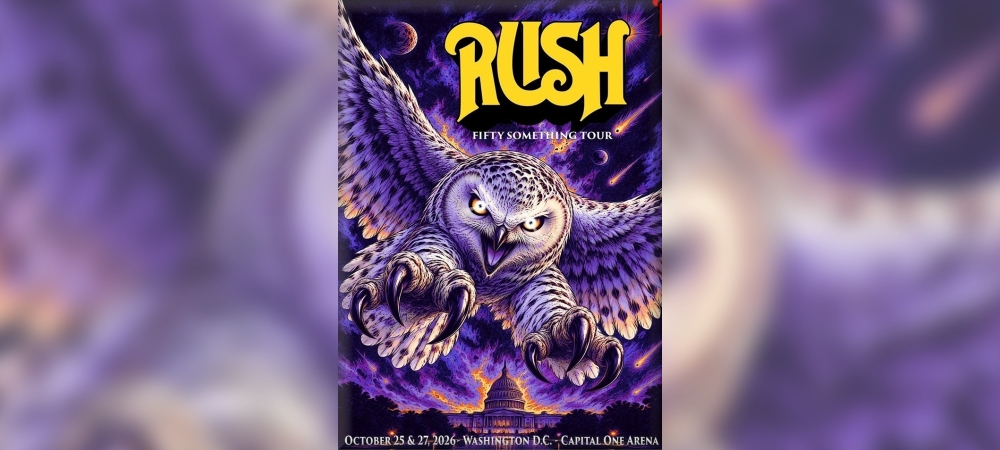
Capital One Arena, Washington, D.C.
Tuesday, 27 October 2026
Rush hold a special place in my heart. They are one of the bands that I’ll always mention when someone asks me to describe progressive rock, and The Spirit of Radio is the first song that made me sit up and admire the technical musicianship. When I told my drum teacher at the time that I wanted to learn it (aged roughly 14-15), he laughed in my face, as if I’d picked the most difficult song ever. Looking back, he was probably bricking himself, lacking the patience and skill to do the job he was employed to do. Years later, I taught myself, and the rollicking track with its fun time signature changes and reggae breakdown never ceases to be enjoyable to play along with.
But they’re also a band I conflict with, regarding their latter-day musical direction. As a fan of pure, adventurous prog, I still struggle to appreciate their more streamlined, concise forms of expression to this day. If you dare say that in the Rush camp, you’ll invite a lot of snark and criticism about not being a ‘true’ Rush fan, but I think there’s absolutely nothing wrong with liking what you like.
Truth be told, I couldn’t get past Moving Pictures for many years; as a teen, I naively valued a song’s length, thinking the longer it was, the more effort it must have taken to make it good and worthwhile. I noted that The Camera Eye was the last Rush song over 10 minutes, and I was put off by the 5-minute-average track times on the albums that followed. In fact, it took me years to summon the courage to give Signals a try. When I finally did, I was instantly electrified by Subdivisions, and realised I’d made a huge mistake by not giving the band’s 80s synth era a try.
But I soon discovered that the out-and-out prog of the 70s really did fade into something more nuanced as the albums went on; while the musicianship and lyrical themes were still world-class, the songs felt less challenging and ambitious. Geddy Lee has been vocal about how much fun it was to write, record and play Permanent Waves after their most progressive album Hemispheres, which he described as ‘gruelling’. It can’t have hurt that the band scored their first huge radio hit with The Spirit of Radio as well, making it all the more understandable why Rush chose the path they did. As band transitions from prog to pop go, Rush were among the more graceful and successful; the only band I can think of that managed it even better was Genesis, but I’d argue Rush were able to retain more of the prog mentality in their songwriting.
Still, that doesn’t mean I have to like it. While I appreciate plenty of individual songs from their 80s era (including plenty of the cheesier songs from Hold Your Fire), I really couldn’t make it past Roll the Bones without yawning. More songs about space-dogs, please! Having listened to the live albums as well, it seemed that Rush had always filled their sets with newer material, only saving space for a few old hits. So when Rush would occasionally tour in the early 10s, I was reticent to purchase tickets because of the exorbitant price and the fear that they would only play very few of the songs I actually cared about.
Then, one day, Rush stopped touring. And in early 2020, Neil Peart – the drummer who set the gold standard for composing purposeful, meaningful drum parts – passed away. I’d missed my opportunity to see him perform live. And it seemed likely that I’d never get to see Rush either. I suppose that I’d thought it was something I’d get around to doing eventually, but there were fewer grains of sand in that hourglass than I’d anticipated.
So when Rush announced their Fifty Something Tour last year with new drummer Anika Nilles, I initially held off, thinking it would be a bloodbath at the ticket office, with fans scrambling to nab overpriced tickets. I’d recently been burned with a $500 Paul McCartney ticket; while seeing a former Beatle live was invaluable, going to huge, expensive concerts was a habit I couldn’t afford to keep up.
But the new trio’s surprise debut performance of Finding My Way at the Juno Awards on March 29 reignited the Rush fervour; fans analysed every aspect of the performance, and Nilles seemed like a great fit with the band. Their unusual choice to perform their very first song from their debut album (which had not been performed as a standalone track since 1976) signalled a desire to return to the past, and the hype surrounding the performance was enough to convince me to splurge.
When the band’s tour began in June, the online commentary was unavoidable, with setlist spoilers galore. The small amount of disappointment I felt at having the surprise stripped away from me was balanced by just how fantastic the setlist was proving to be. Rush weren’t being coy about rummaging through their earliest record to play fan favourites.
Their commitment to prog was reaffirmed when I entered the giant arena in downtown Washington, DC; 70s classics by Yes, UK, Supertramp and Jethro Tull were billowing from the speakers. Once upon a time, I’d wondered if Rush and other groups had shed their complexity for pop simplicity because they were ashamed of the prog stamp and wanted to distance themselves from it. Tonight, in this arena, it felt like anything but, as they embraced and acknowledged their British influences.
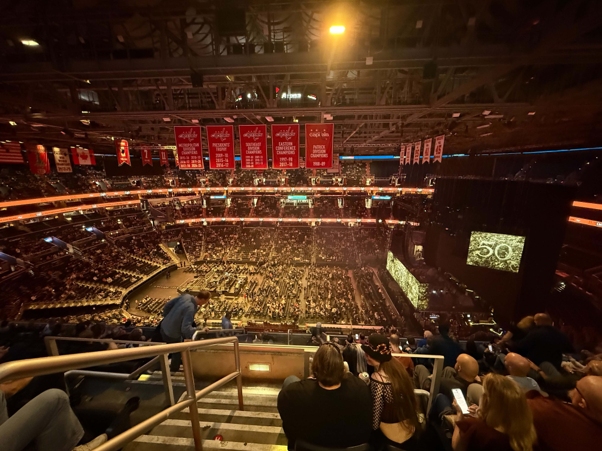
I’ve been to many prog gigs before, and seen that the usual demographic is the older white male. But in my experience, it has never looked this nerdy. In a sea of myopia, I reckon I was in the minority of people not wearing glasses. For fans who might describe themselves as “outcasts”, I couldn’t believe how similar everyone looked. Even if they hadn’t all been wearing Rush shirts, you’d have known these were Rush fans.
I found my chair, once again high in the nosebleeds, and pulled out my binoculars. Having not been able to even make out McCartney’s face at my previous large arena concert since he was so far away, I realised that binoculars were essential to witnessing the action on my terms.
Soon after, the lights went out, and a highly polished, scripted intro film began to play. The seven-minute film featured Geddy and Alex in scary costumes as they introduced a group of young people to a haunted house. Some cameos were laced into the film, such as the cast of South Park and Hollywood actors Jason Segel and Paul Rudd, presumably reprising their roles as the Rush-loving fans from I Love You, Man. Having seen many high-end bands play with a video that looks as though it were put together in an afternoon by an intern using Windows Movie Maker, I was pretty astonished by the high production value and the star power that Rush could afford; I was starting to realise that Rush might be one of the biggest artists I’ve ever seen play. Perhaps it didn’t even take much persuasion for the actors to get involved; given how willing Rush were to get involved with those productions, I’m sure they were happy to return the favour.
At last, the concert began in earnest, and the group began with Xanadu, one of their most out-and-out prog songs, and also one of their most excellent. Fans such as myself had been clamouring to hear it, and I genuinely didn’t know whether to headbang, view the band through my binoculars or get out my phone and record; I ended up doing an awkward combination of the three. Some other eagle-eared fans may have noticed that they skipped about 30 seconds from the outro (the glockenspiel, tubular bell and marching snare bit, for those who know their drums), but it was nonetheless a privilege to have heard the majority of the song intact.
Afterwards, the band delved into their ‘deep cuts’ portion of the evening. I found out after the gig that Rush had been doing some epic shuffling of their songs each night: spending two nights in most cities, they would have an ‘A’ setlist and a ‘B’ setlist that could be further customised by less well-known songs. I wasn’t moved by Dreamline, Headlong or Red Sector A, although I was surprised by the loud bang as controlled explosions ripped from behind the group during the latter. But Subdivisions was a total pleasure.
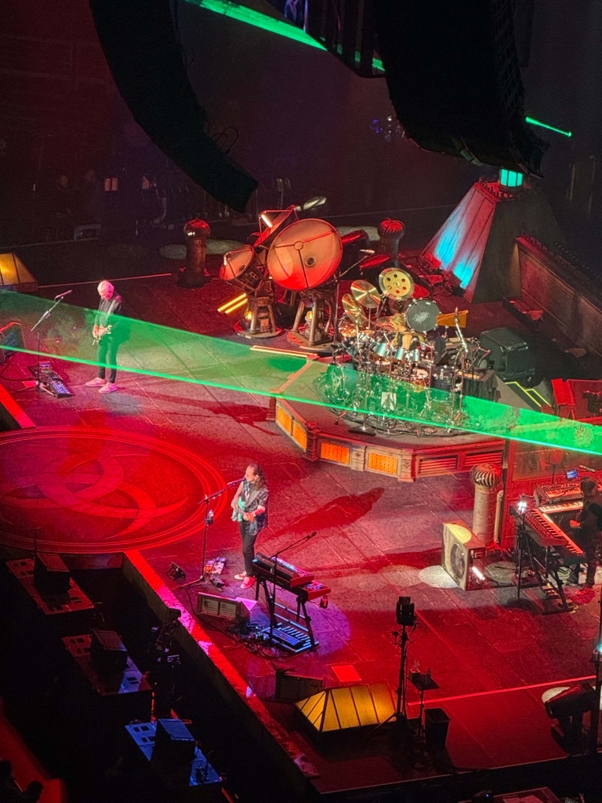
There were many parts of the night that felt like a tribute to the fallen bandmate, but none more so than Bravado, which was prefaced with a compilation video of Neil Peart behind the kit with a voiceover from an interview. It was a beautiful sentiment, and I’m sure he would be happy to see his bandmates keep playing the music for fans in his absence. While it must be difficult to acknowledge the death of a great friend night after night in front of an audience of thousands, I really felt the band showed great tact and never let it drag the mood down.
Another staple of this tour was the full La Villa Strangiato instrumental suite, which the band had not played since 2011. Originally a source of consternation for the group, it’s nevertheless one of their finest contributions to prog, and it was amazing to see it performed expertly by Lee, Lifeson, Nilles and Loren Gold, the band’s guest keyboard player. Nilles could definitely hold her own with this group, capturing Peart’s style wonderfully while occasionally putting her own spin on things.
The title track from A Farewell to Kings proved to be the ‘rarest’ song of the night, having only been played 13 times prior out of the 43 earlier dates. This was a delight indeed; a song I hadn’t listened to in a while, I’d temporarily forgotten about the jazzy breakdown during the instrumental that deviates from the hard rock of the verse/chorus section. Geddy’s voice was also sounding fantastic; there was never an expectation that he’d be able to hit the high notes of the 70s, but he really gave it his all and sounded good doing it. It was a shame that the mix of the evening made some of the lyrics indecipherable, but I’d wager a good 75% of the room knew all the words to every song anyway.
The band finished the first half of the set with The Spirit of Radio, a staple in the band’s canon, and the song that introduced me to prog in the first place. I’ve played it countless times on the drums myself, and it’s difficult to state just how much the track means to me. So it was surreal to watch it unfold in front of me. I’d known it was coming, but now that it was here, five minutes felt too short to spend with it; time stand still, as Rush would say – I wanted to look around me. While the quick pace is part of the song’s appeal, I wished that they could slow it all down like some captain whose ship runs aground. It was another great performance where I had to juggle my urges to rock out to the music and use the binoculars to see just how the band were playing it live.
After that, a 20-minute intermission. Unlike other concerts I’ve attended where the intermission has felt indeterminate, a countdown clock was conveniently provided on the screens at the front so that it was unambiguous when your bum needed to be back in the seat. More 70s prog played over the loudspeakers, mostly in snippet form, but I was delighted to hear Carry On Wayward Son by Kansas in full. I decided to check whether it was a good idea to head to the restrooms, as Americans call them; while at most shows, it’s the ladies who have to wait, the line for the fellas stretched all the way down the corridor. At this point, I felt grateful not to have splurged on a $15 beer.
As a result, by the time the second half started, many bums were not back in their seats, including in the rows surrounding me. A second video involving the South Park characters played, this time with Cartman cosplaying as Geddy Lee. The skit involved the characters performing Tom Sawyer while Cartman sang lyrics pertaining to Huckleberry Finn, the other popular Mark Twain character; after Stan admonished him and badgered him to sing the lyrics right, they counted in once again, but this time the real Rush played. Bums were still not in seats by this point, and I was annoyed to have to stand up from mine to let the people next to me back in during the song. Although there was never a doubt that Tom Sawyer would be featured in the setlist, being their #1 track and having been featured in every concert since its debut, I appreciated that the group could still find fresh ways to introduce it. (Edit: I just found this video with the same intro from 2009, so I suppose it’s not that fresh.)
This was a track that I was keenly tuned in for. I’ve listened to it so often that Neil Peart’s tightly written drum parts are permanently etched in my memory. Every Rush fan knows that the drum fill at the end of the 7/8 instrumental is Peart’s most iconic moment, and I’ve seen countless drumming videos on social media cover this part perfectly or teach the theory behind it. Mastering this blisteringly technical fill is a rite of passage for many drummers; while I can approximate it myself, I’ve yet to get it perfectly accurate – I’m aware of my limits.
So when it came to that drum fill, I was watching and recording. Nilles nailed most of it, but flubbed the very last bar, filling the last crotchet with a simpler bit. The crowd went wild anyway, as she’d done very well, and at the time I was too busy enjoying myself to care. But after the gig, I couldn’t help but be dismayed that she didn’t manage to pull off the most important part of the song. I wondered if this was simply her adding her own spin to the track as she’d done in other songs, but a video on her social media showed her playing the fill flawlessly, so it was clear that she knew how to do it. I know it’s a lot to expect perfection, and filling Peart’s shoes would be a tall order for any drummer, but given how many drummers out there live, breathe and sleep Rush music, and could perform that fill each time perfectly, it was disappointing that Nilles could not deliver at the moment it mattered most. On the other hand, the pressure to perform in that moment when all eyes are on you would probably throw any hardened drummer for a loop.
With Tom Sawyer out of the way, the band launched into Red Barchetta, and this order seemed like more than a coincidence. As the band performed, the mesh video barrier dropped in front of the group, showing an animation of a crimson vehicle. This stylised choice was a little confusing, as it literally prevented us from being able to view the band directly. I really can’t understand why they chose to drop a screen in front of themselves for some of the songs.
Afterwards, Nilles began the 5/4 intro to YYZ, which all but confirmed that the band were playing Moving Pictures in full; Geddy confirmed as much after the song was over. Unlike in previous years, the band did not step away to allow for a drum fill during this song; overall, there was very little song embellishment in the evening, although Loren Gold was allowed a keyboard spot before The Camera Eye, Rush’s final epic song.
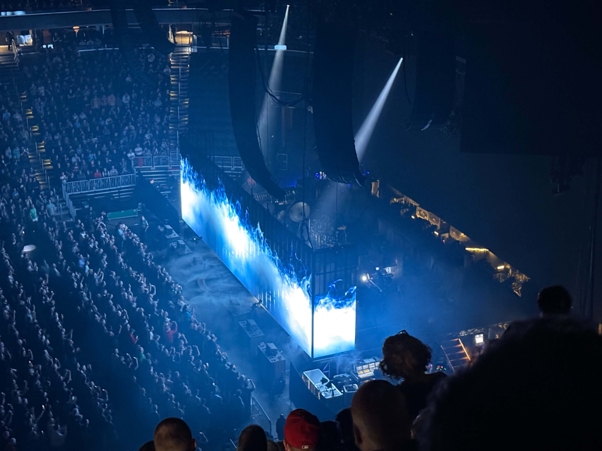
Both this and Witch Hunt were given an epic visual treatment, with fireballs shooting behind Nilles as she pounded the intro to the latter. Frustratingly, however, a honeycomb-shaped set of lights descended from the rafters until they completely eclipsed Nilles and the drum kit from view. Because of the angle, this imposition really only affected my seat and maybe a few others around me; I couldn’t help but find it funny how completely the whole drum kit was masked, as you can tell from the photo below.
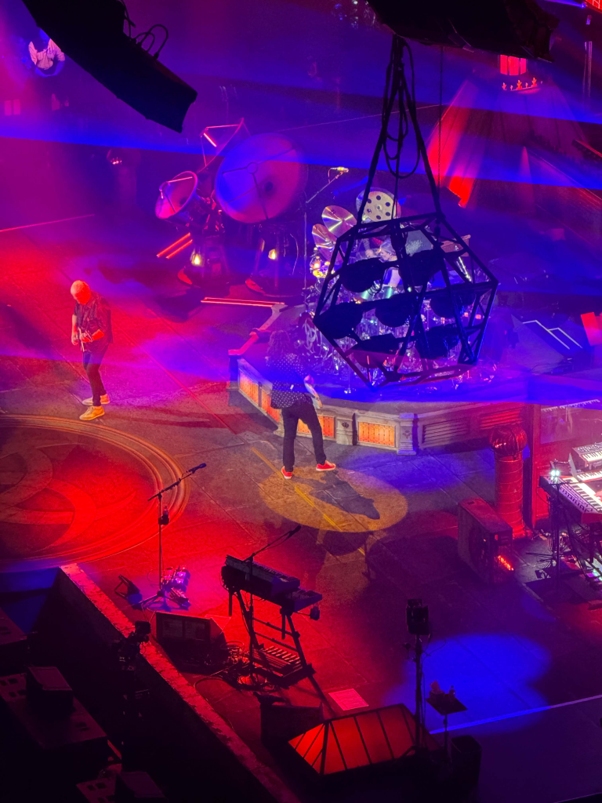
It stopped being funny when the band locked into the final song of the album, Vital Signs; it has a deceptively difficult rhythm to play, as a meticulously planned marriage of reggae and progressive electronica. I was deeply interested in how Anika would approach it, but was robbed of my chance to see by the lighting. In an anecdote, Geddy revealed that the track had been written last-minute when they realised there were still a few minutes of vinyl remaining on Side B after the previous tracks had been written and recorded; I appreciate when you can actually learn things about the band by going to their show, whether it’s about their personality or interesting anecdotes. At another point in the night, Geddy also explained how the group always took the music seriously but never each other; as this was the first time I’d seen them live and heard them explain that, it gave me a new outlook on the original trio, but it was a sentiment that seemed to be reflected throughout their history.
With Moving Pictures in the bag, Rush pulled out Time Stand Still, their poppy late-80s favourite that utilised the female vocals of Aimee Mann, who was briefly shown on screen. Then, for the third time that evening, Geddy invited us back to 1977 and the A Farewell to Kings album; I hoped this would introduce Cygnus X-1, but instead it was the more familiar Closer to the Heart. I knew the setlist couldn’t possibly have everything I wanted.
Staying in the 70s, the band continued by delivering the beloved 2112… well, Parts I, II and VII. I’d heard rumours that they were playing the full suite, so I was a little let down when they skipped from The Temples of Syrinx straight to Grand Finale. After the gig, I found out that the full 2112 was the Set A special while the full Moving Pictures was the Set B special. On reflection, I would have slightly preferred the set they played on Sunday, but the seats were much more expensive that day, so I don’t regret my choice. Interestingly, a video from Sunday’s performance reveals that the band had a false start to 2112 as Geddy’s bass was out of tune; the band halted the proceedings and started again. It’s fascinating to see what bands do when stuff goes wrong.
Even though it wasn’t played in full, 2112 is still an integral part of Rush’s history in prog, so I’m very grateful that they could play us the most iconic parts of the song. And with that, the band bowed and left the stage. I was astonished at how many fans left their seats at this point. We’ve all waited eleven years to see Rush play again, with no confirmation of whether they will continue to tour afterwards… and you’re not gonna stay for the encore? I can understand a few fans here and there wanting to beat the crowds, but I wondered if there was also a collective ignorance of how bands typically play encores. Given the cost of the tickets, I wanted to squeeze every cent out of the experience.
Staying around proved to be worth it. Until now, the band hadn’t touched their sophomore Fly by Night album; the band leapt into action with By-Tor and the Snow Dog, the fantasy-themed piece with the bonkers instrumental section. As the frenetic portion of the song ended, the band launched into Working Man instead. In the accompanying video, I was pleased to see the band give a small tribute to their other fallen drummer, John Rutsey, who passed away in 2008.
After a ripping performance of the fan favourite hard rock track from their debut, Rush were officially through. As they left the stage, there was one last surprise: an alternate skit with Jason Segel and Paul Rudd saluting Neil Peart before getting into a disagreement on how to pronounce his surname. I could relate, having studied the Professor’s parts many times but still fully unsure how to pronounce his unusual surname. An end title read “See you down the road”, possibly teasing future performances. We can but hope.
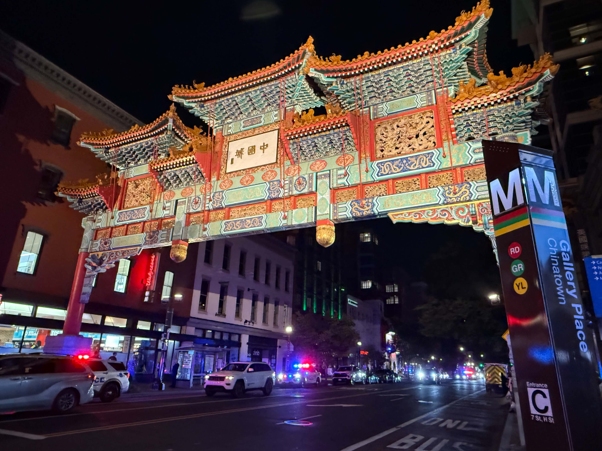
The audience spilled out onto the street en masse, and I looked around, thoroughly confused about where I was until I saw the iconic Chinatown arch. It seemed I had exited the arena on the opposite side from where I’d walked in. Rush fans crowded the Metro station, much to the chagrin of other passengers.
I reflected on the show I’d just seen. While there were several minor quibbles about the night, I could have barely expected a more perfect evening with the group. Geddy and Alex can still perform like they’re in their 20s; I see now that it would have been a tragedy if the two had never played together again after Neil had passed. The setlist was absolutely phenomenal, and as a prog fan, I thoroughly appreciated that it was skewed towards the band’s earlier material.
While I only occasionally beef with Anika’s accuracy (playing the songs 95% correct instead of 99-100%), I can nevertheless see that she was an exceptional fit for the group; the three looked very comfortable, and Anika was able to bring the power and specific technical feel of Peart back to the group to bring Peart’s parts back to life while given enough space to also be herself. I was fascinated to read that she had to ‘unlearn’ some of her own skills – such as playing jazzy 5-tuplets when she cameoed in Panzerballett – to fit in the group; when one considers that performance, it’s all the more impressive that she had the self-restraint to play more like Peart for nearly three hours a night. It was also beautiful to see how loving and accepting the fans have been towards her; whenever she had a big moment on stage, the crowd erupted, just as they would have done if Peart were there. And perhaps just as wonderful is seeing phenomenal women in rock not treated as some sort of novelty, but simply recognised for the extraordinary musicians they are.
Add the stage design, the high production videos and the extraordinary effects; Rush delivered one of the best and most polished concert performances I’ve ever seen. They had cameras hidden in all sorts of places to give fans without binoculars excellent views of the musicians, all timed well to focus on the most important parts of the songs. When you consider that the band play a constantly shifting setlist every night, the amount of planning that must go into organising all that is staggering. And yet, all this joy was delivered in a highly professional sheen without a hitch. While the price of admission may be high, I can assure you, it’s worth every penny.
SETLIST
Xanadu
Dreamline
Subdivisions
Headlong Flight
Bravado
Red Sector A
La Villa Strangiato
A Farewell to Kings
New World Man
The Spirit of Radio
– Intermission –
Tom Sawyer
Red Barchetta
YYZ
Limelight
The Camera Eye
Witch Hunt
Vital Signs
Time Stand Still
Closer to the Heart
2112 Part I: Overture
2112 Part II: The Temples of Syrinx
2112 Part VII: Grand Finale
~ Encore:
By-Tor and the Snow Dog
Working Man
MUSICIANS
Geddy Lee – Lead Vocals, Bass Guitars, Synthesisers/Keyboards
Alex Lifeson – Electric & Acoustic Guitars, Backing Vocals
Anika Nilles – Drums, Percussion
Loren Gold – Keyboards, Organ, Synthesisers
LINKS
Rush – Website | Facebook | YouTube | X | Instagram


