
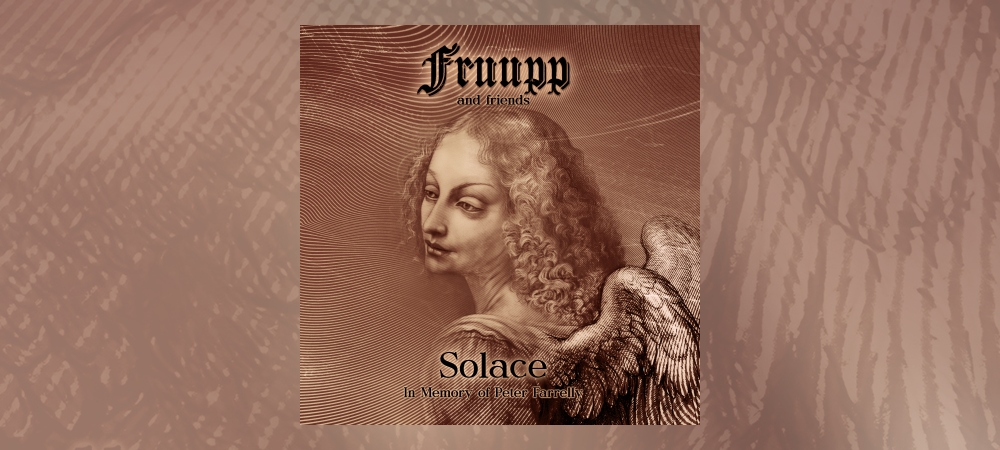
In Memory of Peter Farrelly
There are few reunions in progressive rock as improbable as this one. While many old groups have been reuniting over the last two decades for a few live dates or possibly even an album here and there, it seemed as if the time had well and truly passed by for Northern Irish eclectic symphonic proggers Fruupp. Having been as close to the machinations of the Fruupp Project as I can be without being biased, the general feeling was that a reunion would probably never happen because guitarist and frontman Vincent McCusker felt negatively about the band’s history and had no interest in making more music.
Despite this demoralising circumstance, a few devoted, loyal fans have come together over Facebook to spearhead new Fruupp releases, with the aim of compensating the original musicians. So far, they’ve been successful in releasing the extraordinary 2022 live album Masquerading with Dawn – remastered from a fan-made tape recorded in December 1975 – and 2024’s multimedia omnibus A Twilight Adventure, something of a treasure trove for superfans.
This third release by the team is by far the most ambitious, however. Born out of a meeting at bassist Peter Farrelly’s funeral last year and a mutual desire to pay respect to the late artist (who also created the fascinatingly beautiful covers of Fruupp’s first two albums), McCusker finally agreed to head back to the studio with drummer Martin Foye and create new music under the Fruupp moniker for the first time in half a century. Pigs can fly! When the first rumblings of this news began to appear on the Fruupp Facebook group, I could scarcely believe it was true.
But as more details began to emerge, I could see that it wasn’t going to be quite the full band reunion we’d hoped for. The album was by “Fruupp and Friends” rather than just Fruupp. I couldn’t help but feel that any other artist’s contributions would simply be a distraction from the main event. But anything felt worth it just to have new Fruupp recordings available to the public, especially the brand new recording of Steam Machine, Fruupp’s regular encore from back in the day that had never been recorded and hadn’t been heard by anyone for fifty years.
I truly wasn’t sure what to expect, and on my first listen, I was utterly baffled by the presentation of archival recordings alongside new material. With music from so many interconnected artists featured, the audio quality would also switch drastically from song to song, creating something that felt wildly incohesive. Even among the newly recorded tracks, Ian Wright of Flight76 and i-a-n features programmed drums in his self-produced music, and the audio quality pales in comparison to the more exquisitely produced tracks by Argos. Truth be told, these inconsistencies were a huge distraction to begin with, but I pushed past them to try and listen to the actual music.
The album’s running order has changed drastically since it was first announced, and has been whittled down from 66 minutes to just 54, with McCusker ready to trim any fat he sees. Despite this, the album still comes presented as a rather short double LP (or single CD). While I’m not usually one to consider how music is split over sides of vinyl, that is how they were presented to me in my press kit, and I have to admit that this is a really fantastic use of the format as it presents the album as self-contained chapters.
The best way to see Solace is not as a Fruupp album but more as a Fruupp festival with different artists celebrating the group while Fruupp themselves headline right at the end with their new material. This festival begins with some familiar Introductions by Peter Farrelly; this is the same 1975 recording from the Masquerading with Dawn live album played before the set closer Song for a Thought, and features a beautiful, soaring guitar theme by McCusker that was not recorded on any studio album.
As the recording ends, it segues seamlessly into a new track, Lady-in-Waiting by Flight76, a clever, playful song that builds directly on the theme from Introductions and extrapolates it into a full song. Wright doesn’t stray far from the original theme, but includes enough variations to keep it from feeling repetitive. The resulting track is incredibly Fruupp-esque and is a striking way to begin the album. Standing alone on Side A, these two tracks together symbolise what the rest of the album stands for: looking back at the past while forging something new.
Side B is dedicated to cleaned-up archival recordings of the band members before and after the group split in 1976. Opening the side is a 1973 live recording of one of Fruupp’s best songs, On a Clear Day, which features the Jupiter theme by Holst (and was originally withdrawn from the band’s first album at the Holst estate’s request). The audio quality is scratchy in places, but it still rocks hard, and it’s nice to find something familiar on this album. For the outro, McCusker has recorded a new guitar solo in the studio to beef up the sound of the original recording, although when the two tracks differ, it’s pretty noticeable.
Curiously, I noted that the second half of the track was abridged slightly to remove some of the build-up to the second repetition of the Jupiter theme. I asked McCusker himself about this change, and he responded that he felt some of the short sections distracted from the cohesiveness of the piece. I don’t agree at all that they distract; they actually help to build the tension before the final part of the song. Perhaps it’s simply because I was so used to hearing how the song sounded before, but the ‘jumps’ in this new version always bother me.
Bear with me as I go on a film-related digression: I’m reminded of a 1972 interview with Alfred Hitchcock where he discussed his 1936 film Sabotage and how he regretted a suspenseful scene where he let a child carry a bomb around for several minutes of screen time before eventually letting him blow up in front of the audience. To me, that was ironically the most innovative, subversive and Hitchcockian thing about that film, because you expect the boy to be saved and are deeply shocked when he isn’t. It’s funny how a creator can be so self-critical of something they made that is already brilliant. I won’t get into George Lucas’s endless revisions to his Star Wars series, but you get the point.
Two more songs follow on Side B. The first is Chasing After You by MGM, a 70s group formed shortly after the break-up of Fruupp, which included Farrelly on bass and vocals and Martin Foye on drums. The hard-rocking, high-tempo tune featuring prog-esque organ work has been delivered to me in a few different iterations; I’ve heard the scratchy 70s live recording of this song, as well as Ian Wright’s version under the Flight76 moniker, which seemed inspired yet different from the original but arguably had a better chorus. The completed track for inclusion, however, sounds like a fully computer-programmed rendition of the song with Farrelly’s original vocal included. The result is bizarre, with other sonic remnants of the original track popping through with Farrelly’s voice, but I suppose it is a sonic upgrade to the original, in some sense.
Last on Side B is I Don’t Think It’s Love, by McCusker’s late-70s post-Fruupp project Minx. The original can be found on YouTube along with other tracks by the obscure five-piece. Once again, McCusker has taken the original and laid down new tracks, such as a new male voice, which now masks the original female singers. It’s a slower, lurching love song that doesn’t fit the Fruupp vibe as well as Chasing After You did, but it’s nonetheless fascinating to hear what the musicians got up to after Fruupp were through.
Side C gathers pieces inspired by Fruupp but played by other artists. Ian Wright contributes two bookending tracks as i-a-n: the Fruupp cover Why and the soft, poignant Solace. The latter of these makes for a calm yet meaningful title track. Wright also brings a surprising clarity to Why, with plain singing over a simple acoustic guitar arrangement highlighting the lyrics themselves. When I spoke to McCusker, I noted that I’d never really paid attention to the lyrics before, and he understood, feeling that John Mason’s piano arrangement, while skilful, took the focus away from his poeticism. Perhaps that’s why McCusker chose this particular tune to re-record with Martin Foye back in early 2025.
I’m less sure about the inclusion of two songs by the German neo-prog band Argos from their album Doctor Wilde’s Twilight Adventure released earlier this year, using the working title of Fruupp’s unfinished fifth album. Clearly, the spirit of Fruupp was in the recording of these two songs, but to me they simply don’t belong here because the two groups sound nothing alike in terms of timbre or composition. Argos are very good at their instruments, but I get no sense that they were actually trying to make a new ‘Fruupp’ song when they made this music. Furthermore, their style is on the gentler side of prog, and I prefer my music with a bit more edge.
At last, it’s time for the main attraction. Side D is devoted to new Fruupp material, and it feels as if Sides A, B and C have been carefully preparing us for this moment. But instead of the progressive fire that forged classics like Decision, Song for a Thought or Faced with Shekinah, we’re greeted by a simple acoustic ditty, sung gently by Vincent McCusker. This track features lyrics that McCusker wrote in the 70s, set to new music. It’s not the return to prog glory that I hoped for; instead, it’s a realistic portrait of where McCusker is at, now, musically.
Martin Foye joins on the slow, macabre piece that follows, Banshee Woman. Over the minor chords, McCusker belts out a mournful guitar solo; the timbre of his playing has never sounded better. The piece segues brilliantly into the sound of an old-fashioned train, and then it’s suddenly time for Steam Machine, Fruupp’s ‘lost’ encore. The jigsaw puzzle fits into place; I could imagine this song being played live all those years ago as part of the band’s set. McCusker’s triplet arpeggio throughout this song is so distinctly ‘Fruupp’ that it doesn’t matter that the song is only 2½ minutes long. It’s a bit more 12-bar blues feel than I’d expected, but it’s still magical to hear Foye and McCusker interplay like this.
After the piece ends abruptly, Foye departs again for the final dirge, the solemn instrumental Lament for Peter, made as a tribute to their fallen bandmate. With a beautiful Irish lilt focused on guitar picking, I’m slightly reminded of the quieter parts of Journey of the Sorcerer by Eagles – known by British audiences as the theme tune to The Hitchhiker’s Guide to the Galaxy.
With Side D only lasting a mere 10½ minutes – and Foye only playing half of that time – it’s hard to escape the feeling that the reunion was too short-lived to reach its full potential. In hindsight, my expectations were set too high in imagining another prog epic from McCusker; his musical taste appears to have shifted in the intervening half-century, and it’s better to hear a more authentic musical statement than forced fan service. All the same, I can’t help but think the reunion might have sounded a lot brighter and more optimistic if it weren’t recorded in the wake of a bandmate’s passing, and I wish it could have happened sooner.
Solace might just be the most unusual album I’ve ever reviewed. Part archival release, part tribute and part reunion, it’s an audacious prospect indeed. But besides the excellent first side, which neatly combined two of these aspects, it never settles into a coherent artistic statement. There are some fantastic gems to be found, and the passion that drove this fan-led project is impossible not to admire, but the album’s uneven structure and freewheeling scope leave it feeling more like a collection of disparate fragments than the triumphant return that the Fruupp name inevitably invites. The live recordings, the tribute work and the reunion all tell different stories, and one can’t help feeling they would have worked better as separate EP releases rather than coexist on the same album. Here, the reunion serves as the rushed final act of an album that simply doesn’t gel.
If you can sense the frustration in my words, it comes out of a deep love for the band and a deep desire to see Fruupp finally achieve greatness and recognition. McCusker freely admits that the band’s four albums from the 70s were hampered by poor production, and I was hoping that Solace might finally provide the definitive Fruupp experience that history had denied them. Instead, I find myself more bothered by sound quality than I ever was before. While I appreciate all the hard work that the fans put in to make this record happen at all, Fruupp deserved a return that could stand on its merits; ten minutes of new material propped up by low-quality archival recordings and tributes feels disappointing and underwhelming.
But it’s worth remembering that Solace was made as a tribute to Peter Farrelly, and in that way it works beautifully, albeit imperfectly. To honour a beloved bandmate’s passing, two musicians joined by fellow artists and fans came together to actually create something memorable and poignant. What it lacks in polish, it makes up for in its sincerity and passion. While celebrating the band’s past and featuring recordings of all five Fruupp members in one form or another, the album respects where the remaining musicians are in the present, delivering their genuine voice and allowing for other artists to lend their voices too. Listeners who approach this album as a celebration of the band’s legacy will find much to appreciate; those hoping for a grand reunion or a return to the glory days should temper their expectations.
TRACK LISTING
Side A
01. Fruupp – Mr. Peter Farrelly’s Introductions (3:30)
02. Flight76 – Lady-in-Waiting (6:34)
Side B
01. Fruupp – On a Clear Day (5:48)
02. MGM – Chasing After You (5:41)
03. Minx – I Don’t Think It’s Love (3:36)
Side C
01. i-a-n – Why (3:20)
02. Argos – Moytura House (Solace) (6:49)
03. Argos – Under the Influence (4:42)
04. Flight76 – Solace (3:46)
Side D
01. Fruupp – Tuesday Night at No 11 (2:34)
02. Fruupp – Banshee Woman (3:30)
03. Fruupp – Steam Machine (2:39)
04. Fruupp – Lament for Peter (1:52)
Total Time – 54:21
MUSICIANS
– Fruupp
Peter Farrelly – Bass, Vocals (A1 & B1)
Vincent McCusker – Guitar, Vocals, Keyboards
Martin Foye – Drums
John Mason – Keyboards (A1)
Stephen Houston – Keyboards (B1)
~ With:
Carl Harvey – bass (Side D)
– MGM
Peter Farrelly – Bass, Vocals
Martin Foye – Drums
Gus Devlin – Keyboards
– Minx
Paddy Quigley – Vocals
Trevor Davis – Bass
Norris Adair – Drums
Vincent McCusker – Guitar, Harmony Vocals
– i-a-n and Flight76
Ian Wright – Vocals, Electric & Acoustic Guitars, Bass, Synths, Piano, Programmed Drums
– Argos
Thomas Klarmann – Bass, Flute, Keyboards, Guitar, Vocals
Robert Gozon – Lead Vocals, Keyboards
Bogáti-Bokor Ákos – Guitars
Ulf Jacobs – Drums
~ With:
Martin Foye – Drums
ADDITIONAL INFO
Record Label: Bad Pressings
Catalogue #: BPDCD3 (CD) | BPLP002 (Vinyl)
Country of Origin: UK/Ireland/Germany
Date of Release: 30th October 2026
LINKS
Fruupp – Facebook (Private Group) | YouTube
Burning Shed – Solace Double Vinyl Release | Solace CD Release


