
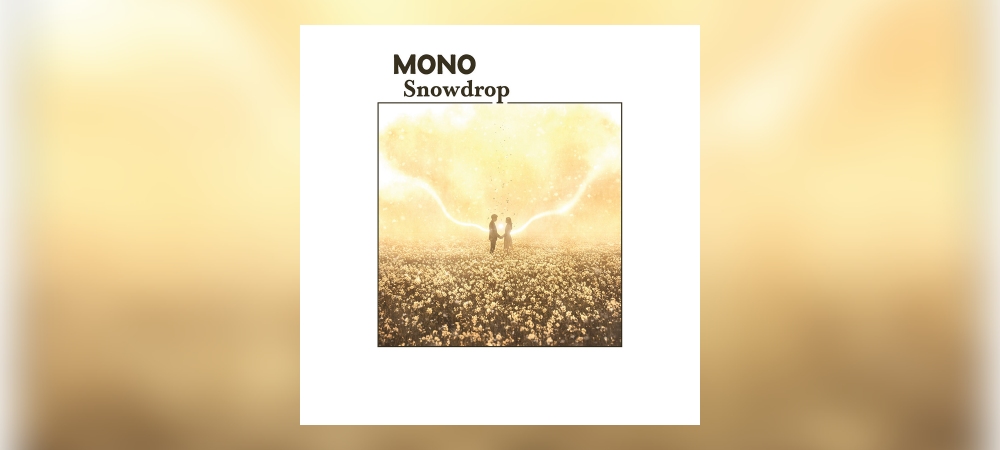
The inspiration for Snowdrop, the latest and 13th album from Japanese instrumental rock band Mono, came about from the passing in 2024 of long-time friend of the band Steve Albini, Mono’s recent production partner, and, in the past, audio engineer of choice to the likes of Nirvana, PJ Harvey, The Wedding Present and Mogwai. As a result, Snowdrop is a contemplative and carefully constructed set of tracks that are deliberately designed to be less melancholic and more uplifting. In the band’s words “our hope is that this album serves as a source of light and hope for those who have lost someone dear.”
Over the course of the band’s history, since forming in 1999, the band has been renowned for its experimental approach, marrying post-rock and classical influences. From a quick perusal of the back catalogue the raw edginess of their approach is clear for all to hear but the sadness that is at the heart of the origin of this album has resulted in a very different, and dare I say it, more progressive rock sound.
Despite their longevity and regular touring in Europe and the UK, and my own growing affinity for Japanese music culture, I haven’t come across Mono before. In addition to the 13 strong album catalogue they are also award-winning cinematic soundtrack artists and, marking their pedigree amongst the post-rock community, in 2018 they were personally invited by Robert Smith, of The Cure, to headline the Meltdown festival at the Queen Elizabeth Hall in London.
On that night they shared a stage with contemporary heroes My Bloody Valentine and Mogwai, but this time round the songs on Snowdrop have more in common with prog bands like Anathema and early period Pineapple Thief. More of this later, but after more than a few spins of this disc the only quibble I have with the album, despite the undoubted craft on show, is that the context for the songwriting seems to have constrained the amount of experimentation and resulted in a rather vanilla-sounding playlist.
The title track opens with a lament, picked out on guitar and piano, an immediate reference to the inspiration behind the album. In the second half of the track the rhythm section crashes in to lift the mood, and orchestral strings add weight to the power of the melody. It’s not until the finale that we see a variation to the main melody as the tempo increases, and the track closes in true prog fashion with a short reprise of the original lament. It’s an arresting start for the listener, a song with great power and emotion.
Winter Daphne reverses the song structure with an aggressive rock opening; thumping drums and a fired-up base line laced with twanging guitars. The fade out of this opening salvo is a false ending with the second half composed of a subtle, extended, atmospheric soundscape and choral finale.
Track 3 Gerbera makes full use of the chorus and orchestra, who are the main accompaniment playing over a military style drum rhythm. The use of repetitive themes to underpin the songwriting is already becoming a characteristic of the album. Adding to the progressive outlook to the album, Gerbera is reminiscent of the closing section to Marillion’s Care, the musical arrangement tugging on similar emotional heartstrings but it also demonstrates how the album is beginning to look like a series of very pleasing parts that don’t quite deliver a more satisfying whole.
As if to illustrate the point, the following three tracks Statice, Hedera, and Shion have similar arrangements, where the songs feel like an ending section to an epic song that hasn’t yet been written. Appetising and tasteful bites, but leaving the listener wanting something more substantial.
Bells Of Ireland is a memorable and more concise blend of tolling bells (obviously!), piano and orchestral strings. It’s the only wholly melancholic song in the set and as a result it stands out as a delicate and particularly meaningful piece of music. The album closes with Farewell to Spring a more upbeat, melodic song that returns to the by-now familiar style.
I just wish I could turn back time and listen to this set for the first time again, as initially it ticked all the boxes for enigmatic, cinematic, instrumental, melodic prod. Subsequent listens have proved that it sounds less exciting and more generic in its arrangements. The use of the choir is interesting and effective but it doesn’t add the emotionally lyrical punch that played such a large part in Anathema’s similar brand of post-rock prog.
This album was borne out of a specific set of circumstances and created as a soundtrack to loss and the grieving process. The band was clearly motivated to deliver a particular soundscape, and in that context, it can be regarded as a fine set of songs. In time, there will no doubt be a return to more challenging and experimental work in the future.
TRACK LISTING
01. Snowdrop (7:15)
02. Winter Daphne (5:54)
03. Gerbera (7:46)
04. Statice (5:17)
05. Hedera (4:38)
06. Shion (5:03)
07. Bells of Ireland (5:59)
08. Farewell to Spring (7:32)
Total Time – 49:34
MUSICIANS
Takaakira ‘Taka’ Goto – Guitar
Tamaki – Bass, Piano
Yoda – Guitar
Dahm – Drums
~ With:
Chad McCullough – Conductor & Orchestra Musical Director
– Strings
Susan Voelz – Violin (1-8), Strings Leader & Contractor
Inger Petersen Carle – Violin (1-8)
Emi Tanabe – Violin (1-8)
Vannia Phillips – Violin (1-4, 6-8)
Billie Howard – Violin (1-4, 6-8)
Alison Chesley – Cello (1-8)
Anna Steinhoff – Cello (1-8)
Melissa Bach – Cello (1-4, 6-8)
Kelsee Vandervall – Cello (1-4, 6-8)
– Choirs
Kathryn Sherman – Alto (2-8), Choir Leader & Contractor
Alexandra Burch – Soprano (2-8)
Gabrielle Goudard – Soprano (2-8)
Erica Schuller – Soprano (2-8)
Alyssa Allgood – Alto (2-8)
Meghan Krueger – Alto (2-8)
Chuck Chandler – Tenor (2-3)
Ryan Dennis Kirk – Tenor (2-3)
ADDITIONAL INFO
Record Label: Temporary Residence Ltd | New Noise
Country of Origin: Japan
Date of Release: 12thJun 2026
LINKS
MONO – Website | Facebook | Bandcamp | YouTube | X | Instagram


