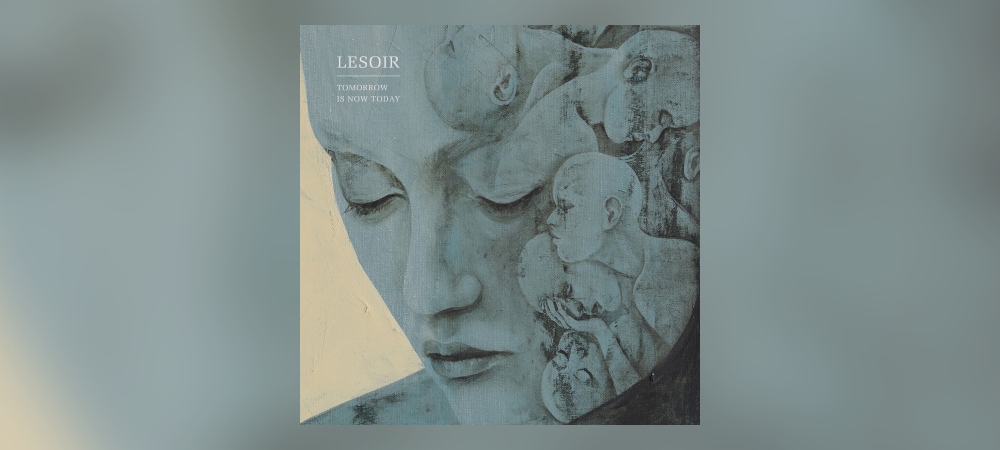
Lesoir are a six-piece band hailing from Maastricht in the Netherlands. Since their 2009 self-titled debut, there has always been a passionate sense of immediacy and urgency in their music, which is particularly evident in their live performances. Their songs have never shied away from confronting challenging topics, often articulating the viewpoint of mistreated or damaged people who are overlooked by society. “Tomorrow is not waiting anymore, tomorrow is now today” is the urgent message proclaimed by Lesoir’s latest album. As humans we are often guilty of ignoring uncomfortable truths, hiding them under the carpet and promising ourselves we will deal with them tomorrow. But it is becoming too late to procrastinate on the future of our world. Tomorrow is now today, and it is time to seize the moment, speak out and take action. In this, Lesoir’s seventh studio album, the lyrics explore pressing global issues including violence, war and climate change, but viewed from a deeply human perspective.
The band describe their style as art rock, and the tracks on this album are for the most part relatively compact in length, and based around conventional verse and chorus structures. But this is music that defies genre in order to communicate its ideas, drawing freely on progressive elements, post rock and modern electronica, as well as integrating ethnic influences and heavier, metal-infused passages. Dramatic contrasts between delicate, intimate textures and densely layered, cinematic walls of sound create exciting and impactful dynamic shifts that significantly heighten the music’s intensity.
Is It Nothing, inspired by William Lovelace’s Gaia theory, poses a stark choice: do we ignore the danger signs in the natural world or do we acknowledge impending disaster and take action? A sense of urgency is immediately established, as the ticking of the doomsday clock morphs into a dystopian dance track of eerie electronic percussion and sampled vocals over a looped bass line. Maartje Meessen’s agile vocal lines have a beguiling sense of spontaneity, following the natural rhythms of speech and transitioning on the turn of a sixpence from fragility to passionate intensity. In the second part of the track the despondent repetition of “nothing” is challenged by the effortlessly floating vocal harmonies of “believe it is real”, building through sumptuously layered instrumental textures and bombastic drums to a searingly emotional guitar solo. This is a stunning and impactful opener which sets a high bar for the rest of the album.
Lesoir describe the compassionate and moving Back to You as “a sincere tribute to courage in the face of conflict”, and the lyrics refer particularly to the bravery of the Ukrainian President and people. The band use a real string quartet on this album, bringing additional warmth and emotional depth to the sonic palette, and this is used to compelling effect on this track. The opening has an intimate, almost folky flavour, the heartfelt vocals complemented by mellow guitars and the organic warmth of the yearning violin melody. An enthralling instrumental section opens with gently pulsing guitars and ethereal vocals, swelling through atmospheric post rock sonorities to an uplifting eulogy for those who “already gave their lives for peace and for glory”. The track ends poignantly with the question that is on the lips of all who are involved in the world’s many conflicts: “when does this fight end?”
Hidden Fire is a compact but powerful track that travels from uncertainty and self doubt through frustration and anger to triumphant positivity. Ingo Dassen and and Rutger Martens’ dual guitars carry us effortlessly between delicate acoustic soundscapes and heavier, rhythmically complex textures, and Maartje’s agile flute leads us into an exhilarating, world music-inflected instrumental caper featuring scampering rhythms and exotic scales. The track peaks with a defiant affirmation of authenticity and personal conviction – the titular “hidden fire” – and closes with a brief but stirring guitar solo from Ingo.
Nadeli is the first of two tracks showcasing the band’s outstanding instrumental skills. Contrasting episodes lead us through a constantly evolving landscape of moods and styles, underpinned and unified by the alternating pairs of tersely enigmatic guitar chords that open proceedings, joined later by a melancholy flute melody. Syncopated Latin rhythms on spectral guitars and staccato synths introduce a ghostly dance, the texture amassing complexity as additional voices join the intricate choreography. Distorted guitars subvert the proceedings like delinquent teenagers, steering the party towards a frenzy that is abruptly truncated by the return of the rhythmic chords from the opening. A stately folk music-infused melody promises to carry us serenely towards the conclusion but the terse guitar chords return once again to end the track as enigmatically it began.
The intense and disturbing Free Pass is a terrifying depiction of how a moment’s excitement can lead to a lifetime of regret. With the graphic immediacy of a disaster movie a chorus of thundering drums and aggressive vocals explodes onto the scene above tensely simmering electronica. Maartje’s agitated and emotion-charged vocals advance the action during the verses, with Staf Wouter’s restless bass lines heightening the tension, before the frenzied violence of the chorus crashes back in. The second part of the track explores the event’s aftermath. Police radio voice-overs float above a sinister backdrop of pattering percussion and suspenseful synth chords. We approach an eerie calm as lightly floating vocals interweave with a regretful melody on high strings, but it is the implacable chorus that has the last word, blazing in the darkness like a traumatic flashback that can never be erased.
La Même Langue artfully uses French lyrics to expose the challenges and superficiality of everyday communication. The spoken text, murmured gently above a hypnotic web of piano, acoustic guitar and strings, describes how we all appear to speak the same language but never really understand each other. In a sudden, impassioned outburst the dream shatters and the vocal melody is almost screamed out against a heavy, post-rock infused soundscape. Only by breaking through the surface to expose our deepest fears can we truly communicate. In contrast, Stay Close to Me is a tender and heart-warming song about the love of a parent for her child, showcasing the gentler side of the band. It pushes no boundaries but boasts infectiously catchy hooks, bewitching melodies and transparently delicate instrumental textures.
Pendulum is the album’s second purely instrumental track. It flashes before the eyes like a dream, but is crafted with inspired precision. Like the captivating Aeon from Push Back the Horizon, the music swings its way effortlessly through a phantasmagoria of styles. Lesoir’s choice to use two percussionists – Bob van Heuman on drums and Ramon Reijnders on live percussion and beats – really scores in this track, creating vibrant tonal colours and complex layers of contrasting rhythmic patterns. A hypnotic nocturnal cityscape of pulsing beats, off-beat bass and bright splashes of guitar and cymbals gives way to a swinging night club vibe, featuring a syncopated dance beat disrupted by raucous stabs of jazzy guitar. A theme that would not be out of place in a 70’s action movie slips into a post rock soundscape of slowly moving harmonies before plunging us back, via the exotic rhythms of the night club, to the dreamy electronica of the opening.
In Army of Love we find Lesoir eloquently setting out one of their central manifestos: however dark the world might seem, never give up hope. This beautiful song, referencing people who have been displaced from their home country, shifts from intimate, gossamer-light vocals and gently twinkling piano to a luminous blend of soaring vocals over a rich orchestration of post rock sonorities. Darker times are powerfully evoked by minor key harmonies, distortion and dissonance, but the people who love and care about us line up like the stars to challenge the darkness and are celebrated with a radiant wave of cinematic splendour, before hushed piano gently fades out the track.
The gently contemplative title track, Tomorrow Is Now Today is saved till last. The simple but haunting instrumentation perfectly complements the lilting vocal melody, which is gently swathed in layered harmonies. Whispered warnings, alternating “today” with “too late”, hover in the background reminding us of the urgency of our predicament. Rather than ramming their message down our throats, Lesoir leave us with challenging questions to ponder in our hearts.
In their detailed and illuminating notes for this album, Lesoir describe their sound as “urgent, cinematic and deeply human”. The first five tracks in particular certainly establish a compelling sense of urgency, with their dramatic contrasts, complex driving rhythms and intense, passionate performances. For me, there is a lessening of tension in the latter half of the album which creates a slight sense of imbalance, and could be seen as reducing the impact of the message, but that is a minor quibble. What is never in question is the emotional commitment that inspires every note of their music, finding ultimate expression in Maartje’s lyrics and vocals. John Cornfield’s production and Steve Kitch’s mastering have helped to create a beautifully balanced soundscape in which every layer and nuance shines through.
With Tomorrow Is Now Today, Lesoir have created a vibrant and contemporary album with a crucial message for our time, and one of this year’s strongest and most impactful releases so far. Whether or not you are familiar with their music, this is an album you should add to your collection sooner rather than later – after all, tomorrow is now today!
TRACK LISTING
01. Is It Nothing? (7:06)
02. Back To You (3:52)
03. Hidden Fire (4:33)
04. Nadeli (6:45)
05. Free Pass (4:51)
06. La Même Langue (2:57)
07. Stay Close To Me (4:27)
08. Pendulum (4:58)
09. Army Of Love (4:12)
10. Tomorrow Is Now Today (3:04)
Total Time – 46:45
MUSICIANS
Maartje Meessen – Vocals, Flute, Keyboards, Guitar
Ingo Dassen – Guitars
Rutger Martens – Guitars, Pedal Steel
Ramon Reijnders – Percussion, Beats Programming
Staf Wouters – Bass
Bob Van Heuman – Drums
ADDITIONAL INFO
Record Label – Independent
Country of Origin – The Netherlands
Date of Release – 23rd October 2026
LINKS
Lesoir – Website | Facebook | Bandcamp | YouTube | X | Instagram