
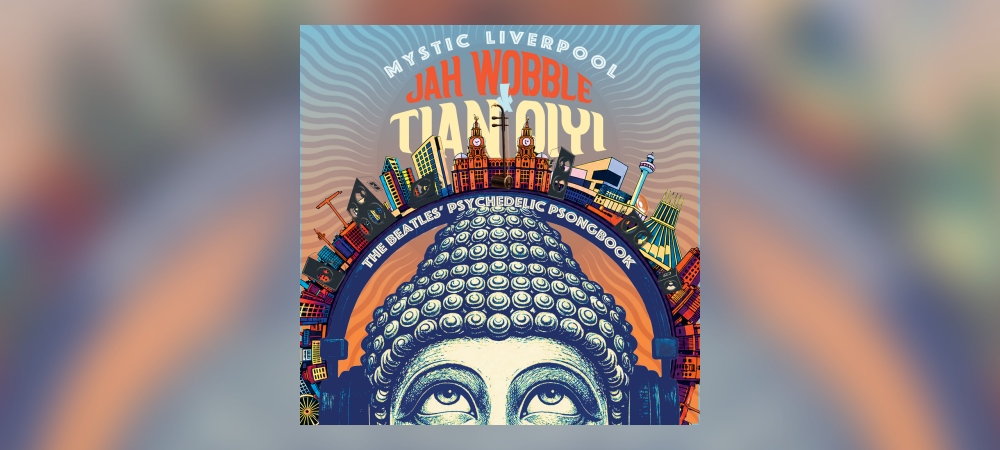
As I said before in my review of We Can Work It Out: Covers of the Beatles, 1962 – 1966, Beatles music is like comfort food to me, and I’ll always be fascinated to hear other musicians’ takes on the catalogue that may be the most famous in music history.
But who’s the contender this time around? None other than Jah Wobble, a prolific bassist who rose to prominence in the post-punk era and made his name with Public Image Ltd. Admittedly, I’m not familiar with this artist, although I did briefly hear his bass on Have a Cigar when I reviewed Still Wish You Were Here, and I remember thinking he had an odd stage name. He’s joined by his sons John T Wardle and Charlie Wardle – as a duo, they go by Tian Qiyi – while his wife adds zither on Strawberry Fields Forever, making this a real family affair. John T was also in charge of recording and mixing, so the album feels essentially ‘bottled at the source’.
But what songs will the Wardle family choose to play? The hints are glaringly obvious in the album’s title – these are on the more psychedelic end of the Beatles’ wide-ranging spectrum, and focus on songs recorded between late 1965 and early 1968. No Penny Lane here. In the booklet, Wobble explains that his favourite Beatle was George, and that really comes as no surprise when you peer at the tracklist and find all three of George’s Indian style songs plus Norwegian Wood, where Harrison famously introduced the sitar to Western audiences. However, Lennon beats Harrison on this tracklist 5-4 (if we’re ignoring the shared credit on Flying), which I suspect is only because John wrote far more songs than George. Paul doesn’t even get a look in, but Wobble does credit him as an excellent and innovative bass player in the notes.
The proceedings begin well with an intense, rhythmic and undoubtedly psychedelic rendition of Tomorrow Never Knows, one of the Beatles’ most vital, revolutionary songs. With only one droning chord to play, it’s pretty hard to get this wrong, and Wobble’s bass gives the song a new texture to develop around.
Strawberry Fields Forever unfolds in a languid, dreamlike cacophony, John T’s drums not keeping a strict rhythm but anchored by his father’s thick bass line. The production swells during the choruses and quietens down for the verses. Charlie’s vocals seem purposefully restrained, not following a melody, but hinting at the original; it’s a bold artistic choice. The song is nothing like the original, but I’m impressed at this pared-back version.
Within You Without You always used to be the track I’d skip on St. Pepper, but as my tastes have matured, I’ve discovered more room for it. Here, Wobble and John T hold down a complex but unchanging 4/4 psychedelic beat for Charlie to sing over. It was difficult to find the 1 at first, and Charlie’s performance seemed completely detached from the beat, but once I found it – it was easier when I dropped into the middle of the first verse than when I started at the beginning of the song – I felt locked in, and the whole thing clicked.
Unfortunately, the praise largely ends here. Wobble and family seem to have frontloaded the album with their best work, and hoped that people won’t pay attention to the rest. Wobble and Qiyi are clearly interested in hypnotic minimalism and unchanging rhythms and chords. Tomorrow Never Knows and Within You Without You were suited well to this style, but the remainder of the tracks simply don’t work. Wobble and John T pick a bass line and rhythm for each song and simply stick with it while Charlie does his best to sing on top. Songs like I Am the Walrus and Norwegian Wood simply sound like hollowed-out shells of songs, while Blue Jay Way loses the drama that was found in the shifting tempo of the original.
These versions gave me a chance to reassess George’s controversial ‘Indian Period’. I’m guessing there is a large swathe of people who’d refer to themselves as Beatles fans who’ve never listened to The Inner Light, released as the B-side to Lady Madonna in March 1968. It’s an oddity in the Beatles’ catalogue as it’s the only Beatles recording produced outside Europe, with Harrison hiring Indian musicians in Mumbai.
But I’d never paid attention to the vocals before, in which Harrison preaches that ultimate truth can be found by looking inward: ‘without going out of your door’ and ‘without looking out of your window’. I find this message to be frankly absurd, and presented without any evidence whatsoever. Sure, it’s good to know oneself, but you simply can’t ‘see all without looking’. It’s quite ironic that the man who travelled to India so many times to understand the culture would sing “The farther one travels / The less one knows”. I wonder what Wobble himself sees in these lyrics. At nearly 7 minutes, the Wobble version is more ambitious and more satisfying musically, and feels more like an instrumental journey after the verse ends. I’m happy to report that The Inner Light is the one cover on this record that I actually prefer to the original.
At the start of the final three shorter tracks, the trio offer a passable but inferior rendition of Love You To. John T isn’t as consistent on the drums here… if they really wanted to make a hypnotic, dub version of this track, they could have committed harder to the part. Flying is pared down to be almost unrecognisable; only a weak synth carries the melody from the original to make it technically count as a cover. Rain finishes out the album in a light and frankly unremarkable way. For this track, the Beatles used a revolutionary technique by slowing down the rhythm track that they’d played 20% faster to stretch out their sound and give the song a dreamlike feel. While Wobble and Qiyi also achieve something dreamlike, it feels far less revolutionary. Charlie’s feeble vocals fail to recapture John’s passionate mantra, and the whole thing feels like a mess compared to the technical marvel of the original. I’m not quite sure what they were going for with this one.
If they’d packaged the first three tracks and The Inner Light as an EP, this would have been a solid release; instead, it seems as if the family overextended themselves to produce a full album’s worth of material. It’s clear that the Fab Four meant a lot to the Wardles, but unfortunately their passion doesn’t always translate unless you happen to be on the same wavelength. Experimenting with filtering Beatles songs (known for their musical vibrancy) through minimalism was always going to be risky.
TRACK LISTING
01. Tomorrow Never Knows (5:27)
02. Strawberry Fields Forever (4:27)
03. Within You Without You (6:36)
04. I Am the Walrus (4:10)
05. Norwegian Wood (5:23)
06. Blue Jay Way (4:51)
07. The Inner Light (6:42)
08. Love You To (3:24)
09. Flying (2:17)
10. Rain (3:15)
Total Time – 46:28
MUSICIANS
Jah Wobble – Bass
John T (Tian Qi) – Drums, Chinese Percussion, Yangqin
Charlie (Tian Yi) – Erhu, Vocals, Morin Khuur (2)
~ With:
Zi Lan Liao – Guzheng (2)
ADDITIONAL INFO
Record Label: 30 Hertz | Cherry Red Records
Catalogue#: 30HZCD49
Country of Origin: UK
Date of Release: 14th August 2026
LINKS
Jah Wobble & Tian Qiyi – Website | Facebook | Bandcamp | YouTube | X | Instagram
![Eyes Of Blue – The Light We See: The Recordings 1969-1971 [3CD Box Set]](https://theprogressiveaspect.net/wp-content/uploads/2024/10/Eyes-Of-Blue-–-The-Light-We-See-150x150.jpg)

