
As a film lover, I’ve long admired Werner Herzog’s astounding and often bizarre catalogue, ranging from fever-dream-like tales such as Aguirre, the Wrath of God to tributes like Nosferatu the Vampyre and unbelievable jaw-dropping visuals such as the famous hauling of a 320-ton steamboat over a muddy hill in Fitzcarraldo. While I’d previously associated Popol Vuh with Tangerine Dream and krautrock (a genre I’ve had rather limited success in enjoying), the atmospheric accompaniments to Herzog’s films introduced me to a warm, restrained, pleasant-sounding group that I would like to explore one day.
That day has finally come with Esoteric’s decision to reissue two of the group’s earliest albums: their debut Affenstunde (‘Monkey Hour’) from 1970 and their fifth album Einsjäger und Siebenjäger (‘One-Hunter and Seven-Hunter’) from 1974. Not knowing anything about the group when I began my listen, I believed the two albums were actually consecutive and was dumbfounded by how different they sounded. In fact, these are the third and fourth Popol Vuh albums to receive a vinyl release on Esoteric: In den Gärten Pharaos and Hosianna Mantra (the band’s second and third albums) appeared last October.
Nature sounds greet the listener on Affenstunde’s first side in a manner that will remind many a prog-listener of Close to the Edge, but it’s important to point out that Affenstunde came first. Rather than descend into jazz-fusion madness as Yes did, however, the listener is plunged underwater to hear the sci-fi wibblings of the group’s various synthesisers, including Fricke’s famous Moog. Perhaps the band intended for this sound effect to reflect going for a dive, but my mind equates the splash sound to having your head held forcibly underwater.
Musique concrète is hard to get right, and its success is highly dependent on the listener. I’ve frequently listened to the bleak yet oddly comforting industrial sounds of David Lynch’s intense Eraserhead soundtrack. Having been intensively and scrupulously designed by the director with the help of sound designer Alan Splet, it has the reassuring quality of white noise while featuring vague additions as undistracting decoration. Ich mache einen Spiegel does not have that quality, and the twiddling keyboards tend to get too loud and feel sharp in the ear.
Only, it gets worse. The following, lively section features four straight minutes of noisy, unsynchronised, improvised percussion. It’s like an alarm bell ringing in your head. I don’t understand who this is aimed at. The final part of this 21-minute suite (dubbed ‘Part 49’ after we just heard ‘Part 4’ and ‘Part 5’, it’s unclear if Florian Fricke learned to count) is more bearable with soft droning, but isn’t exactly engaging.
The second side features the sidelong title track and is a considerable step up. The first five minutes feature dark dungeon-like sounds over a pulsing 4/4 low-register synthesiser riff. After this appetiser fades, a more optimistic chord begins to drone and lasts all the way to the end of the track, with the band members sporadically improvising on top. While still far from the kind of sounds I actively seek, Side B does sound a lot more like music than Side A.
Imagine my surprise when I laid the needle down on Einsjäger und Siebenjäger afterwards and heard nothing but acoustic instrumentation (plus an electric guitar) and a rock drum kit. The warm sounds of the piano and acoustic guitar felt a million miles from the cold synthesisers of Affenstunde; how could this be the same group?
The short tracks on Side A run the gamut from energetic and exciting on King Minos and Würfelspiel to soft and pensive on Morgengruß and Gutes Land. While there’s a vague hint of a framework for the duo of Fricke and Fichelscher to play by, the album is ruled by bursting spontaneity, normally in a major key so that the album feels warmly optimistic.
Side B features the sidelong title suite, apparently recorded in one take, although Fricke has said it was Side A that was recorded in one take; maybe he forgot which side had the long suite on it. Even if that’s the case, I question how it would be possible to record the entire suite live with just two main performers: how is it I can hear piano, guitars and drums at the same time? I’m guessing the guitars were overdubbed.
Djong Yun joins the fray, providing scant vocals, strategically placed within the structured chaos of the otherwise instrumental affair. It’s more of the same style of music from the first side, but the nineteen minutes afforded to this piece allow the ideas to grow and blossom more naturally. The group don’t hold back just because they’re improvising, occasionally locking into tight grooves, with Fichelscher’s propulsive drumming as the track’s engine.
Despite opening with a dark, subdued intro, the suite is largely in a major key and seems to provide endless spiritual hopefulness and optimism. This lightness, as well as the band’s adventurousness, keeps the track from buckling under its own weight. I couldn’t help but compare the piece to jazz in how it seamlessly blends composed parts with improvisation, but the music’s timbre is squarely in the rock camp.
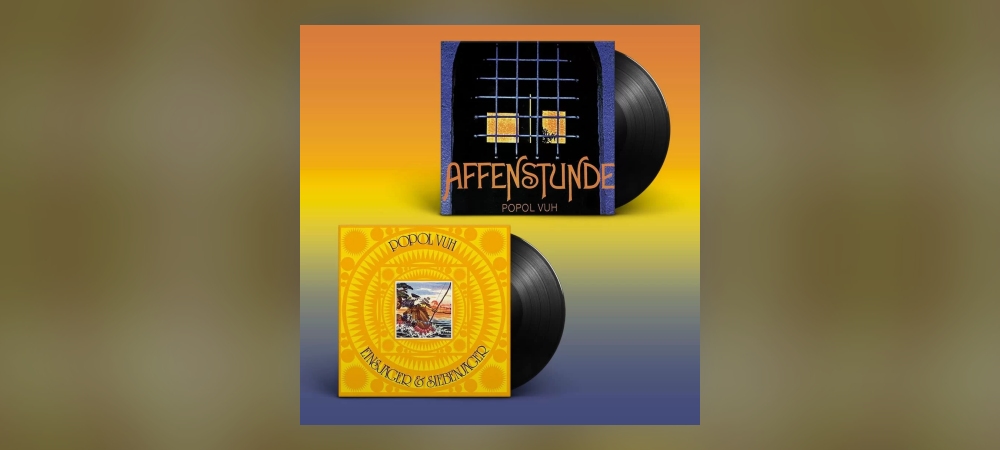
Esoteric’s reissues are gorgeous things indeed, fully recreating the moody, photographic artwork of the gatefold debut and the stunning yellow-and-orange, patterned, single sleeve of Einsjäger und Siebenjäger. This Affenstunde release also contains a band poster with the earliest incarnation of the group framed by a vast blue sky containing the band name and album title; I wish Einsjäger und Siebenjäger also came with a poster as it’s my preferred album. While Esoteric have gone to decent lengths to recreate the original German credits on the sleeves in something close to the original font, I noticed a spelling error: “Bearbeiter von Florian Fricke” rather than “bearbeitet von Florian Fricke”. I’m not saying it’s a big deal, but I would feel I hadn’t done my job properly as a reviewer if I didn’t report it.
It’s a sign of how quickly the music scene was changing in the 70s that two albums released by the same band just four years apart could sound so drastically different. Fricke lost interest in playing electronic keyboards after In den Gärten Pharaos, opting for a more acoustic approach instead; this reviewer is pleased with his choice as Einsjäger und Siebenjäger is significantly more satisfying to listen to than Affenstunde, bold and experimental as that debut album is. Perhaps these records would be more enticing to jazz enthusiasts; I, on the other hand, remain to be convinced that improvised music can be just as satisfying as composed songs, as the chaos on both albums fails to grab my attention the way standard music tends to.
TRACK LISTING
Affenstunde
Side A
01. Ich mache einen Spiegel (Dream Part 4) (8:50)
02. Ich mache einen Spiegel (Dream Part 5) (4:36)
03. Ich mache einen Spiegel (Dream Part 49) (7:41)
Side B
01. Affenstunde (18:36)
Time – 39:44
Einsjäger und Siebenjäger
Side A
01. Kleiner Krieger (1:11)
02. King Minos (4:31)
03. Morgengruß (2:59)
04. Würfelspiel (3:14)
05. Gutes Land (5:18)
Side B
01. Einsjäger und Siebenjäger (19:29)
Time – 36:42
MUSICIANS
Affenstunde
Florian Fricke – Moog Synthesizer
Holger Trülzsch – Percussion
Frank Fiedler – Synthesizer Mixdown
Bettina Fricke – Cover Design, Production, Tablas (un-credited)
Einsjäger und Siebenjäger
Florian Fricke – Piano, Spinett
Daniel Fichelscher – Electric & 12-String Guitars, Percussion
Djong Yun – Vocals
~ With:
Olaf Kübler – Flute (4)
ADDITIONAL INFO
Record Label: Esoteric Recordings | Cherry Red Records
Catalogue#: ECLECLP 2946 (Affenstunde) | ECLECLP 2947 (Einsjäger und Siebenjäger)
Country of Origin: Germany
Date of Release: 31st July 2026
LINKS
Popul Vuh – Website | Facebook | YouTube | Instagram
Cherry Red Records – Affenstunde vinyl info | Einsjäger und Siebenjäger vinyl info
![Eyes Of Blue – The Light We See: The Recordings 1969-1971 [3CD Box Set]](https://theprogressiveaspect.net/wp-content/uploads/2024/10/Eyes-Of-Blue-–-The-Light-We-See-150x150.jpg)

