
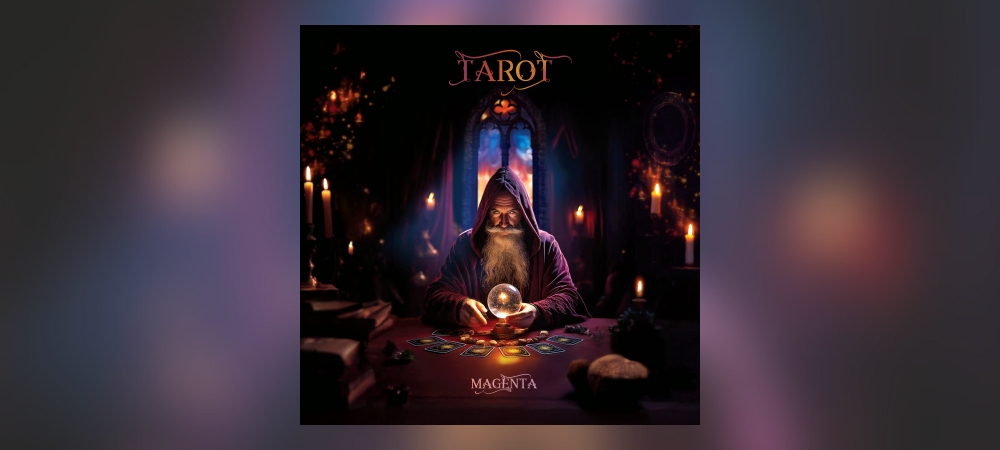
Magenta celebrate their 25th anniversary with their first fully new studio album in six years with Tarot. This is a band which has explored various styles over the years, always with their trademark stamp of high-quality melodic rock, but in Tarot they probably present their most distinctive sounding album of their career. Tarot just sounds so uniquely and consistently like an album that only Magenta could have created.
In some ways Magenta have returned to their earliest inspirations, but have now fully realised that vision with so much brio and skill. In an interview with TPA, to be broadcast on The Prog Mill on Sunday March 15th as part of a ‘Magenta Tarot album special’, Rob Reed revealed that Magenta’s epic 2001 debut album, Revolutions, had originally been inspired by his love of the iconic 70’s orchestral prog band Renaissance. He shared that whilst recording Tarot he listened back to some of the songs and realised that he had been subconsciously drawn back to that Renaissance template. However, on Tarot he felt Magenta have achieved a much more fully realised orchestral approach, but have embellished it with their own inimitable distinct flavour. The echoes of classic era Renaissance are unmistakable, but this is no slavish tribute to that iconic group. Instead, Magenta have taken and developed significantly from that blueprint, enhancing that template with Chris Fry’s stellar electric guitars, which had not been a big feature for Renaissance. Alongside Fry, Reed plays punchy bass work and fluid keyboards, all topped off with some wonderfully complimentary orchestration providing the perfect framework for Christina Booth’s heavenly vocals.
Over the years Magenta have focused on a fascinating range of themes for their albums, including the Seven Deadly Sins with Seven, the premature deaths of a series of cult figures in The Twenty Seven Club and classic Horror film stars in Masters of Illusion. What is distinctive about the Magenta approach is that their lyricist Steve Reed (brother of Rob Reed) has the knack of finding a different twist about the subject about which he is writing, such as in Gift from God from Masters of Illusion about Christopher Lee’s great unfulfilled yearning to sing opera rather than be restricted to Horror movies!! On Tarot Steve was presented with a set of 6 or 7 pieces of music all with working titles of characters which Rob Reed had given the pieces based on what he felt the music evoked for him in his imagination, such as ‘King Arthur’ or ‘Mozart’. Rob Reed explained in that TPA interview that when he sends Steve the songs he has sung over them very rough guide vocals often with ‘gibberish’ words placed there to give Steve the idea of how he wanted the lyrics to be phrased to fit in with the melody and rhythms. Steve then goes away, researches the subjects and comes back with his often-quirky angle on these characters, and then Rob will work on them further, sometimes adapting and honing the music to even more convey the character or story associated with the person or theme. This is an intuitive and evolutionary process, and on Tarot the brothers have really hit new heights in how they have melded words and music in glorious synchronicity.
But where did the idea of the overarching title of Tarot originate to bring together songs about characters as disparate as Guinevere, Harry Houdini, Joan of Arc and Mary, mother of Jesus!!??
Rob Reed has shared that one of the working titles for the Tarot album was Portmanteau, based on a series of classic horror films from the 60’s and 70’s, comprising a series of short stories with one unifying plot device. One of Rob and Steve Reed’s favourites of these portmanteau movies was the rather archly titled ‘Dr. Terror’s House of Horror’ from 1965, starring Christopher Lee, Peter Cushing, a young Donald Sutherland, and even rather bizarrely Roy Castle and Alan ‘not arf’ Freeman!! In the prologue, set on a train, Peter Cushing as ‘Dr. Schreck’ (German for ‘Terror’) deals a pack of Tarot cards, telling of the fate of five travellers. Rob and Steve Reed felt that this would be an ideal vehicle to draw together the five very different people in the songs, with each song character associated with a different Tarot card. It is an imaginative and typically eccentric device from Magenta to pull these songs together… but do they work as songs?
The Lovers triumphantly commences like some sort of medieval adventure story with heroic sounding strings and horn sounds. It is clear that we are entering some sort of Arthurian romance adventure, with echoes of one of Reed’s other projects, Cyan and their epic The Sorceror. The Lovers does have an Arthurian theme, but Steve Reed gives it a definite Magenta twist as the lyrics focus on Guinevere’s affair whilst Arthur is away… but in this version of the story the affair is not with Lancelot. Instead, Steve Reed imagines about Guinevere; ‘…it wasn’t Lancelot or Arthur who were the true object of her affections, it was Arthur’s sister Morgan Le Fay. So the song is about Guinevere’s forbidden love for Morgan Le Fay’ … which is certainly an unexpected twist. Alternating between rollocking passages which fly along, strings, keyboards and drums thunder alongside more delicate piano and synth sections. Reed reprises the main melodic theme with aplomb and then Chris Fry injects an almost bluesy guitar solo. Indeed, this is the first indication of a rather different and more textured distinctive guitar style from Fry on this album, a long way from his often Steve Howe, Yes styled guitar play. The finale alternates between fury and softness with choral effects and synth fanfare before Booth’s voice spirals skywards. The Lovers ends sensuously with a softly tripping piano and Christina quietly intoning ‘I will follow you, my King’ – what a great way to open up the album.
Between each main song on Tarot are a four short Etudes, composed by Chris Fry, based on themes from the album. In the TPA interview Reed explains that when he was developing the album he had a feeling that the listener could become a little overwhelmed by the weight of production and scale inherit in the main songs and that they might need breathers of ‘musical palate cleansers’ between each ‘course’ of the Tarot album. All of them are under 30 seconds, but they are all delightful little musical gems.
Tarot takes another idiosyncratic perspective on an iconic figure in The Magician, which goes nowhere near sword and sorcery. This song considers the famous early 20th century magician and escapologist Harry Houdini (Eric Weiss) but Steve Reed chooses not to focus on his amazing feats of escape. He shares that Houdini was also:
‘a fake psychic medium hunter. Part of his mission in life was to expose fake mediums who prayed on the grief and vulnerabilities of people who were grieving for lost loved ones… The song sees him at the end of his life and saying that he was about to find out if his life’s work was justified… he told his wife that if there was an afterlife and mediums could contact the spirits of deceased people he would let her know somehow. He never did’.
A grand opening recedes to a plaintive Christina vocal over a gentle backing and the refrain ‘Come Join us’ perhaps portraying the fake gentleness of a medium soothing a grieving person in a séance to fraud them of their money, as evinced by clever lyrics: ‘Find a way to forgive… give what you can’. Suddenly a brighter, more optimistic passage opens out with horns and strings (and great bass) in which Houdini is clearly debunking these tricksters with lines talking about a ‘web of lies’ and Fry briefly soars with a lush guitar solo. Houdini is clearly shown as a heroic figure trying to save vulnerable individuals from having their grief cynically exploited. A lovely lyrical guitar passage is followed by a soft clarinet and piano which takes us to the end of a stirring and imaginative song which reveals a little-known facet of this iconic figure.
Christina Booth’s singing is particularly expressive, emotional and touching on this song. Indeed, Tarot is probably one of her finest vocal performances. Rob Reed shared in his TPA interview that unlike previous Magenta albums he was much more conscious of writing songs with her voice in mind, rather than expecting her to contort her voice into all sorts of directions for whatever he threw at her lyrically!
The next main song had a tortuous route to the album as Rob Reed admits he struggled for a while to refine The World, based on Mozart. Indeed, quite late in the process he withdrew the song from the album as he did not think it was working! He then worked on it a little more to knock into shape as a ‘bonus track’ on a deluxe version of the album, but something suddenly ‘clicked’ and it opened up for Rob Reed to hone it into what he believes is the best song on the album… and who are we to argue?! It’s gorgeous. Steve Reed explains that Mozart was:
‘A child prodigy, touring the capitals of Europe playing for Kings and noblemen, supported and accompanied by his father… He finds it easy to write, knowing what is popular at the time… It shows the ups and downs of his career. The song follows him through a life of fame and fortune, adoration and jealousy right up to his death bed where he looks back on his legacy of music, but also realises that some people aren’t always what they appear to be.’
Rob Reed has shared that he really struggled to crack this song as he was seeking a ‘feel’ that was akin to the optimism and light of classic era Renaissance and Yes songs, but he felt he finally succeeded and The World is resplendent with lovely harmonies and delightful melodies, echoing the music of the great Mozart, Rob Reed’s favourite composer. Recorders, acoustic guitars and delicate piano compliment Booth’s beautiful voice. Fry embroiders the piece with his own beautifully expressive subtle bluesy guitar notes. Strings underpin some lovely harmony vocals before a more triumphant synth and electric guitar welcomes in a simple but joyous verse: ‘You are the one, you are my sunshine’ which leads to short, rippling Steve Howe-like guitar and some absolutely ecstatic vocals from Christina – she’s never sounded quite so glorious. A glorious piano and keyboard led finale builds to another great Fry solo until it all fades away with a plaintive piano motif. Boy, after that lushness, do we need an Etude ‘breather’, with a brief mandolin and recorder interlude.
Strength is probably the most straightforward song on Tarot musically and lyrically, based on Joan of Arc. This is based on the story of Joan of Arc, as outlined by Steve Reed:
‘It is about the reasons for her to take up arms and how, as an inspiration to many, in the fight she had her doubts about whether she was worthy of this trust and faith from her followers. She was eventually captured by the English and basically tried as a witch and burned at the stake. The last verse being her plea to her God before finally, in her eyes, meeting him.’
Understandably with such a theme there is a martial edge to the music. Chris Fry slips in a dreamy guitar sequence before some more contemplative vocals and soft piano. In truth this is one piece which does not quite work as well as the other songs on the album for this listener. Alternatively, it may just be that it pales a little in comparison, being sequenced between two of the finest songs on the album (and indeed in the whole canon of Magenta songs), in The World, and the swirling epic grandeur of The Empress, which is one of the crowning jewels of this album.
The Empress is based upon of Mary, the mother of Jesus. Steve Reed shares that:
‘It is taken from a mother’s point of view being so proud of her son and what he has achieved. Being loved and hated in equal measure. Gradually she can see where this is all heading and the fear sets in about his future. Her final pledge being that she will always be there for him and ultimately that she would die for him juxtaposed with the fact he is about to die for all of mankind.’
Bizarrely, Rob Reed shared with TPA that originally the song was going to be about Hitler (yes, honestly!!!), which frankly sounds a bit bonkers. However, he clarifies that the original idea behind the song was from the perspective of a parent proudly holding their baby and dreaming what would they become as the baby grew up, which even Hitler’s parents must have done when he was a baby. Thankfully Rob and Steve Reed decided to take the song in a rather different direction imagining how Mary must have felt about her son, going from her pride but gradually realising her Son’s final fate as the crowds turned on him. This is a great theme for a song, evidently suffused with some sense of faith and an insight into humanity and a mother’s love… but does it work as a song?
Well, the answer is very much a categorical ‘Yes’. The Empress is truly Tarot’s trump card, bursting with energy, memorable melodies, thrilling rock passages and drenched with emotion. Christina sings with passion and strength, backed by a band in perfect unison. The top-class drummer for this song and the whole album is Nick D’Virgilio of Big Big Train and other stellar artists such as Steve Hackett, Spock’s Beard and Frost*, to mention just a few. Indeed, he previously worked with Rob Reed on the 2015 charity single, the glorious re-imagining of Steve Hackett’s Spectral Mornings. D’Virgilio particularly excels on The Empress driving it along smoothly with great rhythm. A more restrained, contemplative mid-section features the sort of organ work Tony Banks would have been proud of, followed by a melancholic clarinet sound. The Empress is a tremendous way to finish the main album.
Magenta conclude with one final beautiful Ace up their sleeve with the ‘coda’ piece, the title song Tarot, which was written quite some time after the rest of the album. Rob Reed shared with TPA that after finishing the other songs he came to the conclusion that the ‘weight’ of all these rather intense orchestrated pieces, layered with production and ornate instrumentation, might be a little overwhelming without providing something lighter, more melodic and more immediately accessible as a way to lighten the atmosphere and leave the listener wanting more. He came up with the lovely Tarot, and ends up managing to produce one of the finest songs ever written by Magenta. Christina Booth excels with soft but inspiring vocals over Reed’s flowing piano melody and pastoral organ sound. Fry’s subtle acoustic guitar adds more beauty to this simple but beguiling song. A short mellotron section opens up the mid-section carried on acoustic guitars. Guests Steve Balsamo (of Chimpan A), and Peter Jones (of Tiger Moth Tales and Camel) provide lovely soulful backing vocals as a fine counterpoint to Christina’s voice. It all sounds rather moving. Christina’s voice raises emotionally, leading to drums, bass and a short but gorgeously soaring electric guitar piece… and then Tarot trails away wistfully on a simple piano and Christina breathing ‘Move, on, move on, move on…’. Such a beautiful, melodic and touching finale to a wonderful album.
Tarot is such a well written and performed album, with impeccable sound production, filled with compelling lyrics and fascinating themes. It does not take a tarot pack to predict that Tarot should become regarded as one of the best progressive rock albums of this year. Indeed, putting cards on the table, Tarot is one of the best albums of Magenta’s illustrious career. Over the last 25 years Magenta have become a guarantee of musical excellence, and Tarot confirms their place as one of modern Progressive Rock’s most outstanding bands.
TRACK LISTING
01. The Lovers (9:02)
02. Etude 1 (0:24)
03. The Magician (8:20)
04. Etude 2 (0:21)
05. The World (9:27)
06. Etude 3 (0:24)
07. Strength (10:02)
08. Etude 4 (0:22)
09. The Empress (10:08)
10. Tarot (4:40)
Total Time – 53:10
MUSICIANS
Christina Booth – Lead Vocals
Robert Reed – Keyboards, Piano, Bass & Rhythm Guitars, Recorders
Chris Fry – Lead & Nylon Guitar
~ With:
Nick D’Virgilio – Drums
Katie Axelsen – Flute
Sam Baxter – Oboe
Steve Balsamo – Backing Vocals (10)
Peter Jones – Backing Vocals (10)
Steven Reed – Lyrics
ADDITIONAL INFO
Record Label: Tigermoth Records
Country of Origin: UK
Date of Release: 10th April 2026
DISCOGRAPHY
• Revolutions (2001)
• Seven (2004)
• Another Time, Another Place (live) (2004)
• The Gathering (live) (2005)
• Home (2006)
• New York Suite (2006) (Home and New York Suite later combined and re-released 2010)
• The Singles (2007)
• Live at The Point (2008)
• Metamorphosis (2008)
• Live at Real World (2011)
• Chameleon (2011)
• Live: On Our Way to Who Knows Where (2012)
• The Twenty Seven Club (2013)
• The Singles: Complete (2 CD version) (2015)
• Chaos from the Stage (live) (2016)
• We are Legend (2017)
• We are Seven (live) (2018)
• Home (Limited Edition) (Remixed and partially re-recorded version) (2019)
• Masters of Illusion (2020)
• The Lost Reel (2020)
• Angels and Damned: 20th Anniversary Show (live) (2021)
• Songs from the Big Room (EP) (2021)
• The White Witch – A Symphonic Trilogy (2022)
• Reach for the Moon (live) (2023)
• Tarot (2026)


