
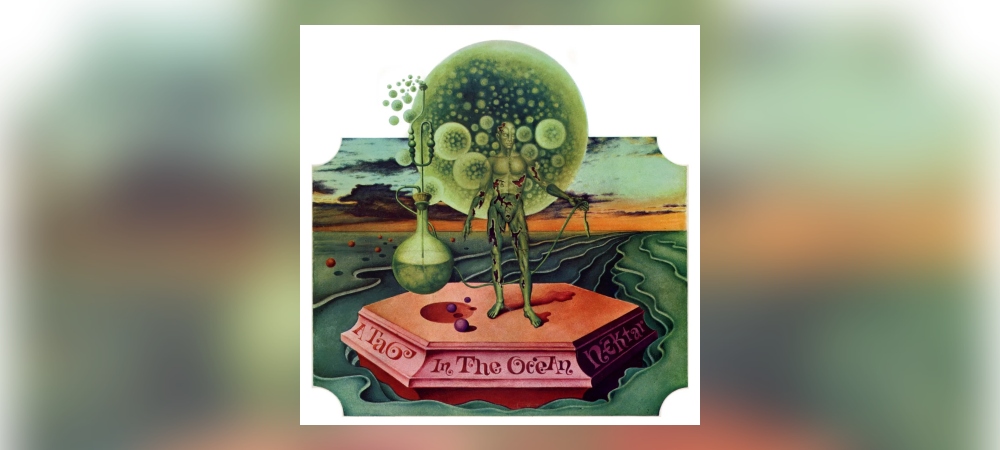
This is full circle for me. After years of discovering and rediscovering Nektar classics, I’m finally back with the album that began my collection, the band’s symphonic second outing from 1972. It was my starting place because it was the highest-rated of their albums on ProgArchives (and still is), and featured a tempting sidelong title track; these were the days when I still thought a song’s length had anything to do with its quality.
However, despite its reputation and its obvious qualifications as a top prog album, there were facets of A Tab in the Ocean that hindered my enjoyment of it and ultimately prevented me from exploring Nektar’s catalogue more than trying one other album (Remember the Future). The most glaring issue was the muddy production. ‘Muddy’ isn’t even the word: ‘swamp-like’ seems a better description. Especially in the intro section, the drums and bass all seem to bleed into an earthy mass, while the mid-range instruments become indistinguishable from each other.
I also could never find myself getting into the second side, which is also an unbroken suite like the first side, but consists of three or four loosely related tracks (Waves is often coupled with Desolation Valley). These are more noodly and less ambitious pieces, which struggle to compete with the grandeur of the title suite on Side One. The disparity between sides is not as stark as, say, Tarkus, but the problem remains, and I’m similarly disinterested in listening to Side Two.
But there are even problems on Side One. Not long after I had begun listening to this album, far back in my university days, I discovered something I’ve never been able to unhear since. The long central instrumental is made up entirely of repeated sections as if made by copy and paste. So the frantic part heard from 8:09 to 8:47 is repeated for 8:48 to 9:25, the bombastic part from 9:26 to 10:21 is repeated for 10:22 to 11:16, and the more languid part from 11:17 to 11:52 is repeated from 11:53 to 12:27. I know repetition is a common part of music practice, but I’ve never seen an instrumental so cheekily doubled in length by repeating sections with absolutely no variation. It made the instrumental feel much less interesting, as if I was only getting two minutes of music for four minutes’ worth.
Problems like this could be more easily overlooked if the album did at least sound nice, but that marsh-like production hampered any enjoyment I might wring from this acclaimed disc. I didn’t listen to it for many years, and the only time I would hear A Tab in the Ocean would be on live albums such as Journey to the Other Side.
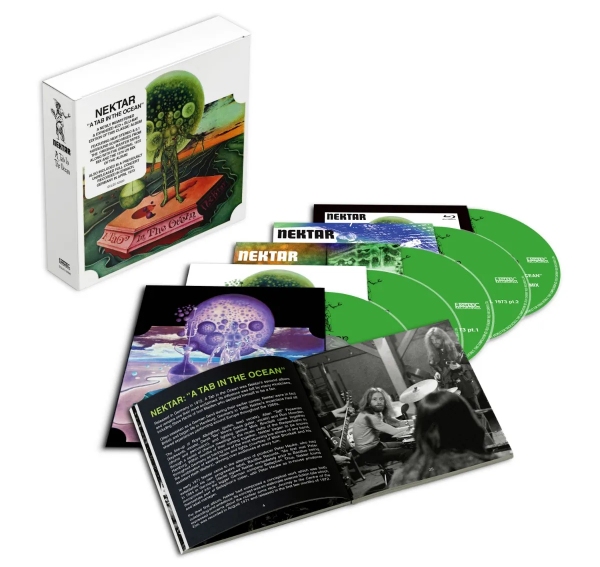
Step into 2025 and Esoteric announce a new five-disc edition of Tab to follow on from their previous deluxe editions of Nektar albums, some of which I’ve reviewed. A new mix of the album is teased, but I don’t think much of it. After all, with a mix as deeply convoluted as this, could it really be possible to make it sound good?
I put on the title track, which begins with a whooshing sound, as so many prog albums do. Allan Freeman’s familiar, undulating chord sequence rises out of this fog. Then suddenly… BANG! Wow! The first note that’s hit by all the members seemed to hit me right in the chest. Instantly, I knew this mix was going to be something different. As the band all join in, I’m dazzled and delighted to finally hear instrument separation. Okay, it doesn’t sound like a Steven Wilson album, but to be able to hear the drums from the bass finally is something wondrous. The grand main theme gives way to psychedelic verses that seem in line with the album’s title; the band had apparently joked about dropping a large tab of acid in the sea to make all the fish trip. It shows how sheltered I was that I still thought of ‘tab’ as being short for ‘tablature’, musical notation.
The rest of the suite – and indeed the album – unfolds splendidly with this new aural arrangement. The original mix of this album was the main thing holding it back from greatness, and now that it has been remedied, it shines brighter than ever. With the instruments actually sounding the way they’re supposed to, I can start to appreciate the songs on Side Two as well, the yin and yang of Desolation Valley being complemented nicely by the calm of Waves. The meandering prog rock of Crying in the Dark gives way to the percussive final song, King of Twilight; Steve Harris was a big fan of the group and decided to cover these two songs as a single track with the rest of Iron Maiden, giving a huge boost of Nektar awareness to the music-buying public. Derek Moore is still thankful in the liner notes.
The second disc of this set contains two further album mixes, the original 1972 mix and the 1976 American mix (A Tab in the Ocean had a huge delay in release there). I tried listening to the 1972 mix once again and simply couldn’t get more than a few minutes into it before turning it off. When you’ve heard how great the 2025 mix is, you’ll never want to go back to the original. The difference between the mixes is akin to the difference between trying to read with your glasses on versus without them if you’re farsighted. The only purpose it serves is to show how much better the new mix sounds.
The American mix is a different beast altogether and sounds completely unlike either of the other mixes. This faster mix causes the timbre of most of the instruments to be very different indeed, with the earthy bass tones now raised into the mid-range. I wondered how conscious a decision this was; did Americans prefer more treble in their music, or was this to do with how music had changed in the space of four years? Either way, fans who’ve never heard this mix before are in for an adventure, as they’ll never be able to predict how their favourite song sections will sound. The liner notes admit to some overdubs, but after the grand main theme, the drums are taken away altogether for a few bars in a really bizarre mixing decision. Later on, a whole minute from the slow-building introduction to Crying in the Dark is discarded to get to the meat of the track quicker.
Overall, the 1976 mix is not ‘good’, but simply weird. I do actually prefer it to the 1972 mix because there is more instrument separation, but I’m glad that the 2025 version exists to preserve the original timbre. I reckon that the band should have simply re-recorded the album for American listeners, much like Banco del Mutuo Soccorso re-recorded some of their most popular tracks for their English language 1975 album Banco.
Last and perhaps least, two live discs recorded in April 1973 in Germany from when the band were touring with this album. It’s remarkably strange that the band don’t play the popular title suite but do play the tracks from Side Two. It seems as if they were mavericks, choosing to hide the stuff that they knew their fans would want to hear the most. I’m still unfamiliar with the songs from Nektar’s 1st and 3rd albums, Journey to the Centre of the Eye and …Sounds Like This, but most of the long-form noodling was uninteresting to me.
The only other track I did recognise was Let It Grow from Remember the Future, presented here in a 17-minute, slow, jam-like embryonic form. I thought it sounded rather like the version I’d heard on Disc One of the Remember the Future box set, but it was only when I was doing the research for this review that I discovered it was the exact same performance from 22nd April 1973. Now that is cheeky, serving me a 17-minute bonus track I’ve already heard before. Interestingly enough, they’ve corrected for time somewhat, as the version on RTF was 18 minutes long, but has been sped up a fraction here. If you play the two simultaneously, the difference in tempo is noticeable. I wonder which version is closer to the correct speed; I’m hoping it’s the one from this release.
Esoteric exec Mark Powell’s notes are decent but ultimately not very informative about the making of this album in particular. For a five-disc set about an album with only four songs, I’d have appreciated some drill-down into each one. I’d have also liked to hear what the band felt about the original mix and about this new one, or how it was technologically possible to make this previously claggy album sound so crisp. These are missed opportunities in the essay. However, a nice note from bassist Derek Moore is a pleasant read.
We’ve seen plenty of remixes of albums that don’t really need them: sure, Steven Wilson might be able to pull a vocal line or a guitar lick into somewhere slightly more audible and interesting on Close to the Edge, but nobody was complaining beforehand about it. But Esoteric’s mix of A Tab in the Ocean is not only necessary, but also downright miraculous in how well it manages to bring the album’s insides out. The problems I had with the album originally have been reduced to mere quibbles; at last, I have no qualms about recommending it to any fan of the genre.
TRACK LISTING
DISC ONE
– 2025 mix
01. A Tab In The Ocean (16:48)
02. Desolation Valley / Waves (8:25)
03. Crying In The Dark (6:20)
04. King Of Twilight (4:24)
~ Bonus track:
05. We Are the Ocean (5:13)
Time – 41:07
DISC TWO
– The 1972 album mix
01. A Tab In The Ocean (16:45)
02. Desolation Valley / Waves (8:20)
03. Crying In The Dark (6:16)
04. King Of Twilight (4:20)
– The 1976 US album mix
05. A Tab In The Ocean (16:08)
06. Desolation Valley / Waves (8:33)
07. Crying In The Dark (5:14)
08. King Of Twilight (4:07)
Time – 69:40
DISC THREE
– Live in Erbach, Germany, 22nd April 1973
01. Look Around (4:55)
02. Cast Your Fate (6:27)
03. A Day In The Life Of A Preacher (14:50)
04. Desolation Valley / Waves (9:27)
05. Crying In The Dark / King Of Twilight (11:14)
Time – 46:50
DISC FOUR
– Live in Erbach, Germany 22nd April 1973
01. Good Day (7:25)
02. Let It Grow (17:21)
03. Wings (3:49)
04. Oddysee / Ron’s On / Never Never Never (9:52)
05. 1-2-3-4 (14:23)
06. Do You Believe In Magic? (4:16)
07. What You Gonna Do (6:10)
Time – 1:03:12
DISC FIVE
– Blu-ray
5.1 Surround Sound & Stereo mixes & original stereo mix
01. A Tab In The Ocean
02. Desolation Valley / Waves
03. Crying In The Dark
04. King Of Twilight
Total Time – 3:40:49
MUSICIANS
Roye Albrighton – Guitars, Vocals
Derek “Mo” Moore – Bass, Vocals
Allan “Taff” Freeman – Keyboards
Ron Howden – Drums, Percussion, Vocals
ADDITIONAL INFO
Record Label: Esoteric Recordings | Cherry Red Records
Catalogue#: ECLEC 52926
Country of Origin: UK
Date of Release: 28th November 2025
LINKS
Nektar – Website | Facebook | YouTube | Instagram | Boxset info at Cherry Red Records


