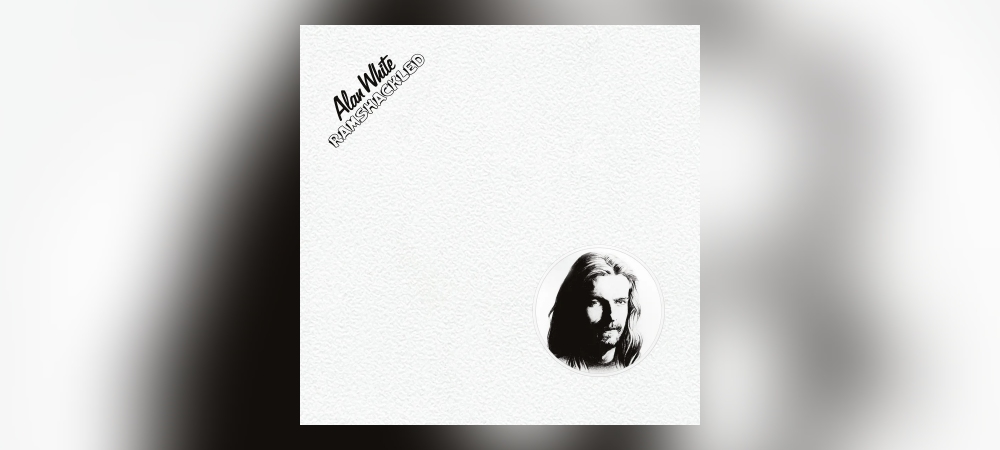
This was not an album that I was looking forward to reviewing. Out of all the solo albums that the members of Yes released during their 1974-77 hiatus, Ramshackled easily has the worst reputation. I mean, just look at it; the cheap-looking album cover is plain white (was this a play on his name?) with a cartoonish font for the title and a small black and white image of White looking vaguely like a pirate. Another well-known fact about this album is that the drummer didn’t write any of the songs on it, making him seem like a background character on his own album. It doesn’t inspire confidence.
However, I chose to review it anyway out of a sense of journalistic investigation, especially as I’d already penned an obituary of White after his passing in 2022. And what I learned is that you shouldn’t judge a book (or indeed, an album) by its cover.
The first thing you hear when you play this album is simply Alan White keeping a solid, uncomplicated samba rhythm for the first few bars. I can immediately tell this won’t be the schlock I had been fearing. Other band members (whom White had originally played with pre-Yes in an unsigned group known as Simpson’s Pure Oxygen, as Steve Pilkington reveals in the liner notes) gradually join in, filling out the sound. Finally, a drum fill and dramatic chords on the organ signal the beginning of the song proper.
You wouldn’t expect a song by a Yes man to have the name Oooh Baby. Curiously, it’s spelt with a varying number of O’s depending on where you look: three on the vinyl itself and in most places online, but only two on the CD packaging. More wildly, I found a whopping four on the reverse of an old vinyl sleeve and as little as one (“Oh Baby”) on the multicoloured handwritten notes that once adorned the inner liner sleeve, which have been faithfully reproduced in the booklet, although the notes for Side 2 are confusingly placed before Side 1.
The vocalist for this track (there are different singers throughout) has a rather unorthodox yet intriguing style as he begins low and suddenly gets very passionate in the middle of the first verse. For some reason, I always mishear the lyric, “Just like a kid, I was shy, and I was awkward,” as, “Just like a gibbon…” Maybe they’re awkward, too. But while the lyrics don’t really stand up to scrutiny, the music is a real treat of soul, pop, jazz and samba, propelled as it is by White’s infectious rhythms.
The following song is slower and more rooted in funk, with more grounded, predictable vocals. Though it took longer to grow on me, One Way Rag is unusually catchy, and I found myself putting it on more and more, thanks in part to White’s delicious accentuation of the rhythm. I just wish I could figure out what a ‘one-way rag’ is or why everyone in the ‘one-way town’ wants to go there. White hires some gospel singers as backing to help close out this fun tune. I was quite amazed to read (and discover evidence on YouTube) that Yes would actually play this song live for a few shows upon reuniting in 1976.
However, the pièce de résistance of this album comes in the form of Avakak, a prog/jazz instrumental that has White counting polyrhythms and more for a delightful seven-minute adventure. White’s snare drums in the intro seem to punch right out of the speaker and blast the listener right into the progosphere. Trumpeter Henry Lowther (whose jazzy debut solo album I reviewed more than a decade ago) guest stars here, and his presence rewards the track immensely.
Unfortunately, the rest of the album isn’t quite as compelling, beginning with Spring-Song of Innocence. I can’t tell if the title is supposed to represent “Springsong of Innocence” or “Spring: Song of Innocence”. After the heavy, dynamic Avakak, this pastoral piece is just a little too twee for my liking, but it does boast star power, as White is joined by fellow Yes-men Jon Anderson and Steve Howe. While they can easily be recognised by their respective timbres, the song doesn’t feel like some sort of long-lost Yes track and was, in fact, written by White’s guitarist Pete Kirtley. Nevertheless, the band would also play this tune on their 1976 tour.
Side Two somehow manages to be even more uneven, with White seemingly wanting to try his hand in a variety of genres. The worst offender is Silly Woman, with its precarious take on reggae with cringeworthy lyrics. But then there’s also the folky acoustic instrumental Marching into a Bottle which doesn’t seem to feature White at all. He neither wrote it nor played on it… so what’s it doing on his solo album?!
As I spell it out, I realise that there’s more music on this album that I don’t care for than I do, but the great run of Ooh Baby, One Way Rag and Avakak on Side One really do make this ‘a venture’ worth checking out. The first two tracks were released as a single the same year, and their single versions appear here for the first time on CD; however, there’s nothing particularly revelatory about these versions, as they are simply cropped for time.
There’s still so much that’s unclear about Ramshackled; was Alan White truly on board with Yes’s decision to split and make solo albums, or did he just go along with it because it was a majority decision? Without a shred of compositional capability or a burning personal concept to back the album up, White essentially became a background object on his own solo album. That being said, the new interview with original engineer David Tucker in the liner notes on this edition reveals that White was deeply involved with the mastering process for the album, taking care to make sure the album sounded just the way he wanted. So perhaps it wasn’t as much of an afterthought as it seems. All I know is, I’d rather listen to the earthy, rhythmic tones of Ooh Baby and Avakak over anything from Olias of Sunhillow.
TRACK LISTING
01. Ooh Baby (Goin’ to Pieces) (5:33)
02. One Way Rag (4:06)
03. Avakak (6:54)
04. Spring-Song of Innocence (5:04)
05. Giddy (3:12)
06. Silly Woman (3:14)
07. Marching into a Bottle (2:01)
08. Everybody (3:14)
09. Darkness, Pts. 1–3 (5:38)
~ Bonus tracks:
10. Ooh Baby (Goin’ to Pieces) (single version) (3:04)
11. One Way Rag (single version) (2:56)
Total Time – 44:51
MUSICIANS
Alan White – Drums, Percussion, Vocals
Peter Kirtley – Guitar, Vocals
Colin Gibson – Bass Guitar, Percussion
Kenny Craddock – Keyboards, Vocals
Alan Marshall – Vocals
Bud Beadle – Solo Sax, Flute
Andy Phillips – Steel Drum
Steve Gregory – Added Tenor Sax, Flute
Henry Lowther – Trumpet
Joanne Williams, Madeleine Bell, Vicki Brown – Backing Vocals
David Bedford – Orchestral Arrangements & Conducting
Steve Howe – Guitar (4)
Jon Anderson – Guitar (4)
ADDITIONAL INFO
Record Label: Cherry Red Records | Spirit of Unicorn
Catalogue#: SOUM2CD577
Country of Origin: UK
Date of Release: 26th September 2025
LINKS
Alan White – Website | Facebook | Info at Cherry Red Records | YouTube | Instagram