
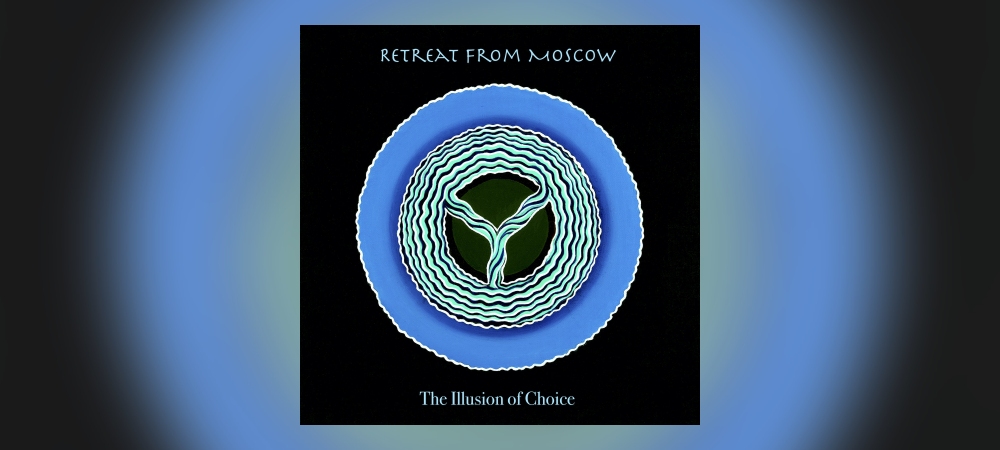
Ever since childhood, two of my favourite pastimes have been losing myself in fictional worlds and exploring new music, so a contemporary band that can tell an enthralling musical story is potentially onto a winner. Retreat From Moscow’s 2022 debut, The World As We Knew It showcased the band’s flair for exploring eclectic and intriguing concepts and narratives, and their outstanding 2023 sequel, Dreams Myths And Machines continued the trend in spectacular style. In their latest album, The Illusion Of Choice, Retreat From Moscow serve up equally stimulating subject matter drawn from history, psychology and current affairs. Anglo Saxon poetry and a decidedly gruesome slice of European folklore also make an appearance – not to mention the near-death experience of one of the band members!
Retreat From Moscow first arrived on the scene in Cardiff in 1979. After three years of gigging the four musicians disbanded in order to follow independent paths, but the vision lived on, and in 2018 they decided to re-form. Their roots in the early 80’s progressive rock scene are evident in their full-bodied version of neo-prog, complete with sweeping melodies and addictive hooks and laced with nods to the classics of the 70’s. If their lyrical themes seem darker than before, rest assured that the music is as bold, accessible and superbly performed as ever. Andrew Raymond’s thrilling keyboards provide colour, atmosphere and grandeur while the mighty rhythm section of Tony Lewis (Wal bass) and Greg Haver (drums and percussion) provides the powerhouse for some serious rocking. Add to this the vigorous and compelling vocals, boldly expressive guitar work and multi-instrumental skills of John Harris and you have a band whose energy will transport you through time and space into mythic realms and perilous landscapes.
The unashamedly rocky and hard-hitting title track demonstrates how our freedom of choice is undermined and manipulated for political or financial gain. Brash harmony vocals suggest an advertising jingle, while dissonant, off-beat synth stabs, Greg’s relentlessly pummelling drums and Tony’s neurotically athletic bass depict the way our minds and senses are constantly bombarded by new, shiny and often contradictory information. An abrupt tempo change (the first of many on this album) leads to a stand-off between John’s wheedling guitar and the shrill insistence of Andrew’s Hammond organ, as each goads the other towards a hysteria familiar from televised political debates. The answer to the final, desperate question, Who is in control? is never in doubt – this is a band who know exactly what effect they want to achieve and possess the expressive and musical skills to ensure their message is clearly heard.
Earth-Stepper’s evocative lyrics are a creative mash-up of four Anglo-Saxon poems. The outward-facing urge for excitement, exploration and pilgrimage on the sea road is contrasted with the pull of safe familiarity and the warmth of family and friends. The sedate polyphony of a Renaissance recorder consort (courtesy of Les Penning, renowned for his work with Mike Oldfield) leads into a wistful sea shanty, the gently insistent accompaniment of acoustic guitar and mandolin maintaining the ambience of times gone by. The voyage becomes more tempestuous once the rhythm section bursts in. John’s guitar soon gets the wind in its sails, letting rip with a frenetic triplet figure as the harmony vocals rise in warning: Earth-stepper, this is not your element. ‘New beginnings’ are suggested by a quirky instrumental interlude, with wah-wah guitar and synths overlaying Tony’s leaping bass line. An energetic reprise of the chorus restores us to terra firma, all vocal and instrumental guns blazing like fireworks before the mandolin brings the track almost full circle to a more restrained close.
Like Flowerbride, my favourite track from Dreams Myths and Machines, Bones Will Sing is a dramatic retelling of a tragic folktale based on the theme of the jealous lover – this time an elder sister who deliberately leaves her younger sibling to drown. The murdered girl’s bones are fashioned into a harp, which sings out the whole shameful story. The limpid tones of John’s own harp ripple plaintively through the track, giving this version of the tale a distinctively Welsh flavour. The narrative is played out between male and female vocals, the latter provided by the pure and expressive vocals of Christina Booth (Magenta) against a backdrop of exquisite instrumental textures. The track a masterful piece of storytelling that draws in the listener like the powerful currents of a stream, building inexorably from reflective melancholy to a powerfully menacing climax before reaching an eerily chilling conclusion.
Navigators of the Trym tells how the fourteen-year-old Tony Lewis and his best mate spent their summers investigating the course of their local river, nearly drowning in an underground tunnel when a sudden downpour dramatically raised water levels. The music twists and turns like a river in spate, switching between a variety of moods and time signatures. The opening has a heroic feel, its restless 7/4 time signature and Tony’s swaggering bass portraying the boys’ excitement and intrepid sense of adventure. As the first storm clouds roll in the tempo slows and the harmonies become more plaintive. A nostalgic piano figure establishes a more reflective mood, reinforced by John’s soulful solo flute, until the deceptive calm is shattered by a jumping, arpeggio-based theme on guitars and keys, suffusing the texture like the relentlessly torrential rain. All ends happily and the boys are saved, but the close of the track has a pensive, regretful quality, reminding us that the resourceful friend who saved Tony’s life that day was later to die of a brain tumour, aged only 35. The track is dedicated to his memory.
Both the next two tracks were inspired by the Russian ‘special operation’ in Ukraine, although their themes are timeless and universal. Polina is a hauntingly beautiful and deeply moving track featuring ethereal harmonies, heart-rending melodies and emotional performances from John on vocals and guitar. The lyrics relate how 10-year-old Polina and members of her family were gratuitously gunned down by Russian troops, and picture her pure spirit standing at the shoulders of the Ukranian soldiers, inspiring hope. Vocally the honours are shared between John Harris and Jillian Slade, whose vocals are veiled in a ghostly shimmer of reverberation. Despite the tragic subject matter this spellbinding track simply radiates compassion and faith in the resilience of the human spirit. Snowfall Road reflects on themes of winter and uncertainty, inspired by the synchronicity of a UK snowfall with news of the siege of Mariupol, and the freezing misery suffered by the thousands of trapped Ukrainians seeking shelter or escape. The punchy neo-prog opening with its Pallas–like synth fanfares is interrupted by a wildly agitated guitar break that feels like a desperate plea for mercy. John’s vocals enter with a typically expansive RFM melody, and distorted bass and guitar provide a brief digression in the direction of jazz-funk before we return to the synth fanfares from the opening.
Black Mist, with its obsessive bass guitar riff and muted instrumental palette, exposes the shocking tragedy of Operation Totem, an uncontrolled atomic weapons test carried out by Britain in Southern Australia. A sinister bass figure insinuates itself throughout the track, wreathed in eerie wisps of synth, suggesting the black miasma which lingered after the detonation, bringing agonising sickness and death to the indigenous population. The lyrics pull no punches in relating the shameful tale, and in passionate response John’s guitar gives vent to an intense and heartrending lament for the suffering and loss of life. The hauntingly emotive chorus will linger in the mind long after the track has finished:
Through the blood red eremophila
Poisoning forever
Their land of dreamtime birth
In reaction to the restrictions of the Covid lockdowns, the band have made a conscious effort to spend in-person time together writing this album, launching the process with a week of collaborative experimentation in a Cardiff studio. This has resulted in a tight and energetic ensemble style which effortlessly melds features from a variety of genres, ensuring an enjoyably varied listening experience and an album which surely deserves a place on this year’s ”Best of …” lists. In addition to his sterling services on vocals and guitars, John’s accomplished performances on flute, mandolin and Celtic harp (the latter possibly a ‘first’ in Prog) add delightfully fresh and evocative colours to the soundscape of the album, while the thoughtful and often provocative lyrics offer plenty of food for thought. If you enjoy gripping narratives served up with earworm hooks and riffs, soaring melodies and impeccable musicianship, then this album should certainly be in your collection.
TRACK LISTING
01. The Illusion Of Choice (7:27)
02. Earth Stepper (8:26)
03. Bones Will Sing (11:22)
04. Navigators Of The Trym (8:14)
05. Polina (9:15)
06. Snowfall Road (5:09)
07. Black Mist (8:53)
Total Time – 59:46
MUSICIANS
John Harris – Vocals, Guitars, Guitar Synth, Harp, Mandolin, Flute, Keyboards
Andrew Raymond – Keyboards, Pedal Steel Guitar
Tony Lewis – Wal Basses, Backing Vocals
Greg Haver – Drums, Percussion
~ With:
Les Penning – Recorders (2)
Christina Booth – Vocals (3)
Jillian Slade – Vocals (5)
ADDITIONAL INFO
Record Label: White Knight Records
Country of Origin: UK
Date of Release: 7th November 2025


